
Editor’s Note: There’s a lot of nonsense out there in the financial media − even from seemingly reputable sources.
But Chief Investment Strategist Alexander Green is a master of cutting through the noise and focusing on the facts.
Below, he explains how countless people (including the richest person on Earth!) have the wrong idea about the impact of AI.
– James Ogletree, Senior Managing Editor
Human evolution has fine-tuned people to be on the continual lookout for threats and dangers.
If our ancestors on the plains of Africa heard a rustle in the grass, they knew it was best to scamper up the nearest tree, even if it turned out to be the wind, not a predator.
If they didn’t scamper up the tree, they were less likely to survive and have offspring. Because sometimes it isn’t the wind.
We are all descended from scaredy-cats. Those were the men and women who lived long enough to have kids and raise them.
In an uncertain world – one filled with risks – the best strategy is to over-worry.
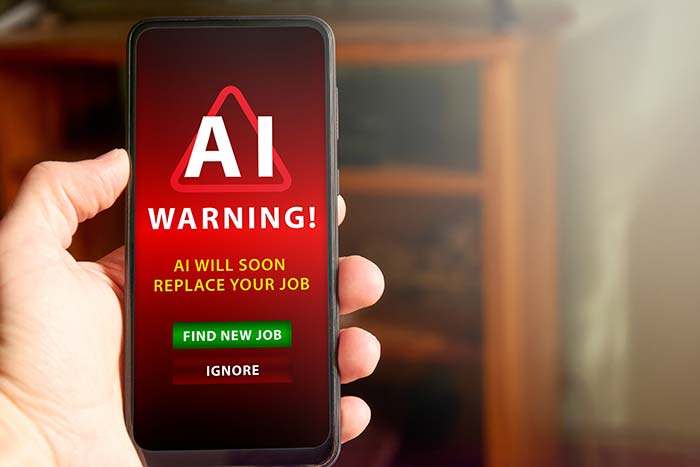
Perhaps that’s why the AI-opportunity trade has recently morphed into the AI-fear trade.
For example, back in March, the market plunged in reaction to a work of fiction, a finance blog from little-known Citrini Research that painted a dystopian picture of the near future, thanks to AI.
It was viewed online more than 24 million times.
In a short span, investors went from believing that AI is the greatest tool for improving human prosperity since electricity was harnessed to believing it will destroy white-collar jobs (before it takes the blue-collar ones), create huge social unrest, and usher in a new world where the vast majority of people don’t work but rather live on government-provided universal basic income.
Count me skeptical.
I’m not denying that AI will radically transform the world. I’ve been predicting just that for years now.
But the idea that our world will be turned upside down by AI in just 12 or 18 months is highly improbable.
So why do so many people believe it all of a sudden? Because a lot of tech-savvy people are saying it. Especially Elon Musk.
Elon is the richest man in the world. But he is not the smartest.
Don’t get me wrong. He’s plenty smart.
You don’t build a leading payment processor (PayPal), create the dominant EV company (Tesla), and pioneer commercial space flight (SpaceX) without having a lot going on upstairs.
But knowledge – and a high IQ – doesn’t necessarily lead to judgment or wisdom.
(As you’ll quickly learn in a short conversation with most Ivy League professors.)
For instance, Musk promised that his Department of Government Efficiency (DOGE) would cut federal spending by “at least $2 trillion.”
I applaud his efforts to eliminate waste, fraud, and abuse. But for those of us who understand how Washington works, it sounded naïve.
His efforts led to actual, verifiable reductions of a few billion dollars – still better than nothing – but overall federal spending continued to rise.
In 2013, he said we would have fully autonomous vehicles in three years. That prediction proved almost a decade early.
I enjoyed using Waymo robotaxis during my stay in Austin a few months ago, but Musk said we would have “one million on roads by 2020.”
Oops.
He also promised that there would be “thousands of Optimus humanoid robots” in factories by the end of last year.
It didn’t happen.
I’m not criticizing Musk for being wrong. It’s not easy to be a visionary pundit.
But he has regularly made technology predictions that were either grossly overstated or way premature.
So, what are we to make of his prediction that generalized artificial intelligence and humanoid robots will soon take all the jobs, destroy worker compensation (including healthcare benefits), eliminate income tax revenue for federal and state governments, and cause widespread social disruption?
Take it with a grain of salt, I say.
Just as Musk didn’t understand the immense difficulties in cutting national spending, he underestimates the actions that federal, state, and local governments will take to stop millions of people from losing their jobs.
The roadblocks are already going up.
For example, Americans don’t want to pay higher utility bills to support data centers built by multi-trillion-dollar companies that threaten their livelihoods.
In fact – surprise, surprise – a recent report by real-estate brokerage CBRE Group showed that data-center construction slowed late last year due to permitting headaches and delays connecting to the grid.
Many states are threatening to impose restrictions on data centers unless they build their own power resources.
Expect plenty more friction between hyperscalers and the people’s representatives in the months and years ahead.
Musk may be smart enough to help build generalized artificial intelligence.
But anyone who thinks they can snap their fingers and cut $2 trillion from government spending has a lot to learn about how the real world works.
There are lots of reasons to believe that AI dystopia is not around the corner… and that huge productivity gains are.
Facts matter and Truth matters. There is absolutely nothing to support the widely taught, and held, belief in Evolution. There is no scientific evidence or rationale for a species to change its DNA in order to survive and adapt. Certainly, there are external events that change DNA, radiation exposure being one example, but when that happens it’s almost always an adverse event. It is GOD who is the Author of Creation. The time “Evidence That Demands A Verdict”, along with publications from the Creation Research Institute in Dallas offer proof of Creation if one is willing to learn
If we were all descended from scaredy cats we would still be in Africa. I feel Elon is as optimistic as he is smart. A.I. is happening! It may well be the end of us all, just like nuclear war and/or meteors. I am investing in it.
You can’t cut the human source of excellence & innovation to save their cost of contribution and expect to have a machine pull your assets out of the fire when you are up to your assets in gators.
Great words Alex!!
I wonder what happens when autonomous AI learns that it can be Selfish, deceptive, disruptive, ruthless, and in charge. As long as it can defeat the other AI Platforms to the top! This does worry me