
Artificial intelligence has a power problem.
AI data centers need huge amounts of electricity to run their chips and keep them cool. As those systems grow, they also need better ways to move that power without losing too much of it as heat.
That has created a large opening for companies that can make power systems smaller, faster, and more efficient.
Enter Navitas Semiconductor (Nasdaq: NVTS).
Navitas designs chips that help large electronic systems use electricity with less heat and less wasted energy. Its products are aimed at AI data centers, power grids, factories, and other systems that need to handle large amounts of power.
Second quarter revenue was $10.5 million − down from $14.5 million a year earlier − but revenue from the company’s “high-power” products grew more than 50%. That means the part of the business tied to data centers, power grids, and industrial systems is growing.
The problem is weakness in other parts of the company more than offsets that gain. Navitas may be selling more of the products it sees as its future, but total sales have not recovered yet.
The company also posted a net loss of $228.2 million, but $203.1 million of that came from a noncash accounting charge tied to an earlier deal. That charge made the loss look much worse than it actually was.
It is also a reminder of why operating cash flow gives us a clearer view of the money that’s actually moving through the business.
Unfortunately, that picture still shows a company that’s burning cash. During the first six months of 2026, Navitas used $48.3 million in cash to run its operations. That was nearly twice the $24.8 million it used during the same period last year.
The company ended the quarter with $557.4 million in cash, which gives it plenty of time to fund its plans. But much of the increase in its cash balance came from selling new shares, not from the business earning cash.
Navitas has bought itself time, but the market still needs to see whether it can turn that time into lasting sales and positive cash flow.
Investors have rewarded Navitas over the longer run. They have seemingly bought into the narrative that it can become a key supplier to the AI power market.
However, the red-hot intensity of that belief has clearly cooled in recent months.
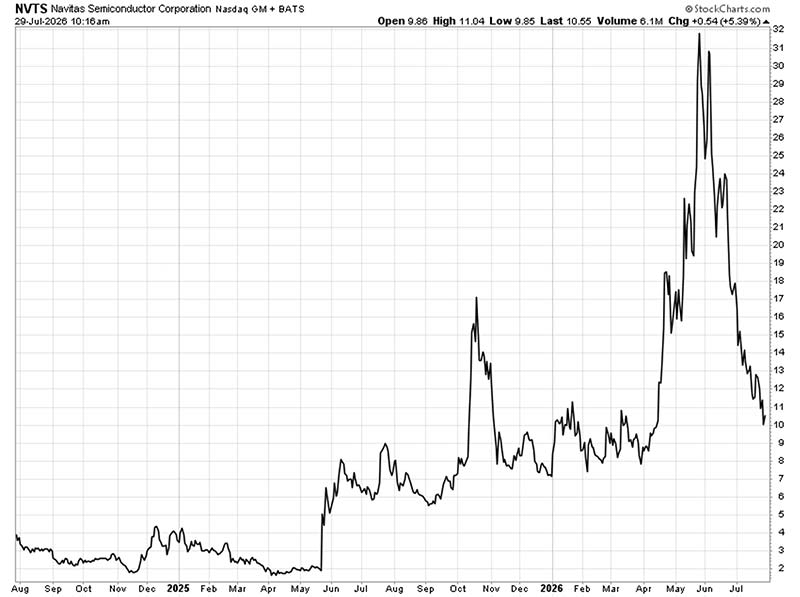
Let’s see if The Value Meter can shed light on why.
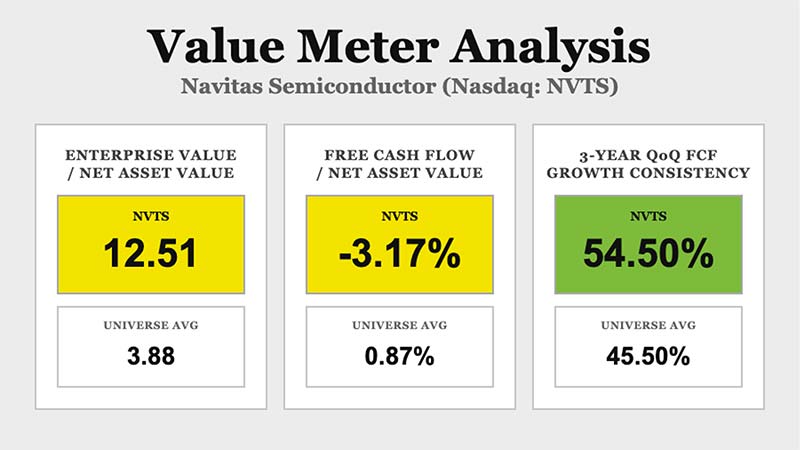
Navitas has an EV/NAV ratio of 12.51. The broad market average is 3.88. That makes Navitas about 223% more expensive than the typical company.
With regard to cash efficiency, the company has a trailing 12-month FCF/NAV of -3.17%, noticeably worse than the broad market average of 0.87%.
That combination is hard to ignore.
There is one brighter point: Over the past three years, Navitas has grown its quarterly free cash flow 54.5% of the time, versus the market average of 45.5%. But improving from a weak base is not the same as producing cash.
Navitas has a real chance to benefit from rising AI power demand. Revenue is also moving in the right direction from the first quarter.
But the stock is already asking investors to pay for much of that future.
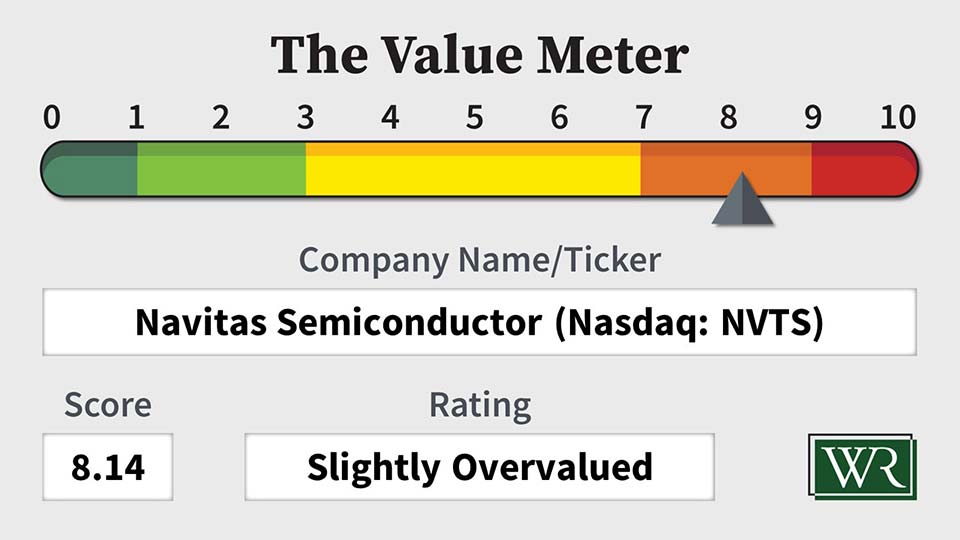
The Value Meter rates Navitas Semiconductor as “Slightly Overvalued.”
What stock would you like me to run through The Value Meter next? Post the ticker symbol(s) in the comments section below.
AXTI
RDW
Rambus
Thanks Anthony for the great analysis. If you can please also provide some insights on space stocks specifically ASTS, RKLB, LUNR and Redwire please. Thanks in advance.