
Editor’s Note: Below, Dr. Mark Skousen, The Oxford Club’s Macroeconomic Strategist, reveals the one area of the tech sector he’s watching extremely closely right now.
Also, a quick housekeeping note: We will not be sending Wealthy Retirement on Monday in observance of Memorial Day. We will be back with a new issue on Tuesday.
As we remember those who’ve paid the ultimate sacrifice in service to our country, all of us here at The Oxford Club express our gratitude to those who’ve served and wish you a restful holiday weekend with family and friends.
– James Ogletree, Senior Managing Editor
“I skate to where the puck is going to be, not where it has been.”
− Wayne Gretzky (The Maxims of Wall Street, Page 72)
Investors have zeroed in on big tech names like Nvidia, Microsoft, and Palantir recently, and it’s not hard to see why. AI has become one of the dominant investment themes of the decade.
But, like Wayne Gretzky’s puck, markets are always moving.
Once a breakthrough becomes obvious, Wall Street immediately starts searching for “the next big thing.”
That’s exactly what’s happening right now.
The market’s attention is beginning to shift toward what I call “applied AI” − technology that operates in the real world instead of simply generating text or images.
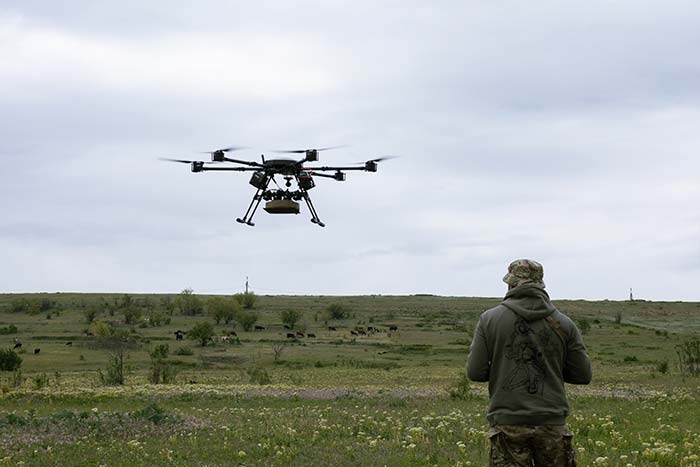
One of those exciting new technologies is drones.
Military drones have been in the news because of the U.S.-Iran war, but the drone industry is also aggressively expanding in other areas, such as agriculture, business, and home delivery services.
Drones are allowing farmers to “grow more with less” by drastically reducing the amount of water, fertilizer, and pesticides required, and the drone home and business delivery market is growing rapidly. It boasts the fastest compound annual growth rate in the industry (approaching 30% yearly) and is on track to exceed $25 billion over the next decade.
All in all, the global drone market is projected to balloon to over $96.3 billion in 2026.
AI and Drones in Wartime
NATO countries are ramping up military spending. The Pentagon is focusing more on autonomous warfare. Venture capital is flooding into defense-tech startups. And the IPO market is reopening for emerging AI-defense companies.
This isn’t speculation anymore. It’s a reality.
It makes me think of a couple of quotes in my book The Maxims of Wall Street:
- “The difference between a rich investor and a poor one is the quality – and timeliness – of his information.” – Bernard Baruch (Page 30)
- “If you wait to see the Robin sing, Spring may be over.” – Warren Buffett (Page 46)
Now, we never want to be chasing hype.
What we want is to be able to recognize major trends before they become obvious to everyone else. Once the story lands on the front page of every financial publication, the most attractive opportunities are already gone.
We may be on the doorstep of that with defense AI.
Most everyday investors are still focused on yesterday’s AI story. Meanwhile, institutional investors are lining up for what many believe is the next phase of the technology boom: AI-enabled defense infrastructure.
The speed of this transition is remarkable.
Look at Ukraine, for example. Autonomous drones have completely changed the game. Military analysts are predicting that “robot-on-robot warfare” will be the future of global conflict.
The fallout from that shift could be enormous, as every autonomous system requires software, communications networks, satellite infrastructure, navigation systems, and real-time coordination.
In many cases, the software may ultimately become more valuable than the hardware itself.
That’s where some of the most intriguing opportunities sit right now.
At the same time, another important trend is starting to pick up steam: the return of the IPO market.
After several sluggish years, investor appetite for new technology offerings is heating up again. Historically, the early stages of a new IPO cycle have produced some of the market’s most explosive winners.
Remember, Nvidia, Tesla, and Palantir were all widely misunderstood after going public.
Wall Street initially underestimated every one of them.
That’s common with transformational companies. Analysts tend to value young businesses based on their current earnings while missing how quickly adoption can accelerate.
In those cases, early investors can do extraordinarily well.
The key takeaway here is that this trend could stretch far beyond defense.
The technologies being developed today for military applications could eventually reshape logistics, agriculture, shipping, mining, industrial automation, and emergency response.
History shows this happens all the time.
The internet started as a government communications project. GPS began as military technology. Even semiconductors were initially fueled by defense spending.
Today, autonomous AI systems may be following the same path.
One thing I’ve learned after decades studying markets is this…
The biggest gains usually don’t come from buying what feels comfortable. As J. Paul Getty says, “No one can possibly achieve any real and lasting success or ‘get rich’ in business by being a conformist” (Maxims, Page 38).
The biggest gains come from recognizing potential before the crowd fully understands it.
Right now, several massive forces are converging: accelerating AI adoption, rising defense budgets, renewed IPO activity, and growing demand for autonomous systems.
That “perfect storm” could create some of the market’s biggest winners over the next decade.
Thank you Mark for an interesting and thought-provoking article. I am looking forward to reading your future picks.
Subscriber,
Hubert Olis