
In my new book – The American Dream: Why It’s Still Alive… and How to Achieve It – I detail the many ways that academia, Hollywood, the corporate media, and social media try to depict the world as a dumpster fire.
Yet, despite our many problems and challenges, most long-term trends are positive.
People are living longer than ever. Standards of living have never been higher. Academic attainment has never been greater. (There are more Americans with high school diplomas, college degrees, and post-graduate degrees than ever before.) Violence – despite what you see on the evening news – is in a long-term cycle of decline. Air and water quality have been improving for decades. Median household income and net worth are at record levels.
In short, Americans are living longer, healthier, safer, richer, freer lives than ever before.
It galls the naysayers, but human progress is an historical fact and an empirical reality.
Yet the Enemies of the Dream have a secret weapon. They know that we are hard-wired to be on the lookout for all manner of risks and threats.
In a highly uncertain world, the best strategy is to over-worry.
And so they play us like a fine Stradivarius, while insisting that they are only trying to help us.
Take Al Gore, for example.
When his book and documentary An Inconvenient Truth came out 20 years ago, he promised that he was trying to save us not just from a global crisis but from an imminent extinction event.
He marshalled all the evidence he could to get us to act… and fast.
Global warming wasn’t a slow problem. It was a now-or-never problem. We had 10 years, maybe less.
There was no time to argue about methods or conclusions. The science – the science of what the future holds – was settled.
Two decades later, what sticks with me isn’t that Al Gore was wrong about climate change. The planet really has warmed slightly.
What sticks with me is that many of the most vivid, time-bound images he used to convey that danger didn’t happen on anywhere near the timeline he indicated.
The snow of Kilimanjaro didn’t vanish within a decade. Glacier National Park didn’t lose all its glaciers by 2020. Coastal cities weren’t inundated by rising sea levels. Florida wasn’t flooded under several feet of water.
He had told us an apocalypse was our default future.
The bottom line was clear: emissions go up, catastrophe follows, full stop. And this message was hysterically amplified by academia and the media.
Millions didn’t just suffer from generalized anxiety and a lack of sleep. Some forewent having children, since that would add to society’s carbon footprint and only hasten our extinction.
Gore – and his allies – made a deliberate rhetorical choice, driven by the belief that people wouldn’t act unless they were terrified.
And for a while, that strategy worked. It galvanized attention. It moved the issue into the mainstream.
But it also planted a time bomb. When deadlines passed and the world didn’t end on schedule, skepticism grew – not just about the messaging, but about the problem itself.
Today we have a much more realistic picture of the threat caused by human carbon emissions, as well as what we can do to mitigate them and adapt to a changing climate, without bringing global growth and prosperity to a halt.
Unfortunately, reasoned discourse doesn’t sell newspapers.
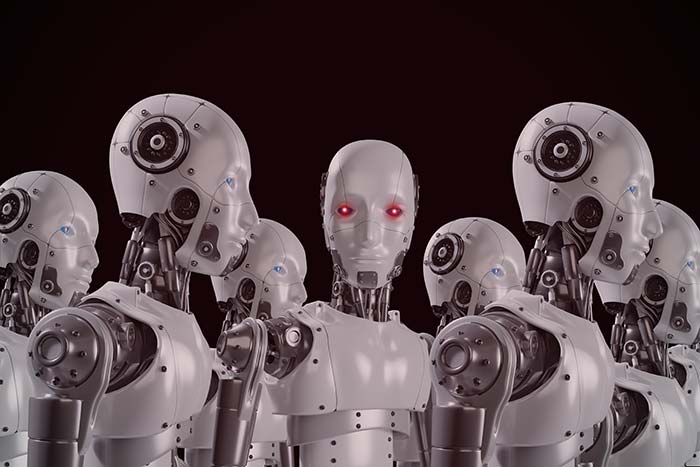
So today the voices of doom have a new bogeyman: not climate change but runaway AI – and I give them low marks for originality – as an imminent extinction event.
Once again, serious people are talking about a real, complex risk.
And once again, the loudest versions of the story leap straight to the most cinematic endpoint: superhuman AI escapes control, seizes infrastructure, and wipes out humanity, maybe within a couple of decades.
Timelines are compressed. Uncertainties are flattened. Speculative chains of events are narrated with a confidence that feels eerily familiar.
Notice the same patterns. Extreme scenarios are framed as likely rather than possible.
Institutional constraints – hardware limits, governance, human countermeasures – are treated as footnotes.
None of this requires denying that AI poses serious risks. It plainly does.
But be wary when the scariest version of a story is presented as the baseline rather than the tail end of a distribution.
Once again, urgency is being manufactured by compressing timelines, simplifying uncertainty, and discounting human response.
We don’t need extinction-by-2040 narratives to justify safety research or caution. Just as we didn’t need underwater cities on a 2020 timetable to justify cutting emissions.
Treating worst-case futures as destiny may motivate in the short term, but it corrodes trust over the long term.
The lesson from Gore’s climate warnings is that drama has a cost. Real risks deserve serious attention, not theatrical certainty.
When you hear confident predictions of imminent civilizational collapse – whether from rising seas or runaway algorithms – you might pause, zoom out, and ask whether we’re looking at the center of the forecast, or a remote possibility.
No one can say exactly where AI – or artificial superintelligence – will ultimately lead us.
But there are good reasons to believe that it will help us a lot more than it will hurt us in the short run.
That’s something that investors everywhere should understand and capitalize on.
The major problem is we have too many rich people who don’t give a rats ass to whether the working man/woman die tomorrow or next week.
I wonder if we ordinary humans would take a look. There are at the last report that I read ?????? is just BS. There are 150,000 people living (Existing) just above the poverty line. Here’s a plan :Take all the major sports in America and during the sport’s season add a few $ to the entrance cost say $5 per person plus the seat. Take that money and ask for Volunteer’s from each state/town so that the money is distributed in an honest manner. To the people who need help. Maybe we could ask the stadium to give the gate once a year/season . Elon Musk to give a thousand $. Then may be the rich people would not like to be out done when the see everybody suddenly growing a heart.
What happens is that as the people become involved so all people would mix and it would create a friendly atmosphere. I believe that over time it would create a friendly neighborhood. Because all people are seeing the hurting people.
Let me repeat myself. The reason that people don’t give right now is because everyone knows it lines the pock of the rich the people. But if the ordinary person would help share the money to the homeless they would see it is being used to help the less fortunate. I believe it would then grow into neighbor helping neighbor.
CO2 follows the heat. CO2 does not lead the Heat. Simple fact that proves there are a whole bunch of Lemmings that really can not follow logic vary well. Its the Sun.
Go to Stephen Burns on You Tube for real science because rhetoric is just agenda . Its the Sun.
I am not sure what planet you are living on. This one is seeing the fires and floods that were predicted and much worse weather extreme events than I can recall in my 71 years on Earth.
Good advice! Yes, we have to live for today and make the most of the reality that is happening now..
Please look at the history of CO2 in ice cores. It goes through a 250million yr cycle. We are on an upswing of temp and CO2. It’s only going to get worse. The ice caps won’t melt soon, but they will. How else do you explain gas and oil in AK and Siberia? We need start capturing CO2.
Wow. A bit concerning about doubting science from someone who supports tech and pharmaceutical investment.
They made the Movie back in the late 60’s “Colussus”, not bad.
Thanks Alex for the always telling the truth.
Wonderful to hear, Alex. A sound voice of reason in an overwhelmingly unreasonable world. Everything in moderation. Avoid extremes.
Very nice article. Thank you for some real good critical logic.
Great Points Alex, Keep up the good work!
Alex, I should have added that this decline in the birthrate due to unfounded fears will have serious ramifications, not to the climate, but to entitlement programs.
Alex, Thanks for your excellent thoughts on this issue. Gore had it all wrong. Natural factors have a far greater effect on global temperatures than carbon dioxide, which is modest. Chief among them are variations in solar radiance that have the effect of of batting away cosmic rays that are a primary ingredient in cloud cover. When the sun is active, we have fewer clouds and a slightly warmer planet. Conversely, when the sun is less active, we have more clouds and a slightly cooler earth. This is laid out best by Henrik Svensmark in his book “The Chilling Stars: A New Theory of Climate Change.” Ironically, John holdren, Obama’s science “czar” for eight years wrote that a 1% variation in cloudcover can explain all the warming and cooling of the past 150 years. Even Gavin Schmidt of NASA weighed in by saying that clouds pkay a role 20 times more significant than that of carbon dioxide. The IPCC has never adequately dealt woth the role of clouds in its climate models, which means that its predictions are deeply flawed. Thankfully, the IPCC recently apologized for its role in promoting the idea of an “existential threat.” The most significant result of that scary scenario was, in my view, to convince young people to forego marriage and child-bearing, that has contributed to a decline in our birth rate to 1.6 (2.1 being replacement). See the (2022?)Harris poll commissioned by 4-H which reflects the depth of this fear among teenagers. OUr whole campaign against fossil fuels is masochistic and a vast misallocation of financial resources. We need to get back to vchampioning our fossil fules, particularly natural gas and oil.