
Once celebrated and now a political football, the COVID-19 vaccines have always generated strong opinions − including the one made by Pfizer (NYSE: PFE).
Financially, it was a windfall. The drug giant’s revenue surged from $41 billion before the vaccine was launched to more than $100 billion in 2022. Its free cash flow swelled from $12 billion in 2020 (pre-vaccine) to nearly $30 billion in 2021.
In 2022, free cash flow was still elevated due to the vaccine and came in at a robust $26 billion.
That has caused a nasty side effect to Pfizer’s dividend safety rating.
One of the metrics that the Safety Net model uses is three-year free cash flow growth.
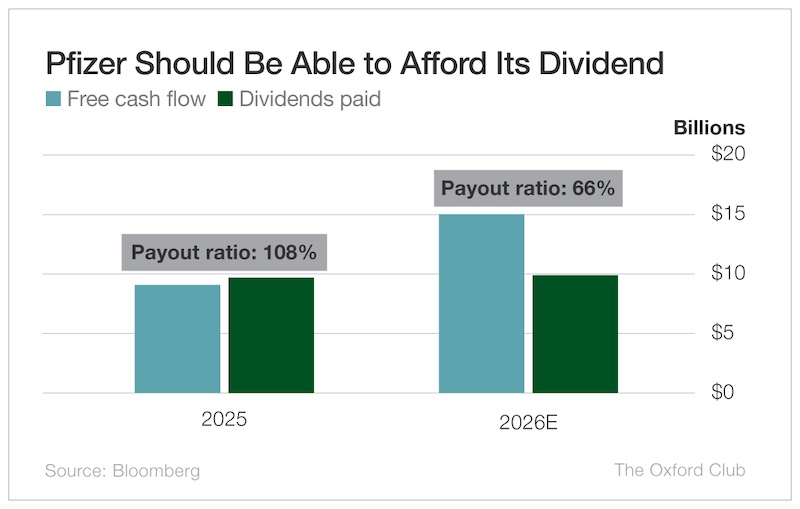
Last year, Pfizer’s free cash flow was $9.1 billion, a far cry from the boom years of the pandemic and the $26 billion in 2022. As a result, its Safety Net rating is penalized for negative cash flow growth over a three-year period.
The vaccine doesn’t fully explain the decline, though. Free cash flow fell nearly 8% year over year from 2024 to 2025 − long after the pandemic ended.
That’s another penalty.
Pfizer suffers yet another demerit because it paid $9.8 billion in dividends last year, nearly 8% higher than its free cash flow total.
However, the company should get some relief this year. Free cash flow is forecast to rise to $15 billion in 2026, while dividends are expected to increase to $9.9 billion for a much more comfortable 66% payout ratio.
Anything below 75% is fine. Once a company’s payout ratio gets above 75%, there’s not a lot of wiggle room if free cash flow declines in the following years. At that point, the payout ratio could become too high for the company to continue to pay its dividend, and it may be forced to cut it.
Fortunately, if Pfizer’s free cash flow is anything above about $13.2 billion, its payout ratio will be low enough that its dividend safety rating will get an upgrade.
Pfizer has boosted its dividend every year since 2010, so it actually claws back one of its penalty points thanks to its 16-year dividend-raising track record.
The current $0.43 per share quarterly dividend comes out to an annual 6.1% yield.
The pandemic was a strange time for everyone. Pfizer saw its numbers sharply spike only for them to come back down to Earth. The company is still feeling the effects, including in its dividend safety rating.
But once the calendar turns and the 2022 numbers are no longer included, Pfizer should see an upgrade in its safety rating.
As long as it generates more than $13 billion in free cash flow, the dividend has a low risk of being cut. If it makes below $13 billion, then the risk becomes moderate.
Dividend Safety Rating: C

What stock’s dividend safety would you like me to analyze next? Leave the ticker in the comments section.
You can also take a look to see whether we’ve written about your favorite stock recently. Just click on the word “Search” at the top right part of the Wealthy Retirement homepage, type in the company name, and hit “Enter.”
Also, keep in mind that Safety Net can analyze only individual stocks, not exchange-traded funds, mutual funds, or closed-end funds.
Please do a safety for JEPQ, Thanks Ray
Hi Ray,
Safety Net can only review individual stocks because it looks at cash flow. That cannot be done with an ETF of fund.
AMZA
IBM
Dividend rating for AMCR?
Marc: Please do a dividend safety analysis / rating for BP. Years ago you gave BP an F for the dividend safety rating. Please up-date. I am a long time Oxford Income Letter subscriber.
Marc: Please give a dividend safety analysis / rating for BP. Years ago you gave BP an F for dividend safety. Please up-date with a new analysis.