
“Avoid investing in those countries with a high level of socialist or government regulation of business. Business growth depends on a strong free-enterprise system.”
– Sir John Templeton (The Maxims of Wall Street, Page 148)
Ben Franklin said, “Nothing is certain but death and taxes,” and unfortunately, it looks like my longtime friend Mark Mobius lived up to Franklin’s old saying by dying last week on Tax Day (April 15).
He lived long enough to celebrate a high Fibonacci number (89)! We plan on dedicating a room to him at this year’s FreedomFest.
Mark Mobius was considered the father of emerging market investing. He was appointed by Sir John Templeton to run the Templeton Emerging Markets Fund in 1987 and remained with the firm until 2018.
Talk about a tall order! Emerging markets have had a terrible record over the years compared with Wall Street. They have suffered from all kinds of problems: runaway inflation, currency devaluations, nationalization, corruption, regime change, and boom-bust cycles.
That’s why I don’t recommend most foreign stocks. They are too risky.
This chart compares the returns from foreign and U.S. stocks in the 21st century.
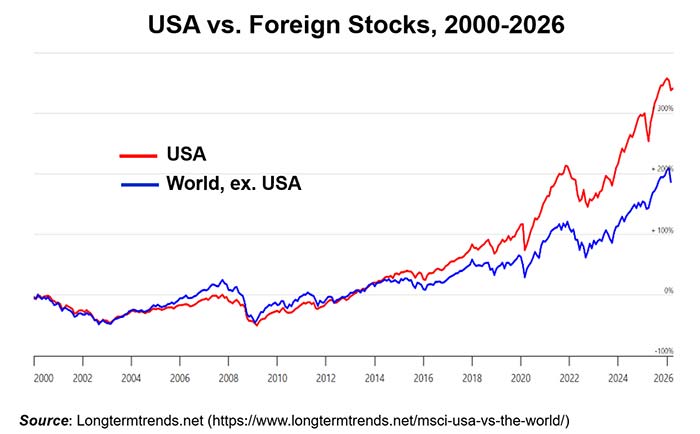
But Mobius was somehow able to beat the market. He was a remarkably successful money manager. His fund earned an average annualized return of 13.4% over a 30-year period! That’s darn good, especially considering that he focused on developing countries, which are notoriously turbulent.
Mobius Rejects Keynesian Economics!
Mobius was born in the U.S. but came from German descent. He earned his Ph.D. in economics at MIT under Paul Samuelson, but the Keynesian philosophy there didn’t seem to stick. (For those unfamiliar, Keynesian economics is more in favor of government intervention than classical or laissez-faire economics.)
Mobius traveled to over 112 countries and confirmed what Sir John Templeton taught him (see quote above): Free-market capitalist countries performed the best.
Mobius defended free markets and the gold standard and was critical of the socialist policies of Biden and Harris. He predicted that a Trump victory would be bullish on Wall Street. He was spot-on.
In his travels, he concentrated on countries that were moving away from socialist policies in Eastern Europe and Asia – primarily the Four Tigers (South Korea, Taiwan, Hong Kong, and Singapore) and later India.
He soured on China after facing currency controls when he sold his building in Shanghai and tried to transfer his funds to Hong Kong. Despite above-average economic growth in China, the Chinese stock market is notoriously bad for investors.
Then He Underperformed…
In 2018, Mobius decided to go out on his own and started his own money management firm, Mobius Capital Partners, which has around $300 million under management.
But at age 82 as a market veteran, it was tough going. The returns in his Mobius Emerging Markets Fund were lackluster, earning only around 6% a year between 2018 and 2024.
In April 2025, he announced that 95% of his funds were in cash. For the entire year, his fund lost around 5%.
But he ended his career on a high note: His emerging market fund was up 12% so far in 2026.
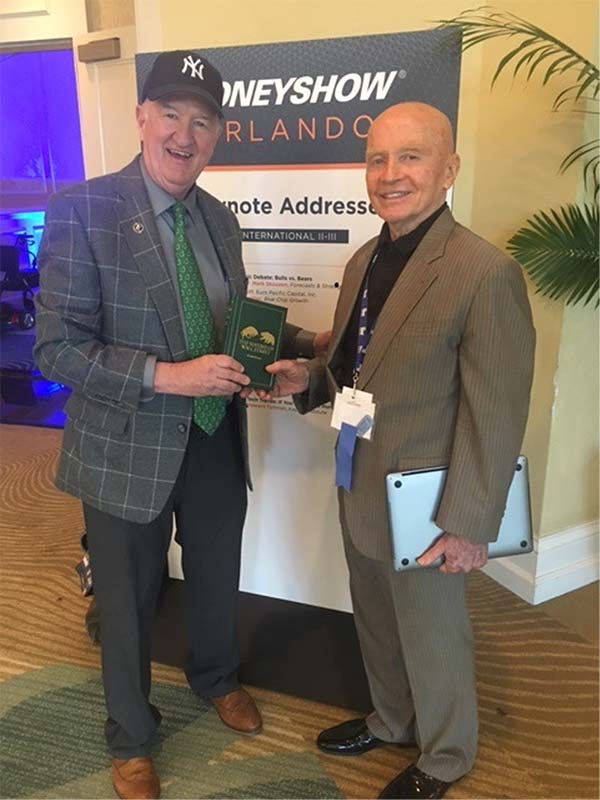
I met him once at the Orlando MoneyShow in September 2021. Below is a photo of the two of us holding a copy of my book The Maxims of Wall Street. He said he was a big fan of the book and referred to it often.
He loved the above quote from Templeton and took to heart this quote from Gerald Loeb: “Successful preservation of capital must overcome the handicaps of socialistic governments, supposedly to help the masses” (Maxims, Page 147).
He nodded his head reading the Chinese proverb “When the king is far, the people are happy” (Page 149), as well as this one from Lao Tzu: “Governing a large country is like frying a small fish. You spoil it with too much poking.”
How to Buy The Maxims of Wall Street at a Discount
The Maxims of Wall Street has become a bestseller, having gone through 12 editions and sold over 65,000 copies.
Dennis Gartman of The Gartman Letter said it best: “It’s amazing the depth of wisdom one can find in just one or two lines from the Maxims. I have it on my desk and refer to it daily.”
Warren Buffett is a big fan, saying, “Love your great little book. I plan to shamelessly steal some of the lines.”
Alex Green, our Chief Investment Strategist here at The Oxford Club, says, “Skousen has collected a treasure trove of proverbs, slogans, stories and juicy quotes, plus plenty of stories and commentary. I recommend every member of The Oxford Club own a copy and refer to it often. I do!”
Hugh Grossman, editor of DayTradeSPY, writes, “I rarely review anything but Mark Skousen’s book was so good it kept me awake most of the night reading one quote after another – inspiring, humorous and thought-providing.”
Maxims is not available in bookstores.
You can buy the book on Amazon, but it’s cheaper at Skousen Books at Discount. The price is $22 for the first copy and $12 for all additional copies. They make a great gift for clients, friends, and relatives. I autograph and number all copies and mail them at no extra charge inside the U.S.
Do you have an electronic version of the Maxims? Most of us love reading ebooks.
Dr. Mark. New subscriber from Oxford Club. What is the AEIOU sign off to all your emails mean? Thanks.
Kevin OD