
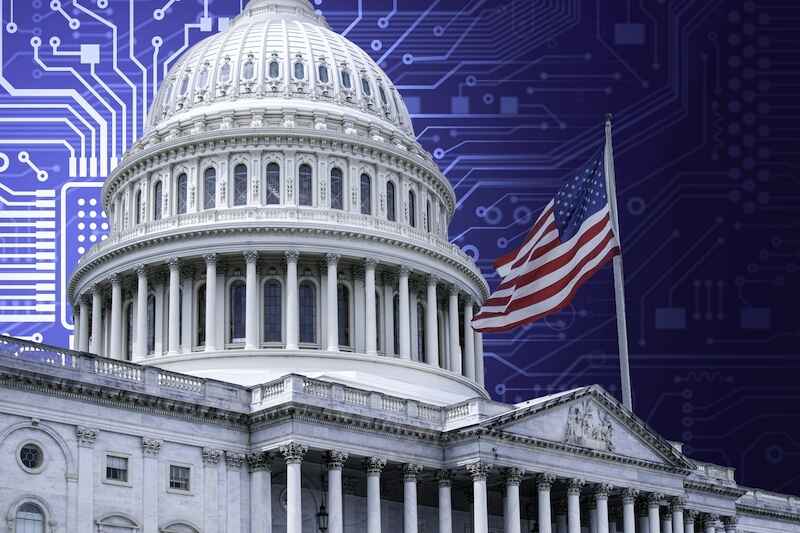
Editor’s Note: Today, we’re handing things over to Matt McCall, the Head Innovations Strategist at Monument Traders Alliance. Matt’s been in the markets for over 25 years. He founded his own investment advisory firm in 2004, and you may recognize him from his years as a regular on Fox Business.
The votes from this week’s midterms may have been counted, but as Matt explains below, the forces that will matter most to your portfolio over the next decade weren’t on the ballot.
For more ideas from Matt and the MTA team, visit their website.
– James Ogletree, Senior Managing Editor
America went to the polls earlier this week.
The full effects of the election results remain to be seen, but one thing is certain. Millions of Americans cast their votes, billions of dollars were spent trying to influence the outcome, and Wall Street will spend the next several days dissecting what it all means for the market.
Republicans will celebrate some victories. Democrats will celebrate others. And the political pundits will debate every possible implication.
But I have a question for YOU.
What if the most important forces shaping your portfolio weren’t actually on the ballot?
Washington Changes. Innovation Doesn’t.
A couple of weeks ago, I gave a presentation titled Beyond the Ballot: The Investment Trends Washington Can’t Stop.
My central message was simple: Presidents come and go. Political parties rise and fall. But the technologies transforming our economy continue moving forward.
Think about the last 25 years.
George W. Bush was president when the internet began reshaping how Americans lived and worked. Barack Obama occupied the White House during the smartphone revolution. Donald Trump and Joe Biden have both presided over important stages of the artificial intelligence boom.
Different presidents. Different policies. Different political priorities.
Yet innovation kept advancing.
That pattern goes back a lot further than 25 years. In 1915, with war raging in Europe, Thomas Edison told The New York Times the government should maintain “a great research laboratory.” The Navy took him up on it. Its lab on the banks of the Potomac opened in 1923 and went on to help pioneer radar and lay the groundwork for GPS.
Since then, 18 different presidents have occupied the White House. Edison’s lab is still producing breakthroughs.
I’ve been investing professionally since 2000, when I started at Charles Schwab. Since then, I’ve lived through the dot-com collapse, September 11, the financial crisis, a global pandemic, and one of the fastest interest-rate hiking cycles in decades.
Every crisis felt enormous at the time. And every single time it created multiple reasons for investors to abandon stocks.
But the most important technological trends didn’t disappear.
Seven Revolutions Bigger Than Politics
Right now, I see seven powerful forces that could reshape the global economy over the next decade.
Artificial intelligence is driving an enormous infrastructure buildout. Robotics is moving beyond factory assembly lines and into warehouses, construction sites, and eventually our homes. AI-powered medicine is helping researchers develop treatments and detect diseases earlier.
Meanwhile, critical minerals are becoming strategic resources. Quantum computing is advancing toward applications that conventional computers cannot handle. The commercial space economy is expanding. And drones, autonomous systems, and advanced sensors are transforming modern defense.
These aren’t Republican technologies or Democratic technologies.
They’re responses to real economic needs.
Of course, Washington matters. Regulations, tariffs, tax incentives, government spending, and export restrictions can accelerate or delay these industries. Some companies will benefit from policy changes, while others will face new obstacles.
But an election doesn’t eliminate the need for more electricity, better healthcare, greater productivity, or stronger national security.
The demand driving these revolutions extends far beyond Washington.
The Numbers Favor Patience
There’s another reason I’m optimistic about what comes next.
According to J.P. Morgan Asset Management, the S&P 500 has delivered a positive return in the 12 months following every midterm election since 1950, averaging approximately 15%.
That’s an impressive historical record, although it certainly doesn’t guarantee another rally.
More importantly, it reinforces a lesson I’ve learned over the last quarter-century: Trying to time your investments around political headlines is rarely a winning long-term strategy.
I’d rather identify companies positioned at the beginning of enormous technological transformations and give those trends time to unfold.
Again, I believe we’re closer to 1995 than 1999 in this innovation cycle. Much of the infrastructure is still being built, breakthrough applications are still emerging, and widespread adoption remains ahead of us in several industries.
That doesn’t mean every innovation stock will succeed. Valuations, execution, and timing still matter enormously.
But the opportunity is much bigger than the election.
The next great fortunes won’t be built by predicting which political party wins the next election.
They’ll be built by investing in future innovation.