

I last looked at mortgage real estate investment trust Starwood Property Trust (NYSE: STWD) in early 2025, before full-year 2024 results were out.
Starwood has a $31 billion portfolio of commercial, residential, and infrastructure loans and has deployed $117 billion since its inception.
When I reviewed it last year, the company received a “B” rating for dividend safety.
However, things have deteriorated since then.
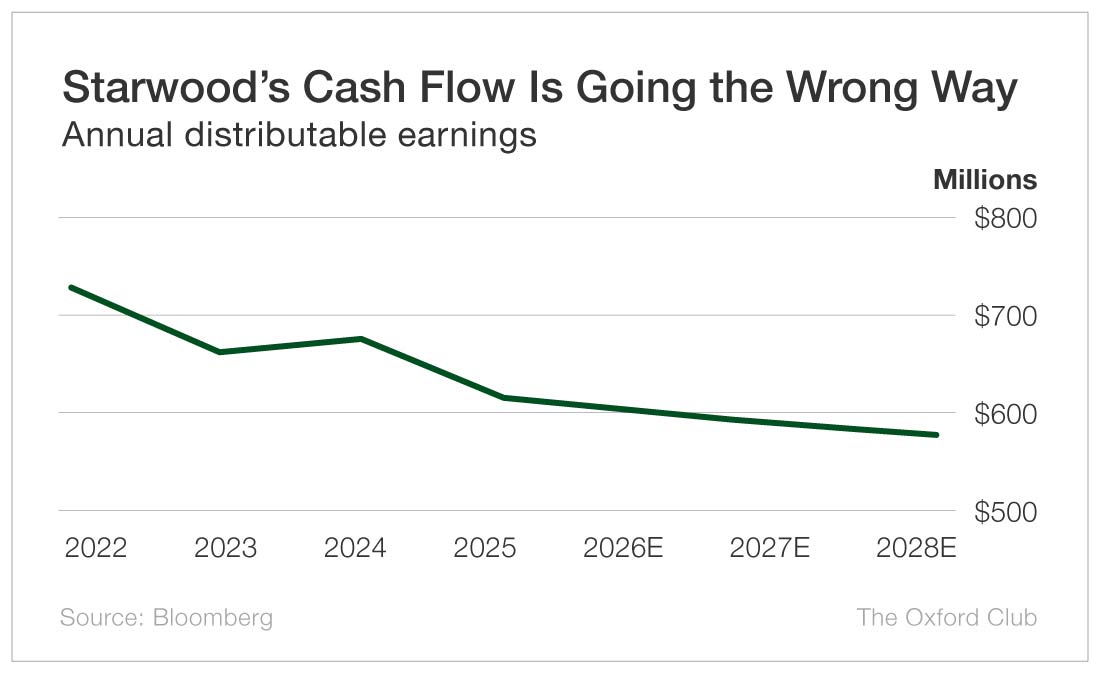
The concern last year was that distributable earnings, Starwood’s measure of cash flow, had fallen in 2023. It was expected to have increased slightly in 2024, and it did in fact rise.
But last year, distributable earnings fell again, and they are projected to decline in 2026 and for the next two years. The next two years’ estimates are not factored into the Safety Net model, but you can see in the chart below that the general trend is expected to be down.
Here’s where it really becomes a problem.
Even though the dividend per share hasn’t increased, the number of shares outstanding has grown over the years.
For example, in 2024, when distributable earnings were $675 million, the company paid out $620 million in dividends and had 321 million shares outstanding.
Last year, despite the dividend per share staying the same, dividends paid rose to $669 million because the company had 350 million shares outstanding.
That caused the payout ratio to rise to 109%, meaning Starwood paid out $1.09 in dividends for every $1 in distributable earnings. That’s not good. That means it had to come up with an extra $32 million that was not covered by distributable earnings.
In 2026, dividends paid are forecast to rise to $683 million, while distributable earnings are projected to fall to $599 million, growing the payout ratio to 114%.
If the estimates are correct, Starwood needs to come up with another $84 million beyond what it brings in from distributable earnings.
The Dividend
Starwood Property Trust has paid a $0.48 per share quarterly dividend every year since 2014. That comes out to an annual yield of 11.6%.
The company has never cut the dividend since it began paying one in 2009. But the only ways it can continue to fund the dividend at the current level are by dipping into cash, raising debt, or − most likely − diluting shareholders further by selling shares to raise cash.
Management may soon realize it has to cut the dividend in order to make it more affordable.
Without a substantial increase to distributable earnings, the current dividend is not safe.
This is a big downgrade from a year and a half ago.
Dividend Safety Rating: F

Next week, I’m going to cover the dividend safety of a company in the high-yielding and popular business development company (BDC) sector.
Which BDC would you like me to analyze? Leave the ticker in the comments section.
You can also take a look to see whether we’ve written about your favorite stock recently. Just click on the word “Search” at the top right part of the Wealthy Retirement homepage, type in the company name, and hit “Enter.”
Also, keep in mind that Safety Net can analyze only individual stocks, not exchange-traded funds, mutual funds, or closed-end funds.
HTGC and MAIN
TRIN or CSWC
Main and HGTC
TRIN is my favorite bdc
Please review the Annaly Company (NLY).
ARCC
MAIN
Htgc
Checkout FCPT
HTGC
ARCC
Mark,
Please review your favorite BDC.
Also, one of your recent reports noted a Dallas Fed study concerning the home insurance premiums and how they are calculated in the CPI. Can you please direct me to the site where it is located. Thanks so much,
Don Losman Losmand@gmail.com
ARCC
MAIN also I’m curious about O.
CSWC; MAIN
MAIN
Trinity Capital please
Bxsl
OBDC
ARCC