

Computers that think for us, robots that work for us, and machines that look and talk like us? That’s the future some of AI’s biggest advocates are painting.
Some people are excited by it. Others are worried. But a rare few are noticing that the most futuristic technology being built today is much harder to see.
It could be going inside our bodies.
Depending on your point of view, that may sound exhilarating… or a little unsettling.
Boston Scientific (NYSE: BSX) is one of the biggest companies behind that quieter tech revolution.
Its devices can help doctors treat an irregular heartbeat with short bursts of electrical energy and close off a small part of the heart to help reduce the risk of stroke. It also has devices that are used to treat kidney stones, chronic pain, cancer, and blocked blood vessels.
And yes, AI has made its way here too. The company uses it to help doctors read heart rhythms.
This is not technology that dances across a stage, but it may matter more to our daily lives.
Boston Scientific generated $20.1 billion in sales in 2025, up 19.9% year over year, and sales from its existing businesses grew 15.8%. FARAPULSE, its treatment for atrial fibrillation, became a major growth engine.
This year has been harder. Second quarter sales still rose 7.5% to $5.44 billion, but progress slowed and the company cut its full-year sales outlook.
There is real growth happening, but there is also a clear loss of momentum.
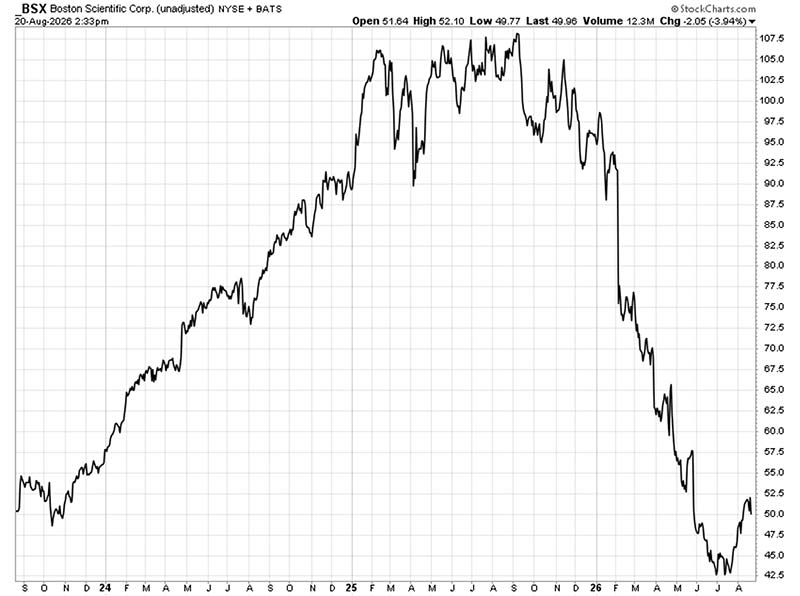
The stock climbed above $100 in 2025. By this summer, the shares had fallen below $45. Even after a rebound near $50, the stock remained down more than half from its peak.
The obvious question is whether the market has gone too far.
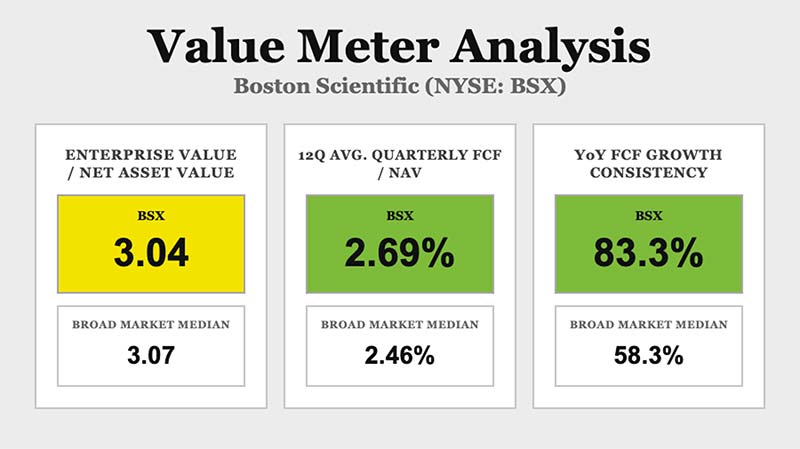
Boston Scientific’s enterprise value (EV) sits at $73.1 billion. Its average net asset value (NAV) − assets minus liabilities − was $24.1 billion over the latest two quarters.
That gives it an EV-to-NAV ratio of 3.04, almost exactly in line with the 3.07 median for stocks in the Value Meter universe. In other words, Boston Scientific doesn’t look especially cheap based on its assets alone.
Of course, the appeal of those assets depends greatly on how much cash flow the business can generate from them.
Over the last three years, Boston Scientific generated average quarterly free cash flow of about $647 million. (The current Value Meter model uses a three-year average here to smooth out the quarter-to-quarter volatility that can make free cash flow unusually noisy.)
Compared with its average net asset value over the latest two quarters, that works out to a percentage of 2.69%. That’s modestly better than the broad market’s 2.46% median.
Here’s where things really stand out.
Our updated Value Meter compares each of the latest 12 quarters with the same quarter one year earlier. Boston Scientific’s free cash flow improved in 10 of those 12 comparisons.
That gives it an 83.3% growth consistency rate, well above the 58.3% median.
This is why the sell-off matters.
Boston Scientific is not obviously cheap on its assets alone. However, the business has been productive, and its cash generation has improved with unusual consistency.
If that cash record worsens, the value case gets weaker. If the stock stays depressed while cash flow holds up, the case gets stronger.
The stock is not a clear bargain, but the numbers support a favorable valuation.
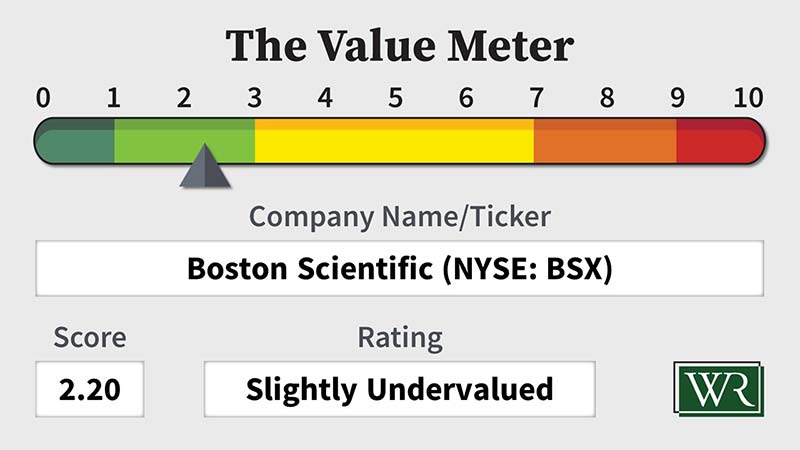
The Value Meter rates Boston Scientific as “Slightly Undervalued.”
What stock would you like me to run through The Value Meter next? Post the ticker symbol(s) in the comments section below.
appl
Hi Anthony,
Thank you for this analysis. Can you please run Nano Nuclear Energy, Inc (NNE) through the Value Meter?
I’m also following you and Marc on the Weekly Income Alert, but still in the observing and building confidence stage. Ha ha
Please review the stock “ALSN.” Many thanks. And thank you for all your informative articles.
Van A. Wright
I would like to see results for stock SXT
Thanks!
So you’re not high but Alex is. Should I sell?
Avgo
Psix
EW
ONDS please
How about RXRX?