

It’s been just over a year since I reviewed the dividend safety of Capital Southwest (Nasdaq: CSWC). At that time, the stock received a “C” rating for dividend safety.
Capital Southwest is a business development company, or BDC. It lends money to companies with $3 million to $25 million of EBITDA (earnings before interest, taxes, depreciation and amortization).
Its portfolio includes…
- Intero Digital, a digital marketing platform provider
- B-O-F Corporation, a 73-year-old company that supplies grocery stores with shelving and merchandising equipment
- ServerLift, which manufactures lifting and handling equipment for data centers and IT infrastructure.
When we looked at Capital Southwest a year ago, it was determined that there was moderate risk to the dividend because even though net investment income (the measure of cash flow we use for BDCs) was growing, the company paid more in dividends than it took in.
Not by a lot, mind you, but if a company is paying more in dividends than it generates in cash, that is not sustainable without dipping into cash on hand or raising more money. If the company needs to raise capital, it typically involves either taking on more debt or selling stock, neither of which is great for shareholders.
In fiscal 2026, which ended in March, Capital Southwest repeated the same behavior.
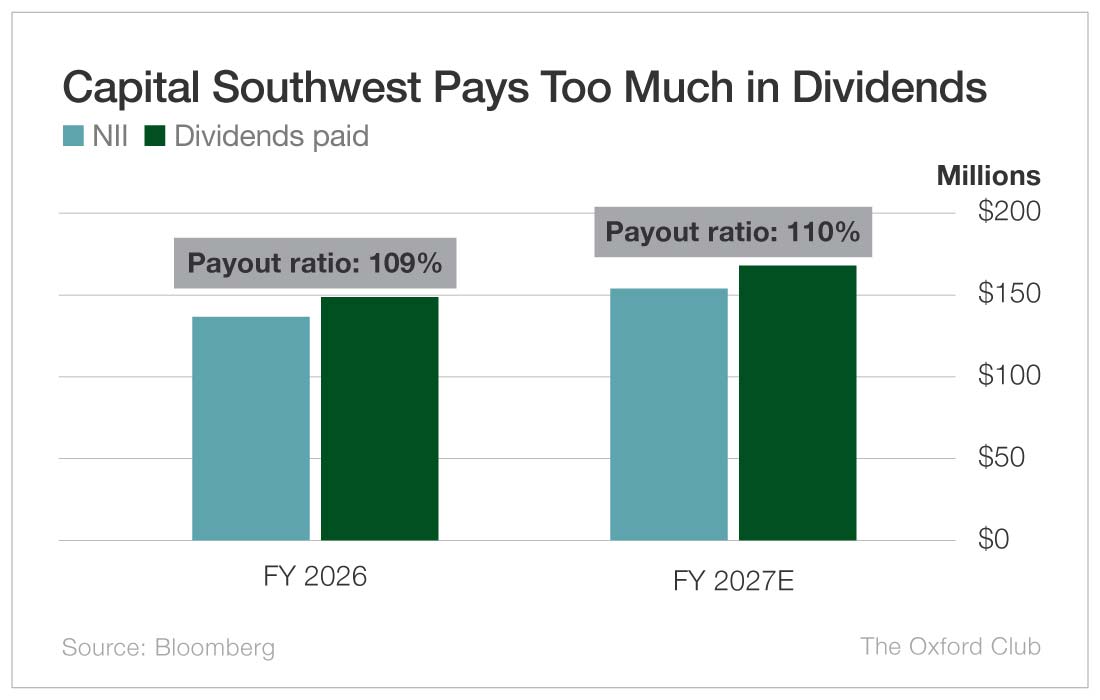
It generated $135.5 million in net investment income, which was 15% higher than the previous year’s total. However, it paid out $147.2 million in dividends for a payout ratio of 109%.
In other words, for every dollar it made in cash flow, it paid out $1.09.
This fiscal year, net investment income is forecast to continue to grow to $152.7 million, but dividends paid are projected to be $167.4 million for a payout ratio of 110%.
Capital Southwest pays a regular monthly dividend and a quarterly supplemental dividend.
The current regular monthly dividend is $0.1934, which comes out to a yield of 10%. Add in the $0.06 quarterly supplemental dividend, and the yield improves to 11%.
Because the supplemental dividend is variable, you should expect some fluctuation in the overall payout.
To determine the safety of the dividend, we’ll only consider the regular dividend. The supplemental dividend has held steady since 2023, but it has varied over the years.
The company has not lowered the regular dividend since 1990.
The fact that Capital Southwest pays more in dividends than it generates in cash flow is concerning, but the company’s nearly four-decade track record of consistent dividends is impressive.
Though the supplemental dividend may vary, the regular dividend is moderately safe.
Dividend Safety Rating: C

What stock’s dividend safety would you like me to analyze next? Leave the ticker in the comments section.
You can also take a look to see whether we’ve written about your favorite stock recently. Just click on the word “Search” at the top right part of the Wealthy Retirement homepage, type in the company name, and hit “Enter.”
Also, keep in mind that Safety Net can analyze only individual stocks, not exchange-traded funds, mutual funds, or closed-end funds.