

It’s rare that we pull back the curtain of The Oxford Clubroom − our interactive, Members-only platform − in Wealthy Retirement.
But with everything that’s going on right now in the markets and around the world, I don’t want any of my readers to miss out.
I recently joined Oxford Club Publisher Rachel Gearhart for a Clubroom interview on a wide range of topics, including why I’m not losing sleep over Iran or inflation, my latest thoughts on the energy sector, a look at precious metals, and which sectors and industries most investors are overlooking.
We’ve selected some of the highlights to share below.
RG: Thanks for joining us today, Marc. To start us off, what’s one thing investors should be paying the closest attention to right now?
ML: One of the things that I’ve learned over three decades in the market is not to pay too much attention to the news. You have to be aware of what’s happening, but I take my lead from the market, not from the headlines or cable news.
What I mean by that is the market is a forward-looking mechanism. It’s certainly not immune to headlines, but generally speaking, the market is going to tell you what the overall environment is going to be six months to a year from now.
The COVID crash is a perfect example. The market got hammered because the whole world was shut down, but remember how quickly it came back? It was telling you that even though the economy was not great for a while, it wasn’t the end of the world and things were going to bounce back.
Right now the market’s hanging in there, so I’m not too concerned about inflation or what’s happening in Iran. Do I think interest rates are going up? Yes, I do. Do I think we could be stuck in this war with Iran for a while? Quite possibly.
But right now, the market’s not giving me too much of an indication to be worried for the intermediate to long term.
RG: We know you’re long-term bullish on oil and energy prices. Can you give us a recommendation? I know you have several in your Oxford Income Letter portfolios.
ML: Yes, Phillips 66 (NYSE: PSX) looks great right now. It’s a refiner.
One of the dynamics that’s happening right now is that the refiners are able to raise their prices even faster than the price of oil is rising, so their margins are going up. It’s called the crack spread − the difference between the inputs into the refinery and the outputs that they sell. These crack spreads are widening, and that’s going to mean more profits for the refiners like Phillips 66.
RG: Do you feel that energy is still the biggest opportunity right now, or are there other commodities or sectors that you like more?
ML: I still think energy is a place you absolutely need to be, with the unrest in the Middle East and the Strait of Hormuz being closed right now.
Plus, energy is very underrepresented in the S&P 500. It’s only about 3% of the entire S&P 500, which is way below historical norms. So just on that alone, it is undervalued.
With everything going on in the world − plus rising prices and new tariffs on Canada − agricultural commodities are another area you want exposure to. Corn and wheat are starting to act well. About 10% of the world’s sugar goes through the Strait of Hormuz, as does 30% of the world’s fertilizer.
The fertilizer aspect is very, very important. It’s one of the reasons I’ve been bullish on Nutrien (NYSE: NTR). It’s a stock I recommended in The Oxford Income Letter a long time ago before the war with Iran started, but the closure of the Strait of Hormuz makes it an even more important play.
RG: We have a Member asking whether you have any comment on short- and long-term prospects for defense stocks, especially drones.
ML: Yeah, it’s hard to argue against defense stocks and drones.
The world certainly is not getting safer and more peaceful, and it’s hard to imagine it ever will. So defense is going to be a priority for the U.S. government and other governments around the world. It feels like a sector that is never going to go away.
In the short term, anything can happen, but you definitely need some defense names in the portfolio.
RG: Another Member is asking about your opinion on gold and silver.
ML: That’s a great question. I like both gold and silver for the long term.
In the short term, I don’t really have a strong opinion on gold. I would be focused on the dollar. Gold isn’t great when the dollar is rising, and right now, the dollar has rebounded a bit. It had been very, very strong before falling in June, but it is starting to come back.
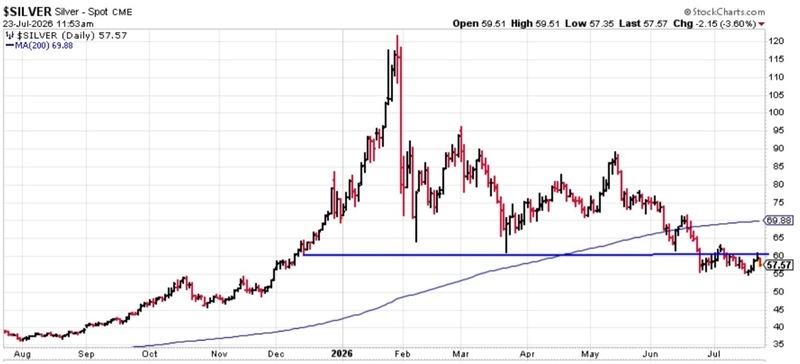
I don’t think silver looks very good right now. I’m sure everyone remembers when it really spiked between November and January… and then came right back down. It’s been bouncing along, making lower lows and lower highs, which is bearish, and then it dipped down below support at about $60 (the thick blue line in the chart below).
If I had to guess, I’d guess silver is going lower before it goes higher. It’s also below the 200-day moving average (the thin blue line in the chart), and there’s an expression that “nothing good happens below the 200-day moving average.” I really want to see silver get a lot more constructive before I would be more bullish in the short term.
RG: We have time for one last question: If you were to put fresh money to work today, where would you be looking? Are there any themes that you think Wall Street is underappreciating right now?
ML: Certainly energy, as we’ve talked about. I really like the financials right now. They’re not being talked about too much in the mainstream financial press. If you look at some of the big banks − JPMorgan Chase (NYSE: JPM), Bank of America (NYSE: BAC), Wells Fargo (NYSE: WFC) − those stocks are acting really, really well.
I’m a big fan of regional banks too. Not only do they also typically do well in rising interest rate environments, but the big banks need growth, and they often snap up smaller banks, so that’s an extra catalyst.
One area that is being completely ignored that I really like − and I’m recommending a stock in this industry in the August issue of The Oxford Income Letter − is insurance.
This is another sector that does well with rising interest rates. When you take out an insurance policy, you pay your premium, and that premium gets invested in fixed income securities. As interest rates rise, the insurance companies are able to put more money to work at higher interest rates, but their claims and the risk and reserves that they have to keep for those claims stay the same.
Insurance stocks have started to slowly creep up, but I think that’s a sector that’s going to be a big winner a year from now.
Lastly, I’ve been very bullish on healthcare and biotech recently and have been moving the portfolios of Technical Pattern Profits and especially Trigger Event Trader more in that direction.
RG: Thanks so much, Marc. Hope to see you again in the Clubroom soon.
ML: Looking forward to it. Thanks, Rachel.
Are there any topics you’d like me to address in a future issue of Wealthy Retirement? Let me know in the comments below.
Hi Mark,
This was an excellent article. Very informative!!
Looking forward for your next article.
Thank you for sharing.