
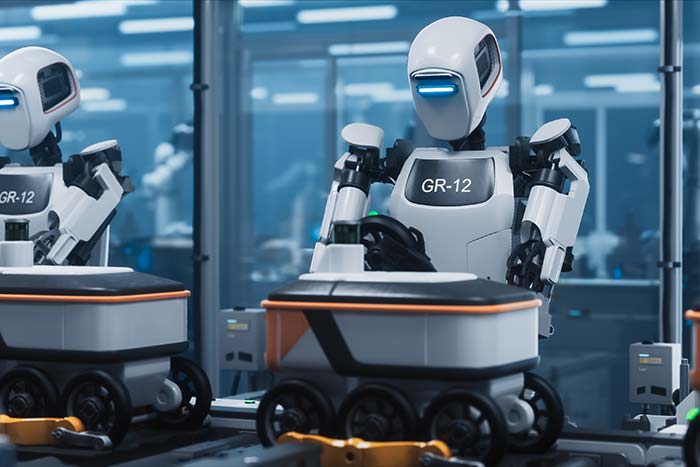
Editor’s Note: For the last three years, AI mostly lived on your screen − a chatbot, an image generator, a coding assistant.
According to Matt McCall, Monument Traders Alliance’s new Head Innovations Strategist, that phase is ending.
Below, Matt explains where this shift is headed and lists three stocks positioned to benefit as “Physical AI” becomes the next major tech buildout.
If you like what you read, I encourage you to subscribe to Matt’s new e-letter, The First Move. He publishes ideas like this several times a week.
It’s free, and it only takes a few seconds. You’ll even receive Matt’s complimentary report on how to profit from the AI revolution.
– James Ogletree, Senior Managing Editor
Over the past few years, nearly every conversation about artificial intelligence has revolved around the same topic: data centers.
Investors have been obsessed with NVIDIA’s (NVDA) GPUs, Microsoft’s (MSFT) AI spending, and whether electric utilities can generate enough power to support the next wave of computing. Those have been the right questions to ask because that’s where the AI revolution began.
We’re now entering the next phase of this story, and it could create an entirely new set of investment opportunities.
Out of the Data Center and Into the World
The physical world.
I got a firsthand look at that future during a visit to BMW’s massive manufacturing plant in Spartanburg, South Carolina. Robotic arms weld vehicle frames with incredible precision. Automated systems move parts from one station to the next. Cameras constantly inspect quality. Humans are still everywhere, but they’re increasingly working alongside intelligent machines rather than performing repetitive tasks themselves.
Henry Ford changed manufacturing forever, but I doubt even he envisioned an assembly line where humans and robots work side by side.
But that evolution is taking another major step forward.
Earlier this year, Figure AI announced that its humanoid robots had spent nearly a year working inside BMW’s Spartanburg facility. During that time, they handled more than 90,000 automotive components used to build over 30,000 vehicles.
These weren’t carefully staged demonstrations designed for YouTube. They were performing real work inside one of the world’s largest automobile factories.
That’s an important milestone.
For the last three years, AI has mostly lived on our screens.
We’ve used chatbots to answer relationship questions, software to generate images of our friends if they were safari animals, and large language models to write code and summarize documents.
Impressive? Absolutely. But those applications all existed inside computers.
The next decade will be different.
The next decade will be about AI that moves.
Physical AI
NVIDIA CEO Jensen Huang calls this next chapter Physical AI.
Instead of simply processing information, Physical AI allows machines to understand their surroundings, make decisions, and interact with the real world.
It’s the technology that will power humanoid robots, autonomous warehouse equipment, surgical robots, agricultural machinery, and next-generation defense systems.
And it’s already happening. Feeling dystopian yet?
Amazon now operates more than 750,000 robots across its fulfillment network. Hospitals continue adopting robotic-assisted surgical systems capable of performing increasingly complex procedures. Farmers are deploying autonomous equipment that can monitor crops and remove weeds with minimal human involvement. Defense contractors are investing billions of dollars into intelligent drones and robotic systems designed to operate where sending people would be too dangerous.
This isn’t one industry adopting robotics. It’s dozens.
China understands exactly where this trend is headed. Morgan Stanley recently increased its forecast for Chinese humanoid robot shipments in 2026 from 28,000 to 50,000 units. By 2030, the firm expects annual shipments to reach roughly 446,000 robots as manufacturing scales and costs continue to fall. China has made robotics a national priority because it views Physical AI as a strategic industry, much like semiconductors and AI software.
Every major technological revolution begins with infrastructure before expanding into the broader economy.
The internet needed fiber-optic networks.
Cloud computing needed massive data centers.
Today’s AI boom needed GPUs, networking equipment, and enormous amounts of electricity.
Now the technology is beginning to leave the server rack and enter factories, hospitals, warehouses, farms, and eventually our daily lives.
That’s why I don’t believe the biggest winners over the next decade will be the companies making the headlines today.
Every humanoid robot will require advanced sensors, machine vision, electric motors, precision gears, batteries, software, and hundreds of specialized components. Entire industries are quietly forming around Physical AI, and many of them remain well below Wall Street’s radar.
Building ChatGPT required GPUs.
Building Physical AI will require an entirely different industrial ecosystem.
That’s where some of the most exciting investment opportunities are beginning to emerge.
In future editions of The First Move, we’ll start digging into that ecosystem and look at some of the companies quietly supplying what could become one of the biggest technology revolutions of our lifetime.
Three Stocks to Watch
Rather than focusing on the companies building humanoid robots, I’m watching businesses that provide the technologies every robot will need.
- Rockwell Automation (ROK) – Helps manufacturers automate production lines with industrial control systems and robotics.
- Cognex (CGNX) – A leader in machine vision, giving robots the ability to inspect, identify, and navigate their surroundings.
- Symbotic (SYM) – Uses AI-powered robotics to automate warehouses for some of the world’s largest retailers.
To the future,
Matt McCall, Head Innovations Strategist
The First Move
Very interesting and forward thinking