
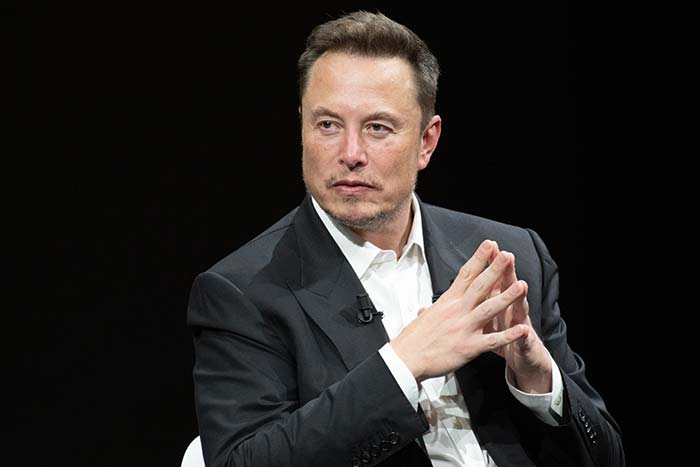
“There is no great genius without some touch of madness.”
– Seneca
My first encounter with Elon Musk was in 2015 at the Baron Investment Conference in New York. At that time, Ron Baron, founder of the Baron mutual funds family, had made a big bet on the future of Tesla (which was publicly traded) and the private SpaceX program. It quickly became his largest position.
My wife and I remember the conference well because not only did Musk make his first appearance there but Ron Baron arranged for us to be entertained by Steve Martin, Martin Short, and Lady Gaga! (The Baron conference is famous for bringing in big-name entertainment every year. In the recent past, we’ve enjoyed Barbra Streisand, Paul McCartney, Hugh Jackman, and many other celebrities.)
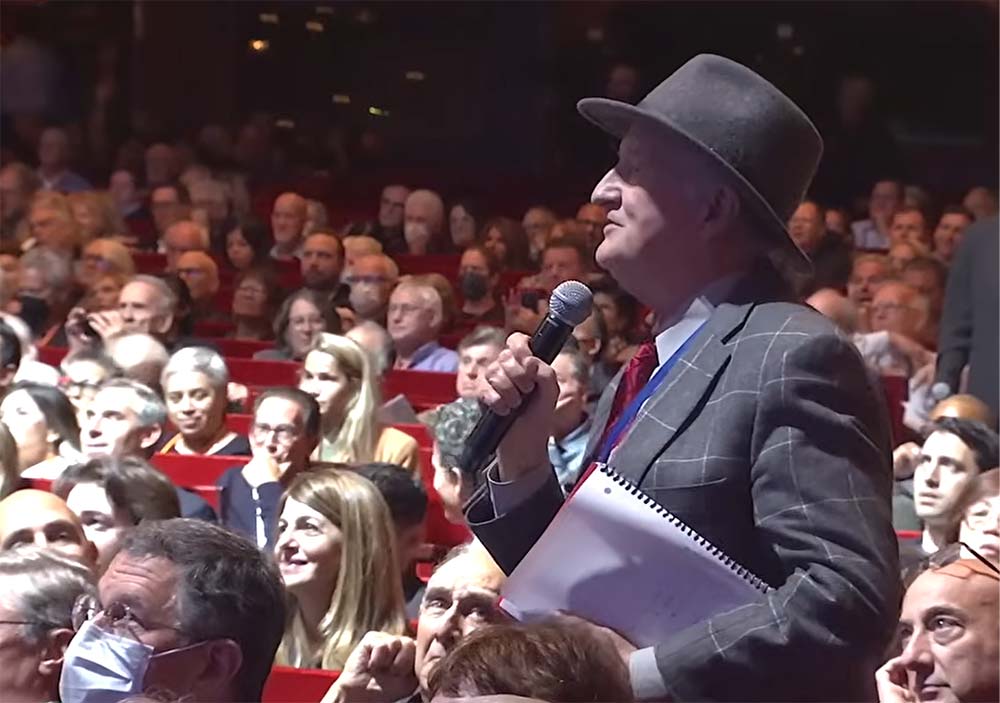
Since then, Musk has made two appearances at the Baron conference, and I was there for both of them. In fact, in November 2022, I was chosen to be one of only two people in a crowd of 5,000 to ask Musk a question. You can watch the exchange here.
In less than 10 years, my investment in the Baron Partners Fund (BPTRX) turned into more than $1 million. (I started with around $100,000 in 2013.)
I took some profits in the past two years, but now I’m adding to my position. I think there’s a lot more money to be made from Musk’s genius.
Time to Make Another Million?
Ron Baron agrees. When SpaceX went public on June 12, he didn’t sell a single share. In fact, he invested another $1 billion. And he is holding on to his Tesla stock as well.
Recently, I asked Ron Baron (whose success has made him a member of the Forbes 400 Richest Americans) who he thinks will be the next Elon Musk. He responded, “There is no NEXT!”
He made the following forecast: “Baron’s SpaceX investment presently valued for $15 billion as a private company… could be valued many multiples higher and become at least 10 to 20 times its IPO price within 10-15 years.”
Why is Baron so bullish on Musk, SpaceX, and Tesla?
Because, as John Mackey says, “Winners usually keep winning.” Musk has made his first trillion dollars. What’s next?
His companies are coming up with great new ways to make life better for millions of people, both here and abroad.
Elon Musk’s “Lucky Seven”
I’m currently tracking seven projects that Musk and his “imagineers” are working on…
1. Tesla: Autonomous vehicles and robotaxis.
Musk’s biggest near-term Tesla bet is fully self-driving vehicles and a large autonomous robotaxi network. Tesla is moving toward using purpose-built Cybercabs rather than simply using existing vehicles.
Instead of primarily selling cars once, Tesla could potentially earn recurring revenue from vehicles operating as autonomous taxis.
2. Optimus: A huge humanoid-robot business.
This may actually be Musk’s largest long-term Tesla thesis.
He envisions Tesla’s Optimus robot doing factory work, household tasks, and eventually many forms of physical labor. Tesla is preparing production capacity, although Musk himself has acknowledged that manufacturing a reliable humanoid robot at enormous scale is an exceptionally difficult engineering problem.
The bull case is extraordinary: millions of robots each potentially producing economic value comparable to a human worker.
3. SpaceX: Space transportation for less.
SpaceX’s central technological objective remains Starship and full reusability. The goal is essentially to make launching enormous amounts of mass into orbit inexpensive enough to support an entirely new space economy.
That leads to several potential businesses:
- Starlink
- Enormous satellite networks
- Space-based computing
- Lunar infrastructure
- Eventually Mars.
Musk has also shifted SpaceX’s near-term emphasis toward establishing a self-growing city on the moon while retaining the longer-term objective of a Mars settlement (which is pretty far-fetched, in my opinion).
4. Starlink: Global communications and AI infrastructure.
Starlink is already SpaceX’s largest revenue source, and Musk sees a much larger opportunity as the number of AI-powered machines explodes.
His argument is that autonomous cars, Optimus robots, and other AI machines will need enormous amounts of connectivity. SpaceX therefore isn’t simply building a satellite-internet company. It could become a major global communications and computing infrastructure company.
5. Space-based AI data centers.
This is one of the more speculative – and potentially enormous – parts of the vision.
Musk has proposed putting AI computing infrastructure in space, where solar energy is abundant. This environment may eventually offer advantages over terrestrial data centers, without using a ton of water resources.
That connects SpaceX’s rocket technology, Starlink, AI, and energy into one business.
6. xAI: The intelligence layer.
Musk’s AI company, xAI, is intended to provide the underlying intelligence for this ecosystem.
The interesting development is that SpaceX acquired xAI, bringing the AI operation directly into the SpaceX structure. And xAI has been growing rapidly. SpaceX’s AI division reported revenue of $2.56 billion in the second quarter.
Tesla and xAI are also working together on AI applications, including a project Musk has described as being capable of emulating the functions of entire companies.
7. Terafab: AI chip manufacturing.
This may be the piece that ties everything together.
Tesla and SpaceX announced a $16.8 billion initial investment in Terafab, a massive semiconductor complex in Texas. It is designed to manufacture AI chips for Tesla’s Optimus and autonomous vehicles as well as SpaceX’s space-based computing ambitions. The project could eventually expand to roughly $119 billion.
Whether you call it genius or madness, Musk keeps building the future in real time – and I know investors will be watching closely to see how it unfolds.