

Today, the average length of time that an investor holds stocks is just over six months, considerably shorter than the average of nine years in the 1970s.
Frankly, I was surprised the current period was that long.
In the era of zero-day options, active trading, and online gambling (which includes “prediction markets”), plus TikTok videos and Facebook Reels, most people’s attention spans are shorter than a substitute teacher’s patience.
That is translating to investors no longer owning stocks for the long term.
That’s too bad, because it’s tough to make money short-term in the markets.
In a recent study, one quarter of men age 18 to 29 said they trade stocks daily. Sadly, 64% said they feel like failures.
According to another study, 52% of Gen Z respondents (ages 19 to 29) have redirected investment funds into sports gambling and 26% said that sports gambling is part of their long-term financial plan.
That’s astonishing − and as bad of an idea as I’ve heard in a long time.
Heck, I’d recommend an annuity before sports betting as part of a long-term financial plan. And I hate annuities.
One of the reasons I despise annuities is their sky-high costs and commissions. But even annuities’ fees aren’t as high as those charged by sportsbooks, which typically include a 10% vig. In other words, on a 50/50 bet, you’d have to wager $110 to win $100.
Imagine if you paid Vanguard a 10% fee. It would be very hard to make money.
I have no problem with sports betting or short-term trading if it’s for fun. There’s nothing like having a few bucks on the game to make it more interesting or a short-term trade to keep the market exciting.
However, we know from more than a century of market history that the way to make real money in the markets is to hold stocks for years.
If you can reinvest your dividends, you compound your wealth, and the numbers can get crazy.
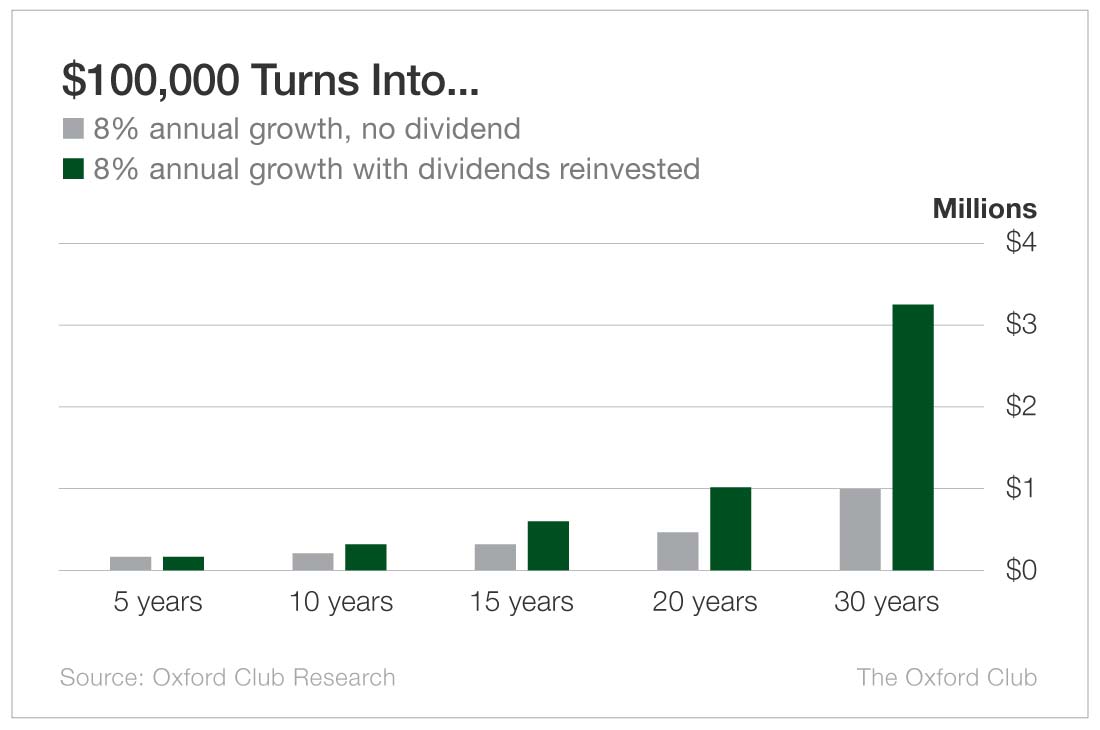
For example, an investor who has a $100,000 portfolio that grows 8% per year (the historical market average) turns $100,000 into…
- $146,864 in five years
- $215,692 in 10 years
- $316,776 in 15 years
- $465,233 in 20 years
- $1,003,474 in 30 years.
On the other hand, an investor who has a $100,000 portfolio that grows the same 8% per year but earns a 4% starting dividend yield and whose dividend grows 8% per year turns $100,000 into…
- $178,553 in five years
- $318,843 in 10 years
- $596,410 in 15 years
- $1,016,980 in 20 years
- $3,244,919 in 30 years.
And that’s without adding a single dollar other than reinvesting the dividends. This is a “set it and forget it” strategy (though adding money over time will increase the total value).
Even if you prefer to collect the dividends rather than reinvesting them, investing in companies that grow their dividends every year means you get paid more cash each year, which helps you keep up with or outpace inflation.
Betting on whether the Fed will raise rates, whether it will rain in Kansas City, or whether the Buccaneers will cover the spread will never − and I truly mean never − produce returns like that.
Investing in dividend growth stocks is the safest, most predictable way to generate wealth.
Look, if you enjoy it, place some bets or take a shot at a speculative stock or option. As long as you’re managing your risk, you should be okay.
I like the action too. It’s fun.
But to make real money, you need to invest for years − not days, weeks, or months. Investing in dividend growth stocks means you’ll get paid 4%, then 5%, then 6%… rather than handing over 7% to an annuity salesman or 10% to Joe the Bookie.
If you need cash today, a dividend is a much surer bet than the Browns +7.
It’s nice to hear true common sense recommendations from someone in the financial field. Thank you Mark. Hopefully more people will follow you.
I’m confused! Yesterday I heard your video to say, “We don’t recommend more than four percent of your portfolio in any one stock.” This narrative says you can’t make “real money” unless you keep stocks for years. My two portfolios are telling me that if I keep making real money on my stock, I’m going to hold it longer than it being four percent of my portfolio. AMAT is one example. It’s now 40% of one portfolio. I’ve had it for years. What am I missing?
This reminds me of the Fidelity Investments study that showed the 2 groups of investment accounts that did best were 1) accounts whose owners had DIED and 2) accounts whose owners had FORGOTTEN about them. Another advantage of “leaving well enough alone” is the absence of daily anxiety about what “Mr. Market” is doing.
Marc, I couldn’t agree more. I’m thankful every day that my wife and I discovered your “Get Rich With Dividends” book and were able to build a portfolio of dividend growers and now are comfortably retired. I rarely ever look at an investment that doesn’t carry a dividend these days. Thank You!
The House always wins over time
I got your advice a few years ago and it has been some of the best value I’ve gotten from my subscription. In just these few years my dividend rate has almost doubled to 14% from my initial amount invested. I’m 74, retired and have 44% of my capital in ETFs and dividend stocks; another 15% is in bonds. Thanks for your great advice! (PS: Trading the balance has been fun too!)
Marc I follow your recommendation meanwhile more than 10 years (since I have read your first edition of get rich with dividends)and the success is impressive.
After build up a robust fundament of dividend stocks (after 5 years) I began to add some money (approx 15%) in riskier investments (tech., biotech., etc). That is my gambling budget, all the rest of new budget is still in- and reinvested in dividend strategy. This combination improved my success.
kind reards