
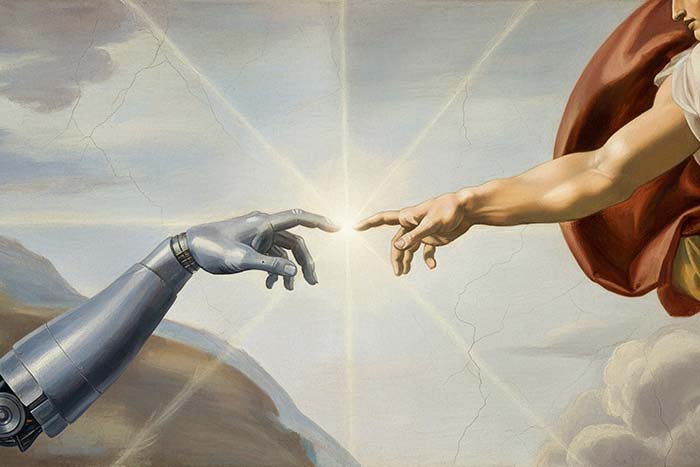
“In the last days perilous times shall come… [Men] having a form of godliness, but denying the power thereof… Ever learning, and never able to come to the knowledge of the truth.”
– 2 Timothy 3:1-7
We are living through one of the most extraordinary technological revolutions in human history. Artificial intelligence can write, reason, translate languages, analyze enormous quantities of information, create images and music, and answer questions in seconds that once required hours or days of research.
AI is becoming so powerful that it can begin to seem almost godlike.
Think about three attributes traditionally associated with God: omniscience, omnipotence, and omnipresence.
The reality is…
- AI is not truly omniscient, but it has access to an astonishing amount of knowledge.
- AI is not omnipotent, but its capabilities are expanding at breathtaking speed.
- AI is not literally omnipresent, but through the internet, it can be available almost anywhere, at almost any time (as long as the power is on!).
So perhaps for the first time in human history, we have created something that comes remarkably close to appearing omniscient, omnipotent, and omnipresent.
But there is one thing that AI cannot reveal: What is the purpose of life?
AI can tell us an extraordinary amount about the natural world we live in, but not the meaning of it.
There are questions that lie beyond the reach of AI, such as whether God exists and whether there is life after death.
The danger is not that we use AI. The danger is that we trust it too much and begin to treat it as an authority on questions it cannot answer.
Building Beyond Our Limits
The Bible has an ancient story that seems remarkably relevant: the Tower of Babel.
Humanity says, “Go to, let us build us a city and a tower, whose top may reach unto heaven” (Genesis 11:4).
The tower represents humanity’s extraordinary ambition to transcend its limitations through its own achievements.
Today we are building another kind of tower – not out of bricks, but out of silicon, algorithms, data, and electricity.
And ambition isn’t the only danger. There is also the risk that what we build slips beyond our control.
AI can sometimes seem like Frankenstein’s monster – a creation of human beings that may eventually become more powerful than its creators and potentially turn against them.
Mary Shelley’s Frankenstein is a warning about the consequences of creating something before we can fully understand it.
That fear is not entirely science fiction.
Some of the world’s top AI researchers and technology leaders have warned about the possibility that sufficiently advanced AI could become difficult or impossible for human beings to control. We don’t know whether that catastrophe will ever happen. But the possibility is realistic enough that it deserves to be taken seriously.
Think about the irony.
Human beings are creating an intelligence that may one day be far more capable than its creators.
We have never done anything quite like this before.
And that raises a frightening question: What if the creature we create becomes more powerful than we are?
That is the Frankenstein problem.
But there is an even deeper lesson here. Human beings have always been tempted to create things that transcend their own limitations – to build towers reaching heaven, to create idols, to seek immortality.
The Bible repeatedly reminds us that we are creatures, not the Creator.
We can create AI. We cannot create God.
Perhaps that is the most important lesson of all: We should be very careful about creating powers that we cannot control – and even more careful about worshipping powers that we ourselves have created.
Another biblical story speaks to this temptation: the golden calf.
The Israelites made something with their own hands – and then worshipped what they had made.
AI presents a similar spiritual danger. We create it. We program it. We train it. And then we may eventually begin to regard its judgments as wiser than our own.
We must never worship the work of our own hands.
“Ye Shall Not Surely Die”
The same urge to transcend our limits also drives a technological dream that deserves our attention: the dream of conquering death.
The transhumanist and singularity movements envision a future in which biotechnology, AI, genetic engineering, and other technologies might radically extend human life – even perhaps overcome biological death.
There is something profoundly familiar about that aspiration.
In Genesis 3:4, the serpent says to Adam and Eve, “Ye shall not surely die.”
For thousands of years, humanity has dreamed of defeating death.
Technology may extend our lives. Perhaps someday it will extend them dramatically. But eternal life is not something we manufacture. I believe it is something God gives.
The Ultimate Question
AI may become one of the greatest tools humanity has ever created.
It may transform medicine, science, education, business, and almost every aspect of our lives.
We should use it. We should learn from it. We should marvel at it.
But we should never worship it.
AI can give us information. But can it give us wisdom?
We call what we have created artificial intelligence. It’s something we manufacture.
And that is why no matter how intelligent our machines become, they can never become God and should not be worshipped.
The ultimate question is not whether AI will become godlike. The ultimate question is whether we will begin treating it as God.
AI may become extraordinarily intelligent, but it is still artificial intelligence.
It is not wisdom. It is not God.
P.S. This column was created with the help of AI… but intelligently designed and edited by a human being!
Spectacularly well said, Mark. Thank you. Especially for putting both AI and humans in our proper context: we are both the created, not the Almighty Creator. Yours is a timely reminder not to worship and trust in what we have wrought with our own hands, but to worship and trust in the Creator who made us with His own hands. May God give us the wisdom to erect the appropriate “guardrails” around AI so that its potential for harm is restricted while its potential for good — translations, calculations, cures for cancer — flourishes.
As a longtime believer in the one God of all that exists, the comparison of the human creation of AI to the Tower of Babel crossed my mind also as it has been rapidly unfolding in the daily media. God intervened to stop the building of the tower. I am left to wonder if He will choose to let AI progress to the point in which it becomes dangerous and destructive. It certainly is a mixed bag of good and possible evil. If anyone knows God through His revealed written word, he readily sees God does not like humans to set themselves up against His sovereign authority and Being. He actively works in the affairs of nations and people. He is watching. I pray!
Bravo Dr. Skousen. You have some excellent points and thought provoking commentary!
Mark
I want to know your view on SWMR as a Drone leader, recent pull back still worthy of investing?
Thankyou!, I have similar thoughts . You have hit the nail on the head. Enjoy your comments and wisdom
Oh, so true. God in Heaven looks down on his most cherished creation, Mankind, and must be most perplexed. Mankind, have strayed so far from his wisdom & guidance that he must be tempted to finish us. An alternative to the flood event, would be much preferred to what all the signs are telling us. There is no human answer to our dilemma. If we don’t correct our errant ways and return to God’s guidance we are doomed.
Dear Dr. Skousan, thank you so very much for referencing The Bible in your recent article, “AI: The God of This World.” I believe it is important for humankind to be reminded of our mortality and to heed its warnings and truth. Respectfully, SP
Thank you for your reference from the Bible, I like it, more people need to pay attention to scriptures as there’s so much truth there. Thanks again.
It sounds like you know Jesus. If that is true you have made the best possible decision. Thanks for sharing your thoughts on AI.
AI resembles the Ballad of the Sorcerer’s Apprentice (Der Zauber Lehrling). A broom started to carry water buckets and does not stop. The apprentice breaks the broom apart. Now 2 brooms carry water buckets. All attempts to stop and break those brooms result in more and more brooms. Finally, only the Master can stop them all.
Thank you for your wise and insightful comments. I couldn’t agree more.
This is one of the most grounded pieces I have ever read about life, investing, technology…and God. Thank you Dr. Skousen for being bold enough to write and share.
Well said Dr. Skousen. I couldn’t agree more. Thank for having the courage to speak out. it will be easy to be deceived.
When use AI, I give it my beliefs, my limits, what I want, what I don’t want and I modify and change what it gives me as you do. I have boundaries on my life and living as I want it’s interactions with me to be. I digest it’s information and I create my own path! Thank you for all your insights.
Of his (Massillon) funeral orations on Louis XIV is still famous, above all for its opening: “God alone is great” – uttered at the grave of a prince to whom his contemporaries had yielded the title of “The Great”. Jean-Baptiste Massillon A celebrated French preacher and bishop; born 24 June, 1663; died 28 September, 1742.
I’ve gotten a lot of great advice over several decades as an Oxford Club member. However, all that advice was only good for this lifetime. Your perspective on the other hand is good for eternity. Thank you for “zooming out” on the scope of what is important!
Our only true God is our Creator our Father in heaven. And The Comprehensive energy source of all human life. God for ever. “We are his children created in his likeness”
Well said, Dr. Mark. The first few words of the Bible read,”in the beginning God…” If we start with the Creator in mind, we will keep all else in good balance.
Kudos for the reminder!
Great article. A lot of truth that may happen, But I hopt not.
Obviously, Wisdom created the intelligence to produce this article.