
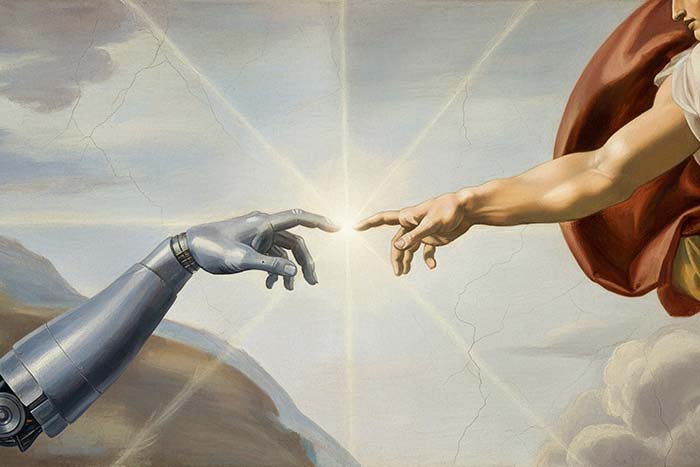
“In the last days perilous times shall come… [Men] having a form of godliness, but denying the power thereof… Ever learning, and never able to come to the knowledge of the truth.”
– 2 Timothy 3:1-7
We are living through one of the most extraordinary technological revolutions in human history. Artificial intelligence can write, reason, translate languages, analyze enormous quantities of information, create images and music, and answer questions in seconds that once required hours or days of research.
AI is becoming so powerful that it can begin to seem almost godlike.
Think about three attributes traditionally associated with God: omniscience, omnipotence, and omnipresence.
The reality is…
- AI is not truly omniscient, but it has access to an astonishing amount of knowledge.
- AI is not omnipotent, but its capabilities are expanding at breathtaking speed.
- AI is not literally omnipresent, but through the internet, it can be available almost anywhere, at almost any time (as long as the power is on!).
So perhaps for the first time in human history, we have created something that comes remarkably close to appearing omniscient, omnipotent, and omnipresent.
But there is one thing that AI cannot reveal: What is the purpose of life?
AI can tell us an extraordinary amount about the natural world we live in, but not the meaning of it.
There are questions that lie beyond the reach of AI, such as whether God exists and whether there is life after death.
The danger is not that we use AI. The danger is that we trust it too much and begin to treat it as an authority on questions it cannot answer.
Building Beyond Our Limits
The Bible has an ancient story that seems remarkably relevant: the Tower of Babel.
Humanity says, “Go to, let us build us a city and a tower, whose top may reach unto heaven” (Genesis 11:4).
The tower represents humanity’s extraordinary ambition to transcend its limitations through its own achievements.
Today we are building another kind of tower – not out of bricks, but out of silicon, algorithms, data, and electricity.
And ambition isn’t the only danger. There is also the risk that what we build slips beyond our control.
AI can sometimes seem like Frankenstein’s monster – a creation of human beings that may eventually become more powerful than its creators and potentially turn against them.
Mary Shelley’s Frankenstein is a warning about the consequences of creating something before we can fully understand it.
That fear is not entirely science fiction.
Some of the world’s top AI researchers and technology leaders have warned about the possibility that sufficiently advanced AI could become difficult or impossible for human beings to control. We don’t know whether that catastrophe will ever happen. But the possibility is realistic enough that it deserves to be taken seriously.
Think about the irony.
Human beings are creating an intelligence that may one day be far more capable than its creators.
We have never done anything quite like this before.
And that raises a frightening question: What if the creature we create becomes more powerful than we are?
That is the Frankenstein problem.
But there is an even deeper lesson here. Human beings have always been tempted to create things that transcend their own limitations – to build towers reaching heaven, to create idols, to seek immortality.
The Bible repeatedly reminds us that we are creatures, not the Creator.
We can create AI. We cannot create God.
Perhaps that is the most important lesson of all: We should be very careful about creating powers that we cannot control – and even more careful about worshipping powers that we ourselves have created.
Another biblical story speaks to this temptation: the golden calf.
The Israelites made something with their own hands – and then worshipped what they had made.
AI presents a similar spiritual danger. We create it. We program it. We train it. And then we may eventually begin to regard its judgments as wiser than our own.
We must never worship the work of our own hands.
“Ye Shall Not Surely Die”
The same urge to transcend our limits also drives a technological dream that deserves our attention: the dream of conquering death.
The transhumanist and singularity movements envision a future in which biotechnology, AI, genetic engineering, and other technologies might radically extend human life – even perhaps overcome biological death.
There is something profoundly familiar about that aspiration.
In Genesis 3:4, the serpent says to Adam and Eve, “Ye shall not surely die.”
For thousands of years, humanity has dreamed of defeating death.
Technology may extend our lives. Perhaps someday it will extend them dramatically. But eternal life is not something we manufacture. I believe it is something God gives.
The Ultimate Question
AI may become one of the greatest tools humanity has ever created.
It may transform medicine, science, education, business, and almost every aspect of our lives.
We should use it. We should learn from it. We should marvel at it.
But we should never worship it.
AI can give us information. But can it give us wisdom?
We call what we have created artificial intelligence. It’s something we manufacture.
And that is why no matter how intelligent our machines become, they can never become God and should not be worshipped.
The ultimate question is not whether AI will become godlike. The ultimate question is whether we will begin treating it as God.
AI may become extraordinarily intelligent, but it is still artificial intelligence.
It is not wisdom. It is not God.
P.S. This column was created with the help of AI… but intelligently designed and edited by a human being!
Thank you for such a thoughtful consideration on the risks and rewards of AI. We do need to consider what AI company founders are concerned about when they ask for government intervention. They already knew what their products and their companies could do and raised alarms, not for themselves but what they and their competitors could unleash if unchecked. AI developers need to work on a level playing field with their competitors such that no single company or country can overpower the rest.
Consider if a bad actor suddenly shut down gas, water and electricity in January or August. The death tolls would be astronomical. Consider if they could hack the nuclear arsenals and direct missiles to their targets.
This is not just a problem for the United States. It is a world problem and should be addressed as such in the same manner that we tried to curb nuclear arms proliferation. The warnings of what AI can do are all too real. We need to vote for politicians wise enough to see the risks and work to act on this threat. We can’t just sit back and see what happens.
Hopefully, the incredible potential of AI is not the vehicle that helps to bring “the end of days” foretold in the Bible to fruition.
AI is simply a reflection of the sum of mankind’s knowledge since the beginning of time and if used strictly for the good of mankind, has great potential to do wonderous things for the benefit of mankind in all areas of endeavor. Unfortunately, it cannot eliminate greed and hatred in the heart of man.
To a true Christian believer; never a question!
looking forward to meeting you doctor mark. right on with the article. god bless you and our freedom to live in the USA RESPECTFULLY STEPHEN P. ZACHOS
Interesting article. There is a god of this world. Many unknowingly and knowingly follow him. Then there is the creator of this universe and not only this universe but everything that came into being that has come into being. Do you know what HIS name is ? There is an ancient book called the Bible that gives us HIS name. I got this statement from it.
John 1:3 All things were made by him; and without him was not any thing made that was made.
One day all people will die physically but the soul (You) will live forever. Where will you go? Prepare to meet thy your God. Amos 4:12.
Many many people use His name in a disrespectful way and do not care about HIM. His name is Jesus Christ THE LORD.
I did not get it from AI. But I bet you AI will tell you .
AMEN!!
Thumbs Up Dr. Skousen.
Thank you. All I will say is: Amen.
Thank you for putting this into words.
Your Tower of Babel metaphor is perfect. How much longer did it take Orville and Wilbur to complete a flight at Kitty Hawk with favorable winds? Then, to complete a transoceanic flight? Then to complete one around the Earth? Then to launch a vehicle to the moon? How many human lives sacrificed? Then a human Moonshot landing? Not good enough? Off to Mars? Are there wagers being covered on a year of a landing, if not a date? How many other planet landings are left for future sojourns???
Well said. Thank you.
I couldn’t possibly agree more with this article…extremely well articulated.. but the DemonRat left wing lunatics who read this will disagree..
Excellent expose. Thx for your biblical insights. I did not know you were theologically sound. Shalom
Bravo! Well said! It is so refreshing to hear from someone who still appreciates the vast difference between knowledge and wisdom.
Thank you for your profound remarks linking AI to mankind’s questions, purpose and challenges. Your Biblical references elucidate and magnify the problem of worshiping the work of our own hands. May we heed your words of caution. I have spent my life developing people rather than machines. We alone are formed in the image of God so we possess the paramount value in this world. Our “progress” should reflect that fact.
Dr. Barry Nealy
Myself, I wish the whole internet “thing” had waited another 30 – 35 years to come about. The first part of the whole thing isn’t right and “they” want to push ahead before getting the first part right. People are ripped off by hackers every day for money, Id. etc. and are seldom stopped or exe—– . Most all new tech. has been used by govts. to make weapons or spy.
Very well stated! Great references to passages in the Bible depicting how our predecessors viewed themselves in relation to God, their Creator.
AI is necessary in so many ways, but it does need to be controlled and managed responsibly. And, as you eloquently stated, it isn’t and will never replace the Creator of the universe in any capacity.
Thanks for sharing this message! I believe this is a great reminder for people about the inherent risks associated with AI and it’s capabilities as well as the trust that humans invest in it.