

When playing Monopoly, the only thing more boring than buying the railroads is buying the utilities.
If someone lands on your utility, they roll the dice and pay you four times the amount if you own one utility and 10 times the amount if you own both.
The utilities generate some cash, but it’s nothing like if an opponent lands on your hotel on Boardwalk.
In real life, owning utilities stocks has a bit more appeal. You’ll collect some income, and if you pick the right one, you could see extraordinary gains.
When I moved to Florida from San Francisco more than 20 years ago, I went from paying $30 a month for electricity to paying $300 due to having to constantly run the air conditioning.
I decided that if I couldn’t beat ’em, I’d join ’em, so I bought shares of my local power provider, NextEra Energy (NYSE: NEE), which I still own.
Florida was booming, and so did NextEra. Over the last 20 years, the stock outperformed the S&P 500 by more than 660 percentage points.
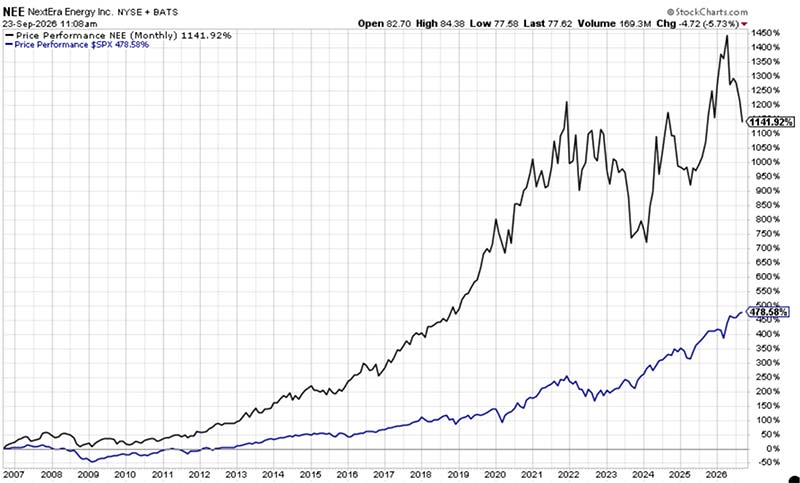
Because I didn’t need the income when I bought shares, I reinvested the dividends, which compounded my position. Every quarter, I bought more shares with the dividends I received. That included during the global financial crisis, when NextEra was trading near single digits (it’s trading above $75 now).
NextEra has raised its dividend every year since 1995. As a result, my dividend is nearly nine times higher than it was when I first bought the stock (even when you adjust for stock splits). Because of dividend reinvestment, that 9X higher payout is on many more shares than I originally bought.
It’s an interesting time for utilities stocks. Interest rates are up, and it is sometimes said that utilities don’t perform well in rising rate environments because their business is capital-intensive (which means funded by borrowed money). Utilities often have fixed rates that have to be negotiated with the government when they want an increase.
So that’s a potential headwind for the industry.
On the other hand, there is a hurricane-strength tailwind blowing behind the industry: the insatiable need for energy by the artificial intelligence sector.
It is estimated that between 2025 and 2030, AI data centers’ demand for energy will quadruple.
Nvidia CEO Jensen Huang estimates that AI will need 1,000 times more energy than we have.
Heck, even if he’s overestimating by 999X, that’s still an incredible amount of new energy that will need to be provided.
Over the next five years, Bank of America expects AI to need a more modest 1.5 times the amount of energy available.
Think about that for a second. This one industry needs about 150% more power than we currently have.
Interest rates may move higher, but I expect boom years for electricity and water utilities.
Like I was during the dot-com boom, I’m interested in the companies providing the tools that will allow the boom to continue. During the internet bubble, I wasn’t trying to figure out whether eBay (Nasdaq: EBAY) or Pets.com would win. I wanted to own Cisco (Nasdaq: CSCO), which was providing the networking infrastructure to most of the dot-coms.
Same thing today. I’m not trying to find the next Nvidia. I’m excited about the companies that are going to provide what the data centers can’t do without.
It’s entirely possible that a better chip comes around. But given utilities’ near-monopolies, there probably won’t be another electricity provider anytime soon.
Investing in utilities with big AI data center exposures is very likely going to be a great long-term investment over the years.
And all during that time, you’ll receive a dividend that should regularly increase, allowing you to earn more income or compound your wealth.
The best part is that unlike in Monopoly, you don’t have to hope someone lands on the utility to pay you at random intervals. Instead, it’s like the AI data centers are passing “Go” and paying you every trip around the board.