

Alphabet (Nasdaq: GOOGL) has spent more than 25 years building some of the world’s most valuable digital businesses.
Now it’s betting that artificial intelligence will drive its next phase of growth.
In the third quarter, Alphabet’s revenue rose 25% year over year to $127.6 billion. Google Search revenue rose 12%, and Google Cloud revenue more than doubled to $30.7 billion.
Management also said the number of Google Searches increased as quickly as it had in five years.
That matters because AI was supposed to be a threat to Google Search.
The fear was simple: If people asked an AI chatbot for answers instead of searching the web, Google’s main profit engine could weaken.
That has not happened yet.
Instead, Google has added AI features to Search while building Gemini, its AI chatbot, into a broader product line. At the same time, demand for Google’s AI tools and computing power has pushed Cloud growth sharply higher.
The stock story is easy to understand.
Google already owns huge digital platforms. If it can add AI to those platforms without losing its old economics, it may have one of the strongest positions in the AI race.
However, the price of running that race is rising fast.
Alphabet spent $51.4 billion on capital projects in the third quarter alone. Most of that money went toward the technical infrastructure needed for AI.
Management still forecasts 2026 capital spending of $195 billion to $205 billion, and it expects spending to rise again in 2027.
That spending is showing up in free cash flow.
Alphabet produced $42.3 billion of operating cash flow in the third quarter. But after capital spending, free cash flow was -$9.1 billion.
Over the latest 12 months, free cash flow was $19.7 billion, so the trend is clearly in the wrong direction.
This does not mean Google’s AI spending is a mistake. It means investors are being asked to pay today for cash returns that may arrive later.
That is where The Value Meter becomes less forgiving.
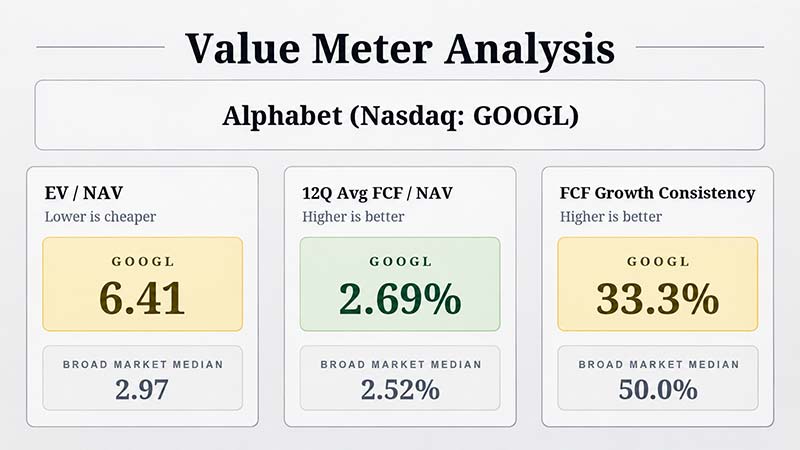
Alphabet’s enterprise value-to-net asset value (EV/NAV) ratio stands at 6.41, more than twice the broad market median of 2.97 and nearly twice the communication services sector median of 3.28.
That means investors are paying a steep premium for Google’s assets.
Though its search business, cloud platform, and AI technology help justify a higher valuation, that premium is harder to defend when we look at cash generation.
Alphabet’s average quarterly free cash flow-to-net asset value (FCF/NAV) over the past three years is 2.69%, compared with the broad market median of 2.52% and the sector median of 4.35%.
Even worse, the company’s free cash flow improved from a year earlier in just four of the past 12 quarters. That gives it a consistency rate of 33.3%, below both the broad market median of 50% and the sector median of 58.3%.
These figures highlight the gap between Alphabet’s growth and the cash it produces. Revenue is climbing, but the company is spending heavily on AI infrastructure, and those investments have yet to deliver stronger cash returns.
That could change. If Cloud keeps growing and AI spending begins to produce more free cash flow, Alphabet may eventually justify its premium valuation.
For now, though, investors are paying a high price for growth that has yet to show up in the cash numbers.
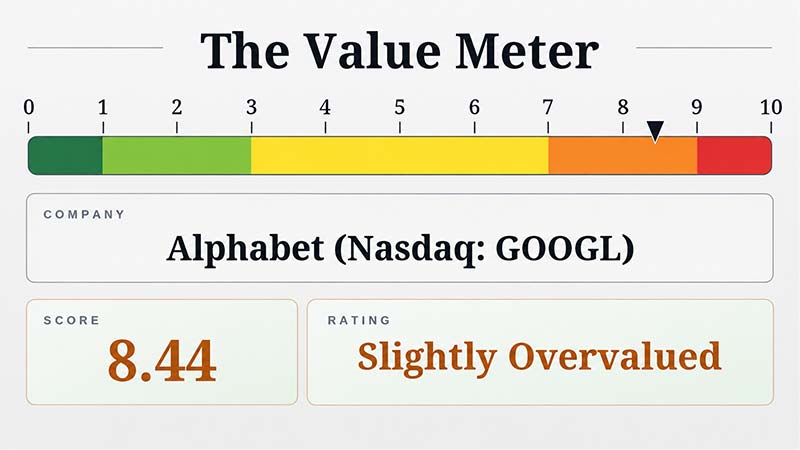
The Value Meter rates Alphabet as “Slightly Overvalued.”
What stock would you like me to run through The Value Meter next? Post the ticker symbol(s) in the comments section below.