

If you take an economics class, one of your first lessons is the law of supply and demand.
This law explains a lot of business patterns that investors can take advantage of.
Take the memory chip business as an example. When demand rises, chipmakers sell more chips at higher prices. They even build new plants to keep up with that demand. But when an abundance of new supplies arrives, prices can suddenly fall, taking profits with them.
Micron Technology (Nasdaq: MU) has lived through that cycle many times. It makes memory chips used in phones, computers, and data centers.
AI systems need vast amounts of fast memory, and Micron is now selling into a boom unlike any it has seen before.
In fiscal 2026, which ended on September 3, its revenue climbed to $133.2 billion from $37.4 billion a year earlier. Its gross profit margin reached 80.7%. That means that after the direct costs of making its products, Micron kept more than $0.80 from each dollar of sales.
Those are striking numbers for an industry that’s accustomed to sharp price swings.
Micron hopes this boom will last as long as possible. It has signed multiyear deals that require customers to buy set volumes of memory. Most of these strategic deals include price ranges, which may help protect Micron if market prices fall.
That matters because the supply/demand cycle has not gone away. Meeting today’s demand takes new factories and costly equipment.
Micron expects to spend about $25 billion on plants and equipment in just the first half of fiscal 2027 − and even more in the second half.
If demand holds up, that added capacity could pay off.
If supply outruns demand, the same expansion could put pressure on prices. Contracts offer some protection, but they may not be enough during a deep slump.
Investors have good reasons to value Micron more highly than they once did. The question is how much of that brighter future the stock price already reflects.
I designed The Value Meter to answer that question.
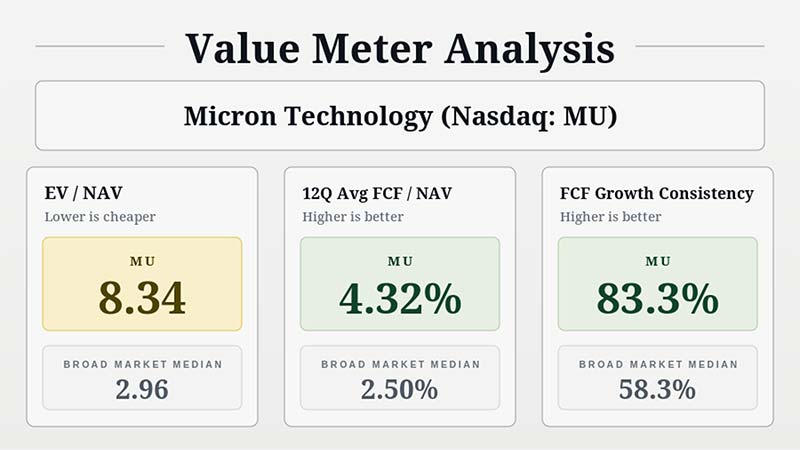
Currently, my model detects a clear premium. Micron’s enterprise value is 8.34 times its net asset value, or NAV, which is assets minus liabilities.
The median stock in our universe trades at just 2.96 times NAV, while the technology sector median is 4.55.
Micron doesn’t look like a bargain based on its assets alone. Yet its cash record makes the premium easier to defend.
Over the past 12 quarters, its average quarterly free cash flow equaled 4.32% of its NAV. The universe median is 2.50%, while the technology sector median is 3.61%.
Micron’s cash flow also improved year over year in 10 of the past 12 quarters. That’s a rate of 83.3%, compared with 58.3% for both the broad universe and the technology sector.
Micron has shown strong cash output across a longer period. There’s no guarantee that memory prices will stay high, but the company’s new contracts may make the next downturn less painful.
For now, the model sees enough cash strength and steady improvement to outweigh a steep price.
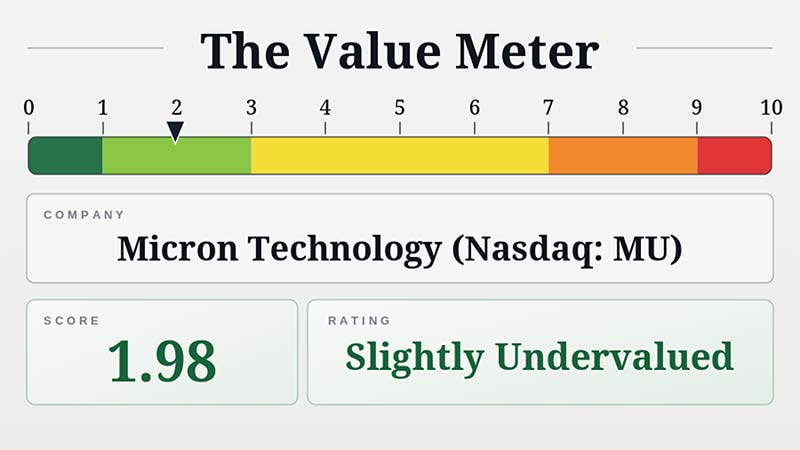
The Value Meter rates Micron Technology as “Slightly Undervalued.”
What stock would you like me to run through The Value Meter next? Post the ticker symbol(s) in the comments section below.