
With oil prices around $100 a barrel, it’s hard to imagine that an oil giant like Chevron (NYSE: CVX) would have a hard time continuing to pay its dividend.
The company pays $1.78 per share quarterly, which comes out to a 3.2% yield.
Can shareholders confidently expect that level of payout to continue?
Last year, with oil prices ranging between around $60 and $80 a barrel, Chevron generated $16.6 billion in free cash flow. That was up from $15.0 billion the year before but down 56% from 2022, when Chevron’s free cash flow was $37.6 billion. That was the year when oil prices spiked to their highest level since 2007.
The reason I bring up 2022 is that Safety Net considers one-year and three-year free cash flow growth in its calculation.
Since three-year free cash flow growth was negative, Chevron’s dividend safety rating is penalized.
Furthermore, last year’s payout ratio was too high.
Chevron paid shareholders $13.1 billion in dividends, or 79% of free cash flow. Anything above 75% is a concern. That means there is not a comfortable buffer to ensure that free cash flow can cover the dividend in a down year.
If free cash flow were to fall again this year, the company may have to make some tough choices about how to pay the dividend, including whether to use cash on hand, borrow money, or, dare I say it, cut the dividend.
Fortunately, that is unlikely to happen to Chevron − at least anytime soon.
With oil prices soaring, this year’s free cash flow total is projected to explode to $39.5 billion. Dividends paid are estimated to be $13.4 billion. Even though the company will pay out more in dividends, because of the huge leap in cash flow, the payout ratio will fall to a very comfortable 34%.
Chevron is a Perpetual Dividend Raiser, having raised its dividend every year since 1990. Somehow, that doesn’t seem that long ago, but that was the year the Gulf War began, East and West Germany reunified, and Nelson Mandela was freed from prison. So it’s been a little while.
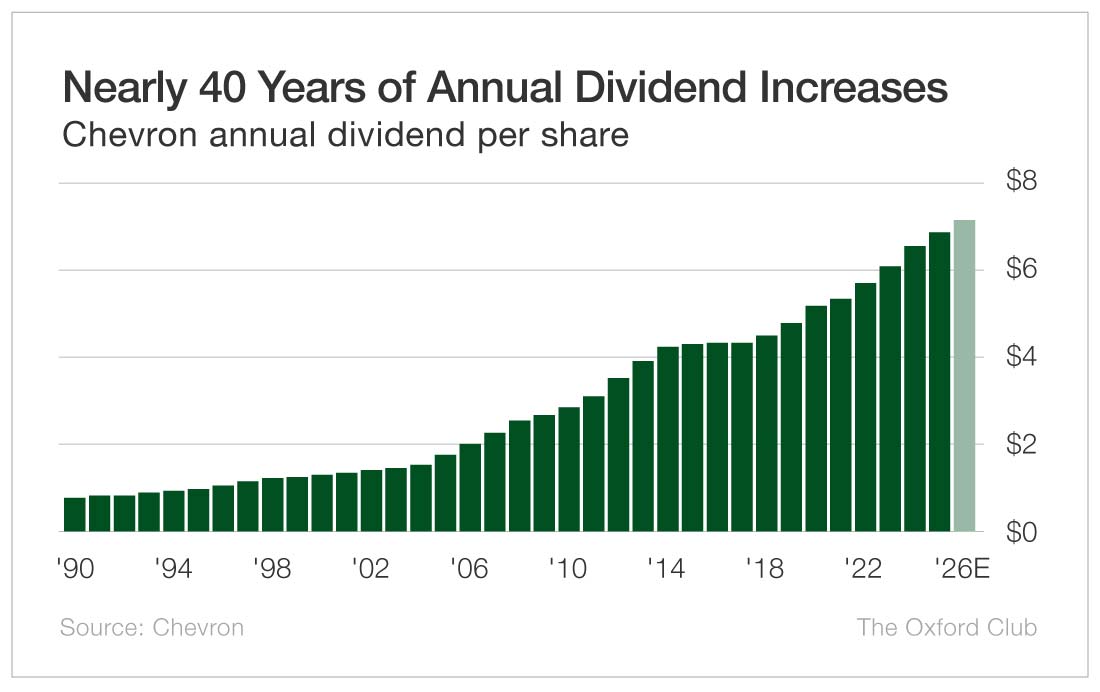
The only blemishes on Chevron’s record are the decline in free cash flow since 2022 and a slightly-too-high payout ratio last year.
But with cash flow surging now and a nearly four-decade track record of annual dividend increases, the risk of a dividend cut is low. In fact, it’s safe to assume that the dividend will continue to increase in the coming years.
Dividend Safety Rating: B

What stock’s dividend safety would you like me to analyze next? Leave the ticker in the comments section.
You can also take a look to see whether we’ve written about your favorite stock recently. Just click on the word “Search” at the top right part of the Wealthy Retirement homepage, type in the company name, and hit “Enter.”
Also, keep in mind that Safety Net can analyze only individual stocks, not exchange-traded funds, mutual funds, or closed-end funds.