

Meta Platforms (Nasdaq: META) has spent years asking investors to believe in big bets. Not long ago, it was the metaverse. Now, it is artificial intelligence.
The company launched its new AI agent, Muse, last month. Within two weeks, it had 2.8 million downloads and topped the free-app charts in the U.S. and Canada.
Meta shares jumped nearly 13% in one week as investors warmed to the idea that AI could become a new source of growth.
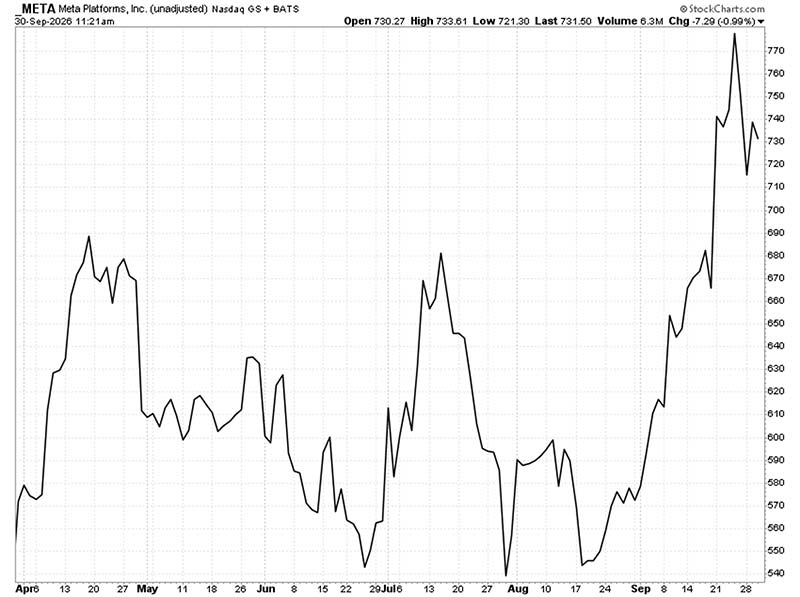
It’s a compelling story in light of Meta’s business strength.
In the second quarter, revenue rose 28% from a year ago to $60.8 billion. Revenue from advertising, which is the heart of Meta’s business, jumped from $46.6 billion to $59.4 billion.
That gives Meta a powerful cash engine and room to make huge AI bets. But lately, those bets have gotten expensive.
Free cash flow fell to just $784 million during the quarter, even though operating cash flow was $31.9 billion. That means Meta spent $31.1 billion on capital projects in the second quarter alone. Management now expects total 2026 capital spending of $130 billion to $145 billion.
That tension between Meta’s growth potential and its spending shows up in The Value Meter’s analysis of the stock.
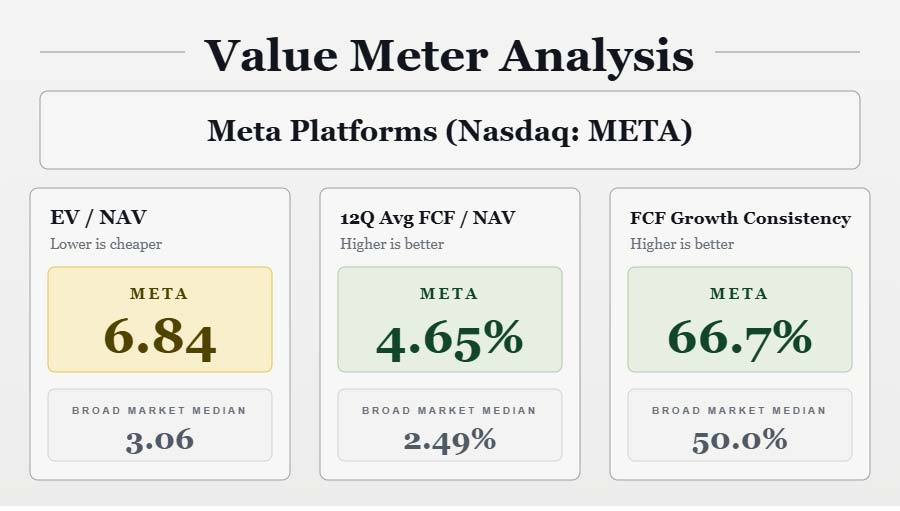
Meta’s enterprise value-to-net asset value ratio, or EV/NAV, is 6.84. The median stock in our universe sits at 3.06, so Meta looks twice as expensive as the typical stock.
However, its average quarterly free cash flow-to-NAV over the past 12 quarters is 4.65%, versus a median of 2.49%. In other words, Meta produces 86% more cash from its net assets than a normal company would.
Meta also has a better cash flow growth trend than most companies. Free cash flow was up from the previous year in 66.7% of the quarters we measured. The market median is 50%.
So while the stock carries a clear asset premium, the business has backed up much of that premium with strong cash production.
The risks are still real. AI spending could stay high for years, and Muse and Meta’s other AI products still need to prove they can earn enough money to justify that spending.
The company’s Reality Labs segment also continues to lose billions, and legal, privacy, and safety issues can bring added costs.
That being said, the numbers do not point to an overvalued business.
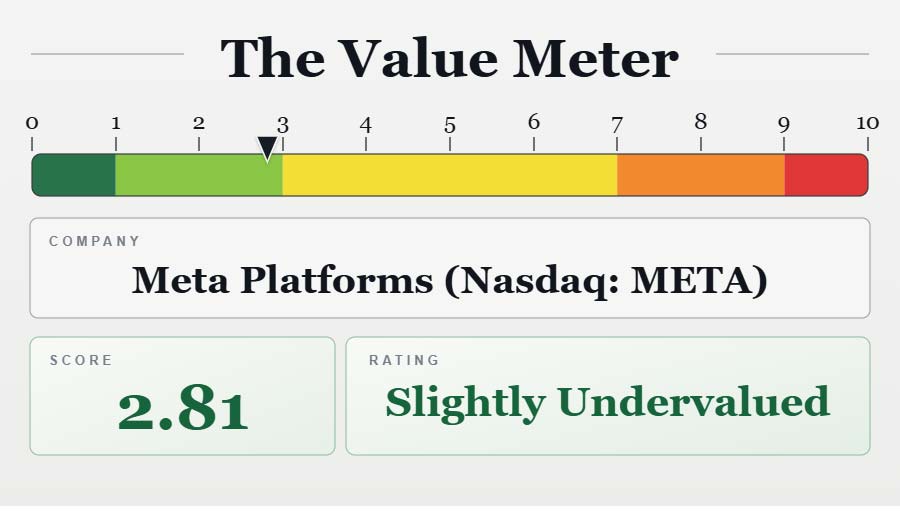
The Value Meter rates Meta Platforms as “Slightly Undervalued.”
What stock would you like me to run through The Value Meter next? Post the ticker symbol(s) in the comments section below.