
It’s no secret that President Trump is not a fan of Canada.
Perhaps he got burned owning the Great White North’s largest telecom company, BCE (NYSE: BCE), as the share price has fallen hard from its high in 2022.
But the president will be retired in a few years, and he should be thinking about dividend income going forward.
Is BCE’s juicy 5.8% yield safer than its share price has been?
BCE is also one of Canada’s largest retailers, with more than 7,000 points of distribution across the country. Like its American peers, BCE provides phone, TV, internet, and a variety of other services to residences and businesses.
BCE was launched when Alexander Graham Bell received a patent in Canada and transferred 75% of the rights to his father, who founded Canada’s first telephone company in 1877.
Fast-forward nearly a century and a half, and BCE grew free cash flow by 6.5% to 3.3 billion Canadian dollars in 2025. It paid out CA$2.2 billion during the year for an acceptable payout ratio of 66%. Anything below 75% is within my comfort zone.
This year, however, could be a problem.
Free cash flow is forecast to plummet to CA$2.2 billion, as earnings and revenue are projected to fall. Dividends paid are expected to dip as well to CA$2 billion, but that’d still be a 91% payout ratio.
That’s too high.
Furthermore, a dramatic decline in free cash flow would mean that the three-year growth rate would be negative. Safety Net penalizes companies for negative growth over one and three years. The idea is that the three-year growth rate is a longer-term indication of the direction of cash flow and weeds out any anomalies.
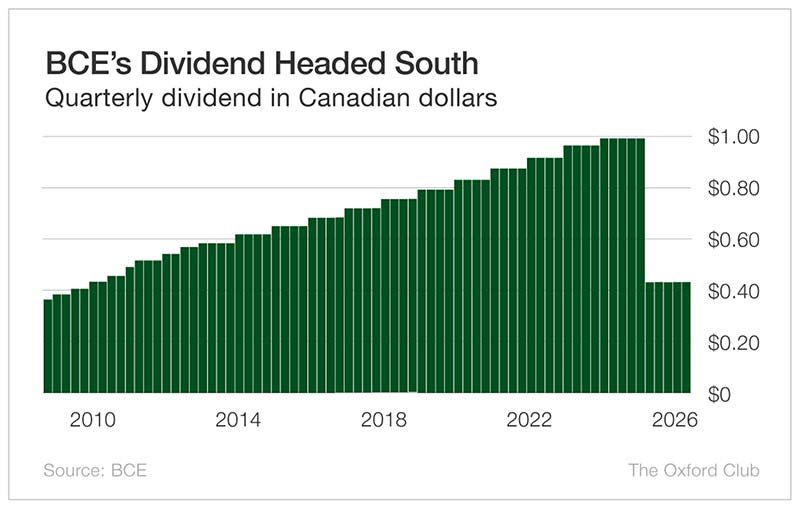
Until last year, the company had raised its dividend every year since 2009. That was 17 straight years of dividend increases.
However, likely in anticipation of the drop in free cash flow, management slashed the quarterly dividend in the middle of last year by more than half, from CA$0.9975 to CA$0.4375.
Also, keep in mind that BCE is a Canadian company whose shares trade as American depositary receipts (ADRs) in the U.S. That means the payout will fluctuate a little for American investors based on currency exchange rates.
The good news is that free cash flow is expected to grow 54% in 2027 to CA$3.4 billion and to more than CA$4 billion in 2028.
BCE is a company in flux.
Free cash flow will likely slide this year, the one- and three-year growth rates are negative, and the company just cut the dividend, so the dividend cannot be considered safe.
If free cash flow does in fact recover, it wouldn’t surprise me to see dividend increases that could take the yield up over 6% on today’s prices in the future. However, that’s a big if at this moment.
Dividend Safety Rating: F

What stock’s dividend safety would you like me to analyze next? Leave the ticker in the comments section.
You can also take a look to see whether we’ve written about your favorite stock recently. Just click on the word “Search” at the top right part of the Wealthy Retirement homepage, type in the company name, and hit “Enter.”
Also, keep in mind that Safety Net can analyze only individual stocks, not exchange-traded funds, mutual funds, or closed-end funds.