

Several years ago, I read a book on how to survive disasters. In addition to keeping a cool head, which the author admits is easier said than done, one of the most important factors leading to survival was the simple act of knowing where the exits were.
Even though I’m guilty of reading my book or watching Netflix on my tablet while the flight attendant teaches passengers how to fasten their seatbelts or put on an oxygen mask, I do look around to make sure I know where the exits are. It’s one of the first things I do when I check into my room at a hotel too – especially because I have a friend who survived a hotel fire for that exact reason.
I do the same with my stock investments. I don’t start considering my exit strategy when the spit hits the fan and my emotions may be running hot. As soon as my buy is completed, I note the conditions in which I will sell.
For some stocks, particularly short-term trades, I use technical analysis. Specifically, I look at where the stock has support and resistance. (These are price levels that a stock has traditionally had a difficult time breaking below or above.)
For example, here is a chart of the price of gold over the past year.
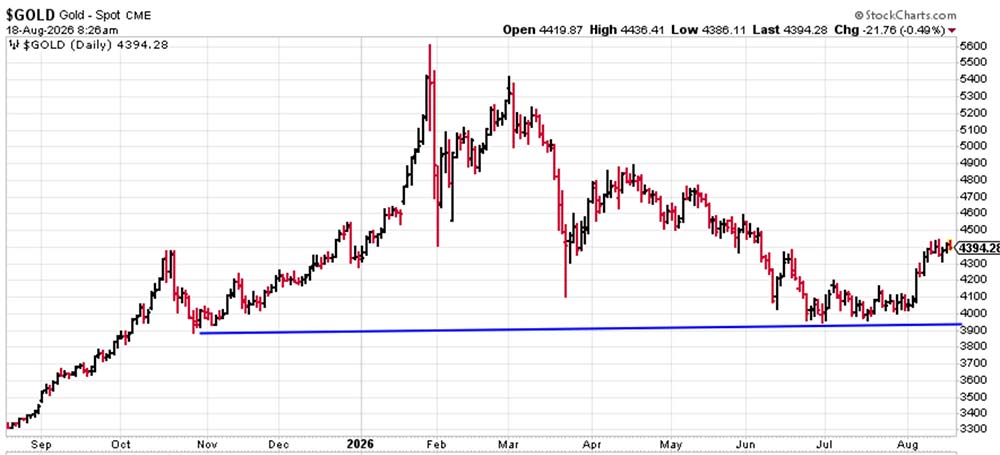
You can see that ever since gold fell to around $3,900 last October, it has rebounded every time it’s gotten near that level again. That is called support.
If gold broke below $3,900, that would be a significant change, and I’d expect it to go lower. If I owned gold as a short-term trade, my plan would be to sell if it traded down to about $3,780, which is 3% below the support level. Generally, a drop to 3% below support represents a meaningful break of that support.
Another strategy is to use a stop.
A stop is an order you set with your broker to automatically sell your stock if it hits a certain price level. You should place the stop order right after you’ve bought the stock. That way, your sell order is placed when you are rational and unemotional. If the stop is hit, you’re out and you don’t have to justify why you should stay in.
We use a stop on many of our positions here at The Oxford Club (Wealthy Retirement‘s publisher). Depending on the strategy, we may raise the stop as the stock climbs in order to protect our profits. We also sometimes use a trailing stop, which means the stop rises automatically along with the stock price.
Emotions are a trader’s and investor’s worst enemy, and stop orders eliminate emotion from the decision to sell.
If you’re invested in a stock for purely fundamental reasons – meaning you love the company’s business – then you should have parameters in mind for whether you would sell if the business changes.
For example, perhaps you buy a stock for dividend growth and that growth is supported by cash flow that has been increasing 10% per year. You may decide that if cash flow growth is flat or negative for two years in a row, you’re done with the stock.
In that event, you’d keep a close eye on the company’s earnings reports. If cash flow went in the wrong direction, you’d sell and move on to a better opportunity.
The important thing is to have your sell decision in place at the time you buy the stock so you aren’t paralyzed with fear if the stock tumbles.
It’s easy to come up with an excuse for why you should hold on even as the stock is dropping. But if you’ve made a rational decision weeks, months, or even years earlier, you’re more likely to survive the disaster.
What are the best lessons you’ve learned about decision-making in investing? Post them in the comments below.
Best thing I learned is to have trailing stops , when I was younger I held GE , Transocean, and some other offshore drilling stocks. All paid good dividends, but for anyone old enough to remember the the blow up at GE or the disaster in the gulf , believe me. I learned a very hard lesson from that . CYA , cover your ass.
It is Okay to buy stocks on a parabolic rise as long as you reset your stops along the way.
Don’t be too greedy . . . but, a little greedy is ok.
BRK-B is still going down
Finally, Oxford has agreed to use supply/resistance to determine sell/stop loss. I have been resistant to use a standard 25% stop loss. I relay on breaking support. Saved me some $ in this past decline. Of course, INVESTORS Business Daily uses a standard 8% loss. Also harsh.
Buy healthy companies and hold on unless conditions change. The economy expands and contracts for various reasons. Stay informed to lessen anxiety!
Embarrassing, I have made the same error several times, forgoing discipline, falling in love with a stock/concept, and thinking that I was actually an owner of the company and not just the owner of a tradable security. The idea that a hypothesis is either “early” or “wrong” is inaccurate, since the market dictates that they are both “wrong”
Marc, this is a question rather then a coment. Is there a way to set a closing stop in a brokerage account such as Schawb?
I don’t believe so. I set alerts. If the alert is triggered, I know to check to see if it closed at or below that level.