

T. Rowe Price (Nasdaq: TROW) manages $1.8 trillion for clients and offers more than 100 mutual funds and ETFs.
The stock sports a generous 5% yield. Let’s see if that yield is likely to be maintained.
T. Rowe Price generated $1.5 billion in free cash flow in 2025, which was a 17% increase over 2024. However, the three-year growth rate was negative, as the company’s free cash flow totaled $2.1 billion in 2022.
The Safety Net model penalizes a company if its free cash flow growth is negative over one- and three-year periods, so T. Rowe Price’s three-year growth rate causes a downgrade.
The asset manager gets another downgrade because free cash flow is forecast to decline to $1.4 billion this year. If free cash flow comes in higher than last year’s figure, that penalty will be removed, but we won’t see the 2026 results for about a year.
In 2025, the company paid shareholders $1.1 billion for a payout ratio of 77%. That is just above the 75% cutoff, so the stock gets whacked with another downgrade.
This year, with cash flow expected to decline, the payout ratio is projected to increase to 82%, pulling further away from the comfort zone. That’s another downgrade.
The good news is that T. Rowe Price has raised its dividend every year for an impressive 40 years.
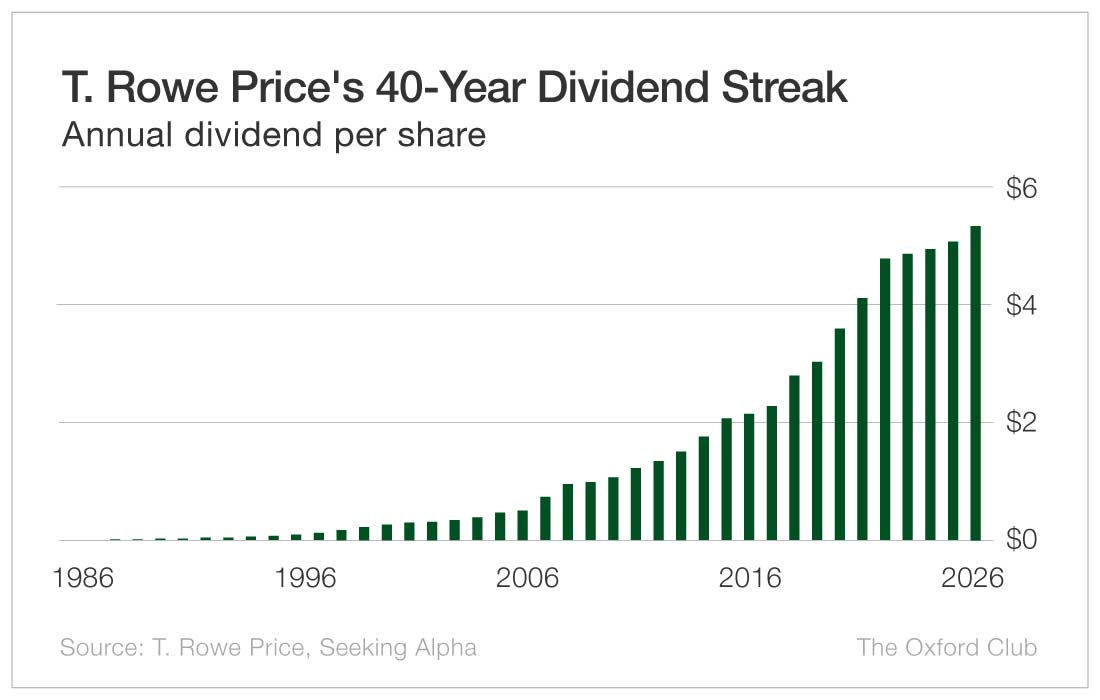
Management clearly takes its dividend-raising history seriously.
In 2023, dividends paid exceeded free cash flow, and the same thing nearly happened again in 2024. Yet the company continued to raise the dividend (though only by $0.02 in order to keep the streak alive).
The financials say the dividend is at risk. Management’s actions when it comes to boosting the dividend say otherwise.
If T. Rowe Price can get back to positive free cash flow growth, that will take some of the pressure off of the dividend rating. If not, management will have some tough decisions in the future.
I don’t expect a cut right away, but at this point, the dividend cannot be considered safe.
Dividend Safety Rating: D

What stock’s dividend safety would you like me to analyze next? Leave the ticker in the comments section.
You can also take a look to see whether we’ve written about your favorite stock recently. Just click on the word “Search” at the top right part of the Wealthy Retirement homepage, type in the company name, and hit “Enter.”
Also, keep in mind that Safety Net can analyze only individual stocks, not exchange-traded funds, mutual funds, or closed-end funds.
Lowe’s and Pepsi
Venom
UPS