
It’s easy for income investors to be attracted to Ellington Financial (NYSE: EFC) and its big 13% yield.
Even better, the company pays dividends monthly.
But can shareholders depend on this eye-popping yield to be paid indefinitely into the future?
Ellington Financial is a mortgage real estate investment trust, or REIT, that has been around for more than 30 years. It invests in both commercial and consumer mortgages in underserved markets. One of its founders, Mike Vranos, who’s currently the co-chief investment officer, was at one time considered the best-known mortgage-bond trader on Wall Street.
Mortgage REITs borrow money short-term and lend it out longer-term. The money they make is called net interest income (NII).
The good news is Ellington’s net interest income is moving in the right direction. In 2025, the company generated $190 million in NII, up 39% from the year before. NII is forecast to grow another 5% to $200 million this year and continue higher over the next couple of years.
Ellington paid shareholders $184 million in dividends in 2025, or 97% of its NII. Mortgage REITs have to pay out 90% or more of their profits by law, so I’m fine with any payout ratio that is below 100%.
The payout ratio is forecast to rise to 98% in 2026. It’s approaching my 100% threshold but is not expected to break it this year.
Here’s where there’s a problem…
Ellington Financial is a serial dividend cutter. There have been four dividend reductions in the past 10 years – five if you group the payouts on a quarterly basis. In other words, when the going gets tough, Ellington shareholders receive lower dividends.
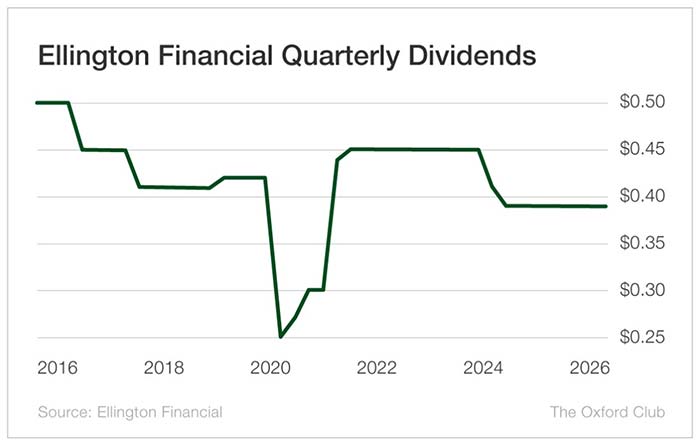
The company reduced its quarterly dividend from $0.50 to $0.45 in late 2016, then again to $0.41 about a year later.
It switched to a monthly dividend in 2019. Then, during the early days of the pandemic, it slashed the payout nearly in half from $0.15 to $0.08.
The most recent cut came in March 2024 – from $0.15 per month to $0.13.
As you can see, management is not shy about taking the hatchet to the dividend.
If Ellington Financial is able to continue to grow NII as Wall Street expects, the dividend should be fine. But if there is any downturn, management has shown it is very willing to reduce the payout to shareholders – and they’ll do it quickly, as evidenced by the cut in April 2020, just a few weeks after the pandemic began shutting things down.
During the good times, investors should continue to receive the current level of dividends. The minute things aren’t as rosy, expect a dividend cut.
The dividend is not safe.
Dividend Safety Rating: F

What stock’s dividend safety would you like me to analyze next? Leave the ticker in the comments section.
You can also take a look to see whether we’ve written about your favorite stock recently. Just click on the word “Search” at the top right part of the Wealthy Retirement homepage, type in the company name, and hit “Enter.”
Also, keep in mind that Safety Net can analyze only individual stocks, not exchange-traded funds, mutual funds, or closed-end funds.
Marc, I don’t understand why you continue to publish stocks with high dividend yield and an “F” for dividend reliability. I would rather have recommendations than “non-recommendations”