

Private credit funds are in the spotlight these days, as concerns about software companies meeting their obligations have picked up lately.
Cion Investment (NYSE: CION) is a business development company, or BDC, that lends money to privately held businesses. It doesn’t list what percentage of its portfolio is made up of technology or software companies. Business services, which may contain those types of companies, is the largest percentage of the portfolio at 17%.
For this analysis of dividend safety, I’m not going to assume those loans are in trouble, as the company has not given any indication that they are.
Cion has 91 companies in its portfolio, and 80% of the loans are first-lien senior secured, which means they are first in line to get paid and the loans are backed by collateral.
The company recently switched from a quarterly dividend to monthly. It pays $0.10 each month, which comes out to a 14% yield.
Can Cion continue to generate such a large yield for its shareholders?
The company will likely report fourth quarter 2025 results in mid-March. In 2024, Cion generated $96 million in net investment income – down from $105 million the prior year. (Net investment income is our cash flow measure for BDCs.) It paid out $89.5 million in dividends.
Through the first three quarters of 2025, Cion paid investors $59.5 million, while net investment income totaled $74.8 million. That was down from $77.2 million in the first three quarters of 2024.
The payout ratios for both years are below my 100% threshold for BDCs, which is encouraging. But it’s not a great sign that net investment income was lower through the first three quarters of 2025 and was down for the full year in 2024.
There are no net investment income estimates for 2025 or the next few years, but there are earnings per share estimates. While earnings are not the same as net investment income, they give us an indication of where the business may be headed.
And it’s not good.
In 2025, earnings are forecast to have dipped 2%, but in 2026 and 2027, they are projected to drop 25% and 21%, respectively. Should that occur, net investment income will probably be lower as well.
When Cion changed to a monthly dividend in 2026, it reduced the payout from $0.36 per quarter to $0.10 per month (or $0.30 quarterly).
It also briefly eliminated the dividend during the pandemic.
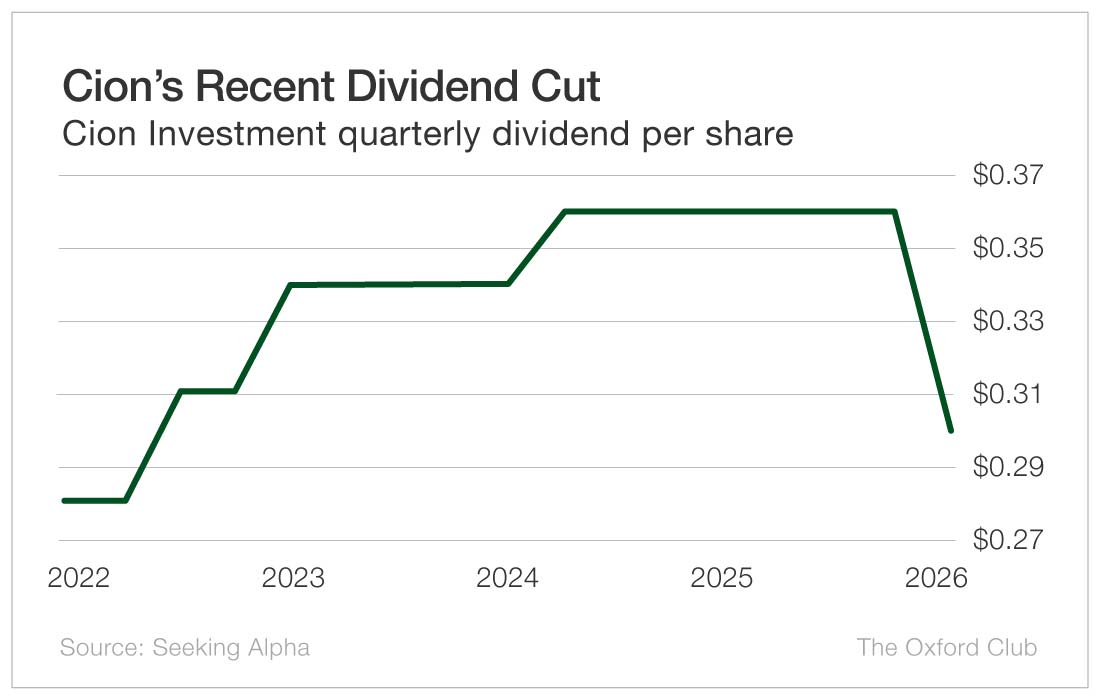
Considering that net investment income has been going the wrong way, earnings are projected to fall significantly, and the company cut the payout to shareholders twice in the past six years, the dividend cannot be considered safe.
Dividend Safety Rating: F

What stock’s dividend safety would you like me to analyze next? Leave the ticker in the comments section.
You can also take a look to see whether we’ve written about your favorite stock recently. Just click on the word “Search” at the top right part of the Wealthy Retirement homepage, type in the company name, and hit “Enter.”
Also, keep in mind that Safety Net can analyze only individual stocks, not exchange-traded funds, mutual funds, or closed-end funds.
please review OFLX
i would like to see an analysis on Rayonier, Inc (RYN)
BXSL
Please review Chatham Lodging Trust – CLDT.
I would like to see an analysis of ARCC, thank you
Can you discuss Carlyle Secured Lending?
Trinity —Trin
Hey Mark, is PBT still a good investment? Considering the petition filed to get rid of the 2/3 majority vote issue.
I would appreciate your analysis of MSIF.
Mark – I generally appreciate your work and subscribe to one of your letters. However, you recently gave an “F” rating to KMI when it had a 26-handle, and I sold it because of that. In the interim, it’s run up to 33, and I’ve seen several bullish articles about it’s go-forward prospects. I guess that I don’t understand what motivates your grading system. Am I missing something or did you miss something? TIA.
Hi Dom, thanks for reading – and good question. The important thing to keep in mind here is that the goal of the Safety Net model isn’t to predict a stock’s future price movements; it’s to evaluate the safety of the company’s dividend using criteria like free cash flow growth, payout ratio, and dividend history. So Marc’s “D” grade for Kinder Morgan in September wasn’t a prediction that the stock would perform poorly. It was an indication that investors may not be able to rely on the company’s dividend because it could have a high risk of being reduced. I hope that helps – let us know if you have any further questions!
QDTE
Applied Materials, Inc. (AMAT)
The SP of CION has fallen from $11.99 in March 2025 to $8.64 now, a drop of 28%!!! UGH!!! What a dog!! I got out in October 2025 at $9.27. I saw the writing on the wall back then.
Can you look at this company PAA Plains all American
Thank you
I would like to see a revies of Trinity Capital Income (TRIN)
o
ZIM
ZIM is being acquired for $35 per share in cash.
AIPI