

DocuSign (Nasdaq: DOCU) helped change how businesses sign contracts. Instead of printing, signing, and mailing documents, customers could complete the process online.
Now the company wants to do much more.
Its Intelligent Agreement Management (IAM) platform uses artificial intelligence to help businesses review contracts, find key terms, and manage agreements. The goal is to turn a simple signing tool into a larger software platform.
The new strategy is gaining traction. In its fiscal second quarter, DocuSign’s revenue rose 9% to $875.7 million. IAM grew to account for 15.1% of annual recurring revenue, up from 12.6% just three months earlier.
Still, the company’s most impressive results came from cash generation.
Quarterly free cash flow jumped 36% to $295.8 million, giving DocuSign an excellent free cash flow margin of 34%. That means it kept roughly $0.34 in cash from every dollar of revenue after capital spending.
These figures suggest DocuSign is doing more than finding new ways to grow. It’s also becoming a more productive business.
But does that make the stock attractive?
That’s where The Value Meter comes in.
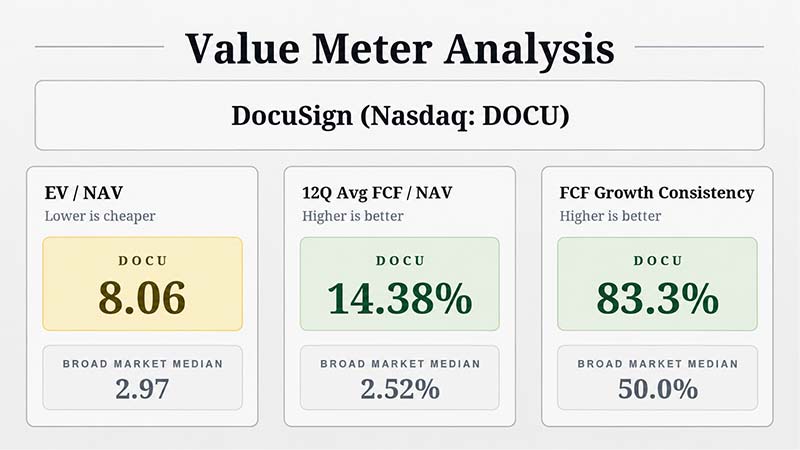
DocuSign’s enterprise value-to-net asset value (EV/NAV) ratio stands at 8.06, well above the broad market median of 2.97 and the technology sector median of 4.46.
Investors are paying a steep premium for the company’s assets, but its cash generation tells a much more appealing story.
DocuSign’s average quarterly free cash flow-to-net asset value (FCF/NAV) over the past three years is 14.38%, compared with the broad market median of 2.52% and sector median of 3.60%.
In other words, DocuSign generates far more cash from its net assets than the typical company.
That cash generation has also been remarkably steady. Free cash flow improved from a year earlier in 10 of the past 12 quarters, giving DocuSign a consistency rate of 83.3%. That compares with 50% for the broad market and 58.3% for the sector.
These numbers help explain why DocuSign stands out despite its high asset valuation. Its software business produces substantial cash without requiring heavy spending on physical assets.
As with any investment, there are risks. Revenue is growing at a modest pace, and DocuSign still needs to prove that its AI tools can drive faster growth.
But the company doesn’t need explosive growth to make a strong case for itself. Its ability to produce cash is already well established.
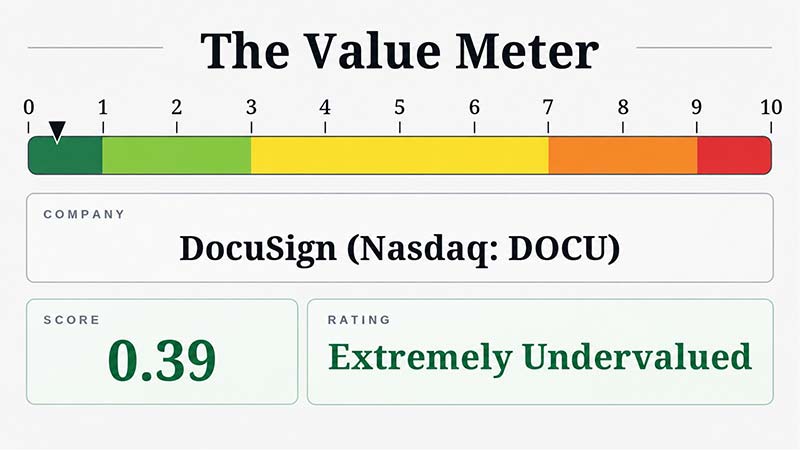
For now, DocuSign’s robust and consistent cash generation more than offsets its expensive asset valuation in our model.
The Value Meter rates DocuSign as “Extremely Undervalued.”
What stock would you like me to run through The Value Meter next? Post the ticker symbol(s) in the comments section below.