
Rivian Automotive (Nasdaq: RIVN) was once called a “Tesla killer.”
These days, it’s one of several automakers trying to build a lasting business in the electric vehicle market Tesla helped bring into the mainstream.
That’s not a knock on Rivian. It has found buyers for its electric trucks and SUVs, and its new, lower-priced R2 SUV gives it a chance to reach far more people.
In fact, Rivian delivered 19,248 vehicles in the third quarter, which was a company record and 46% more than a year ago. Wall Street had expected about 18,000.
So why did the stock fall on the news?
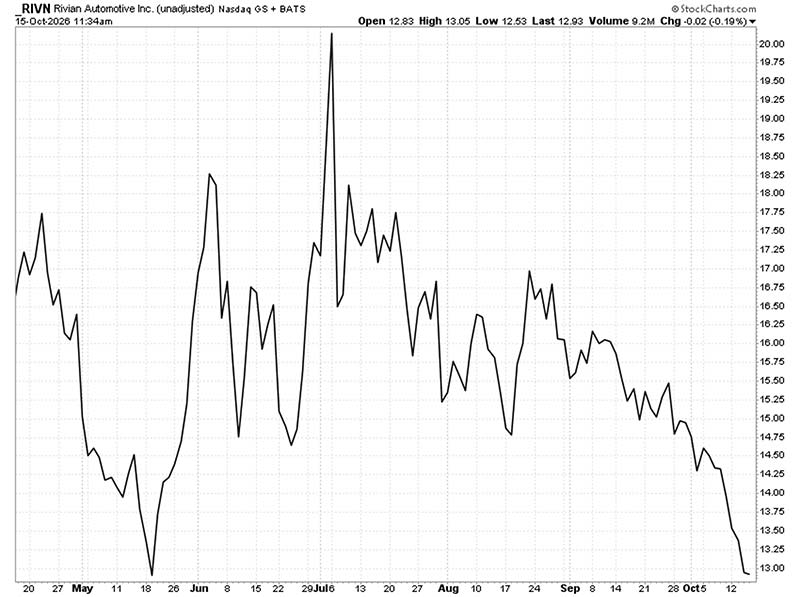
Rivian stuck with its full-year forecast of 65,000 to 70,000 deliveries. Investors had hoped the strong quarter would lead to a higher target.
The latest delivery figures suggest Rivian’s growth plans are gaining ground. But we’ll have to wait for full third quarter results at the end of the month to see what that growth means for the company’s bottom line.
For now, last quarter’s results tell a mixed story. In the second quarter, revenue grew 27% year over year to $1.66 billion, and Rivian reported $179 million in gross profit.
That’s promising. Until you look closer.
All of that profit came from software and services, including the company’s work with Volkswagen. The vehicle business itself still lost $36 million at the gross profit level. Free cash flow was -$849 million, well below the -$398 million figure from a year ago.
In short, selling more cars hasn’t fixed Rivian’s biggest problem: It still burns through cash.
The question is… with shares down more than 35% since their July high, does the company’s potential justify its current stock price?
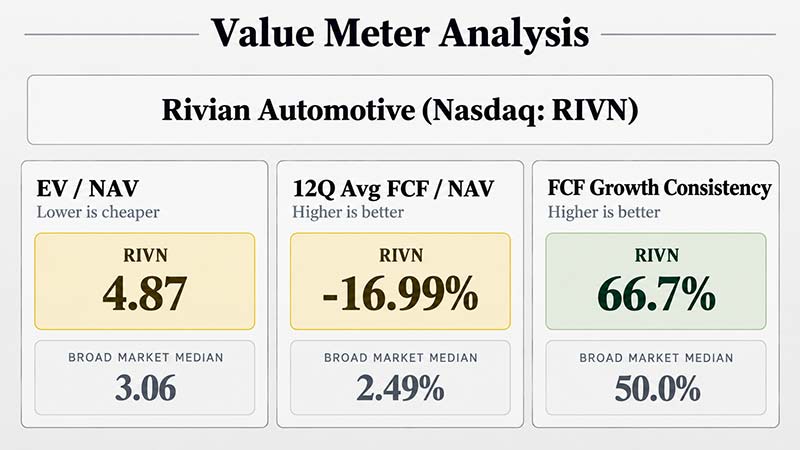
Rivian’s enterprise value-to-net asset value ratio, or EV/NAV, is 4.87. (NAV is what’s left of a company’s assets after subtracting its liabilities.) The broad market median sits at 3.06, while the consumer cyclical, or consumer discretionary, sector median is at 3.2.
Investors are paying a clear premium for Rivian’s net assets. Given its growth potential, that’s not unreasonable if the business is generating enough cash.
It’s not, though.
Over the past 12 quarters, Rivian’s average quarterly free cash flow is -17.0% of its NAV. The median stock in our universe is at 2.5%, while the sector median is 3.1%.
That makes Rivian one of the worst performers on this measure over the 2 1/2 years I’ve been writing this column.
Now, Rivian does perform better than the market on one measure that matters to us. Free cash flow has risen year over year 67% of the time over the past three years against a 50% broad market median.
That’s encouraging until you recognize that a smaller cash loss still counts as an improvement. It isn’t the same as producing cash.
A new $1 billion loan from Volkswagen gives Rivian more room to grow. Still, R2 sales need to rise, production costs need to fall, and the company must find a path to funding itself.
For now, investors seem to be paying a premium for results Rivian has yet to deliver.
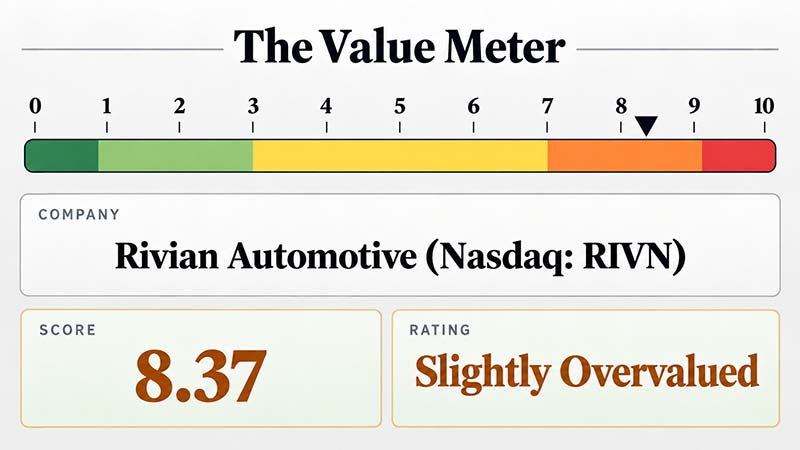
The Value Meter rates Rivian Automotive as “Slightly Overvalued.”
What stock would you like me to run through The Value Meter next? Post the ticker symbol(s) in the comments section below.
IIPR, NLY.
Thanks