
AT&T (NYSE: T) has spent the past few years getting back to basics.
After years of trying to become a media giant, the company sold off WarnerMedia in 2022 and turned its focus back to wireless service and high-speed internet.
That shift came at a cost. AT&T cut its quarterly dividend from $0.52 to $0.2775 per share in 2022, and the payout has not increased since then.
Today, AT&T operates a simpler business. But is its dividend any safer?
Last year, AT&T generated $19.4 billion in free cash flow, up 5% from 2024. Free cash flow is the cash left over after a company pays to run and maintain its business. It’s also the money that helps fund dividends.
This year, however, free cash flow is forecast to fall nearly 7% to $18.1 billion. That decline hurts AT&T’s Safety Net rating.
The model looks at cash flow growth over both one- and three-year periods. By using both, it can spot short-term trouble and longer trends.
AT&T faces a decline in both measures this year.
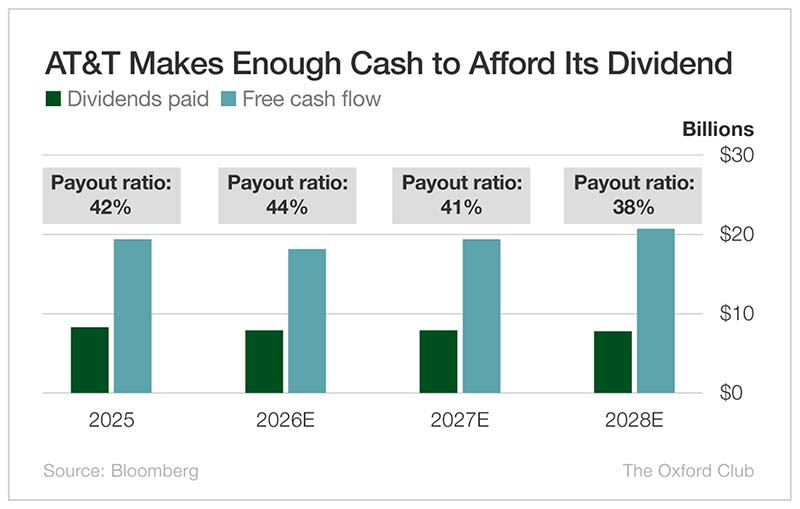
In 2025, AT&T paid shareholders $8.2 billion in dividends. That was just 42.1% of its free cash flow. This year, the company is expected to pay $7.9 billion in dividends against $18.1 billion in free cash flow.
That puts its payout ratio at 43.8%. In other words, for every $1 AT&T generates in free cash flow, it is expected to pay shareholders less than $0.44.
That’s well below Safety Net’s 75% threshold.
So even with the expected decline in cash flow, the company should have more than enough money to fund its dividend.
The outlook improves from there. Free cash flow is forecast to recover to $19.1 billion in 2027 and reach $20.7 billion in 2028. If those estimates hold, the payout ratio could fall below 38%.
That would give AT&T plenty of room to maintain its current dividend.
There’s another factor to consider, though: the reduction in the dividend in 2022 as part of the WarnerMedia spinoff, which came after 36 consecutive years of dividend raises.
We never want to see dividend cuts, but the lower payout reflected a major change in the size and focus of the business. It wasn’t simply a result of AT&T running out of cash.
Still, the cut counts against the company’s Safety Net rating, and AT&T has yet to build a new track record of annual dividend increases. Management has also said it plans to hold the annual dividend at $1.11 per share through 2028.
So where does that leave shareholders?
AT&T’s falling cash flow and past dividend cut are real marks against its record. They help explain why the stock receives a low grade. But the company has a large cash cushion above what it needs to pay its dividend each year.
I would be more concerned if cash flow kept falling or if the payout ratio began moving toward 75%.
For now, neither appears likely based on the forecasts.
AT&T’s dividend is not without risk, but its current cash flow suggests a minimal chance of a near-term cut.
Dividend Safety Rating: D

What stock’s dividend safety would you like to read about next? Leave the ticker in the comments section.
You can also take a look to see whether we’ve written about your favorite stock recently. Just click on the word “Search” at the top right part of the Wealthy Retirement homepage, type in the company name, and hit “Enter.”
Also, keep in mind that Safety Net can analyze only individual stocks, not exchange-traded funds, mutual funds, or closed-end funds.