

Investors are always attracted by high-yielding stocks and ETFs − especially now, with technology stocks getting hammered.
It’s easy to understand why someone hoping to make up for lost ground by AI stocks would seek out a massive yield.
Invesco Mortgage Capital (NYSE: IVR) invests in mortgages and, according to its website, “seeks to enable high income-oriented investors to achieve attractive risk-adjusted returns.”
Those investors have certainly received the high income they’re looking for. The stock currently yields just under 27%.
The attractive risk-adjusted returns? Not so much.
Year to date, the stock has lost 36%. Even if you add back the 27% in dividends, investors are still in the hole for the year.
Over the past five years, the stock has lost 82%.
As I always warn my readers, sky-high yields come with sky-high risk.
However, Safety Net’s job isn’t to analyze whether a stock can move higher or lower. It’s to determine the likelihood that a company can maintain its dividend.
Typically, double-digit dividends are hard to sustain. When they get into the 20s, it’s very rare for them to continue at that level.
Let’s take a look and see if Invesco Mortgage Capital is an exception.
Since the company borrows money to invest in mortgages, the important metric to look at is net interest income (NII). It’s the difference between what Invesco Mortgage Capital pays in interest and the interest it collects, minus expenses.
This proxy for cash flow determines whether the company can afford its dividend.
Last year, Invesco Mortgage Capital generated $75.4 million in NII, more than doubling its total from 2024. However, that was still 19% below what it made in 2022.
Safety Net looks at both the one- and three-year growth rate to evaluate the company’s short-term and intermediate-term trajectory.
This year, NII is forecast to dip again to $68.2 million.
So the cash flow growth rates aren’t good.
Making things worse, Invesco paid shareholders $106.9 million in dividends last year. That’s 42% more than it took in.
Dividends paid are projected to dip to $102.3 million this year, but the gap is expected to widen to 50% due to the decline in NII.
In other words, the company doesn’t generate enough cash to cover the dividend that it pays investors.
Invesco Mortgage Capital pays a monthly $0.12 per share dividend. While that 27% yield is impressive, the company’s dividend track record is atrocious.
Its most recent cut was last year, when the total dividend for the year fell from $1.60 to $1.38. This year, the total payout will likely be $1.44. In 2019, it was $18.50, so the dividend has been reduced by 92% over the past seven years.
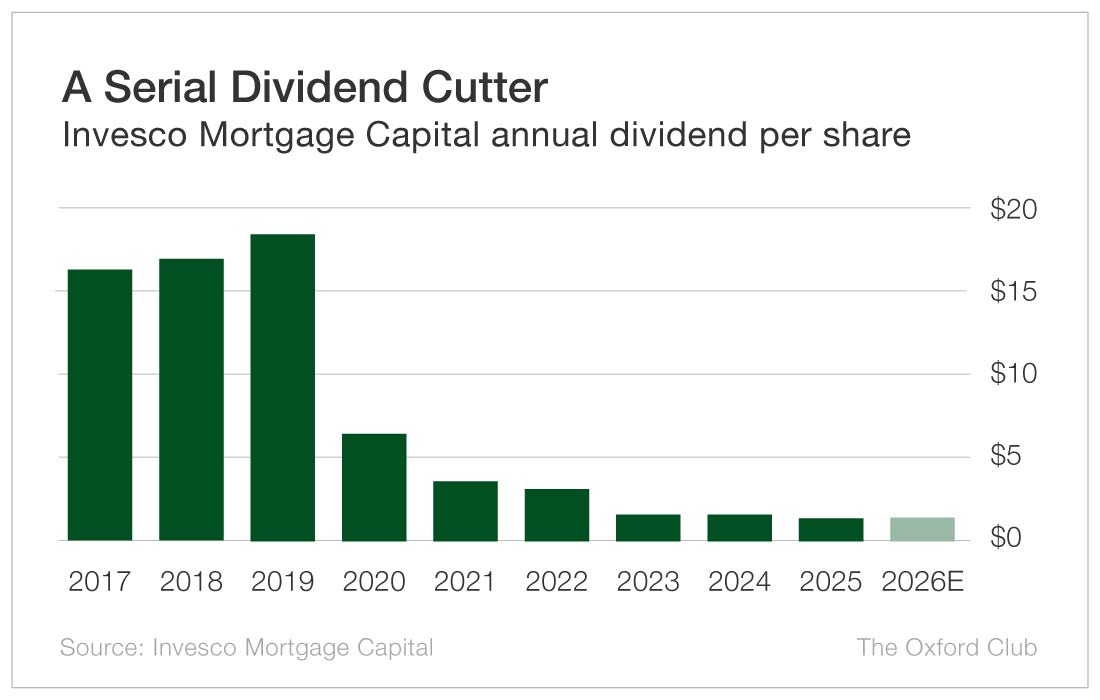
Invesco Mortgage Capital’s NII is shrinking, its dividends paid dwarf how much cash it takes in, and it has a history of regularly slashing its dividend.
Not only is the dividend at high risk of being cut in the next 12 months or so; I’d say it’s practically guaranteed.
Dividend Safety Rating: F

What stock’s dividend safety would you like me to analyze next? Leave the ticker in the comments section.
You can also take a look to see whether we’ve written about your favorite stock recently. Just click on the word “Search” at the top right part of the Wealthy Retirement homepage, type in the company name, and hit “Enter.”
Also, keep in mind that Safety Net can analyze only individual stocks, not exchange-traded funds, mutual funds, or closed-end funds.