

Walmart (NYSE: WMT) is one of those companies that hardly need an introduction.
It is the largest retailer in the world, with more than 10,000 stores and clubs across 19 countries. In the U.S., it sells just about everything people buy every week, including groceries, medicine, clothes, electronics, and household goods.
That scale is still Walmart’s biggest advantage. It can buy in huge volume, keep prices low, and put stores close to millions of customers.
But Walmart is no longer just a store. It has spent years building e-commerce, delivery, advertising, and membership businesses around that retail base. Those newer operations give it more ways to make money from the same customer.
They also help explain why investors now treat the company as more than a slow-growth retailer.
Walmart reported $187.9 billion in second quarter revenue, up 5.9% from a year ago. Global e-commerce sales rose 23%, while U.S. e-commerce grew 24%.
Advertising was even stronger. Walmart’s global ad business climbed 38%, and Walmart Connect, its U.S. ad platform, grew 43%. Global membership fee revenue increased 17%.
The core retail business kept growing too, with U.S. comparable sales rising 2.6%. That was positive, but slower than investors had hoped.
The broad picture is still solid. Walmart is growing sales, gaining more business online, and building higher-margin operations around advertising and membership.
The question is whether the stock price already reflects too much of that progress.
That is where The Value Meter comes in.
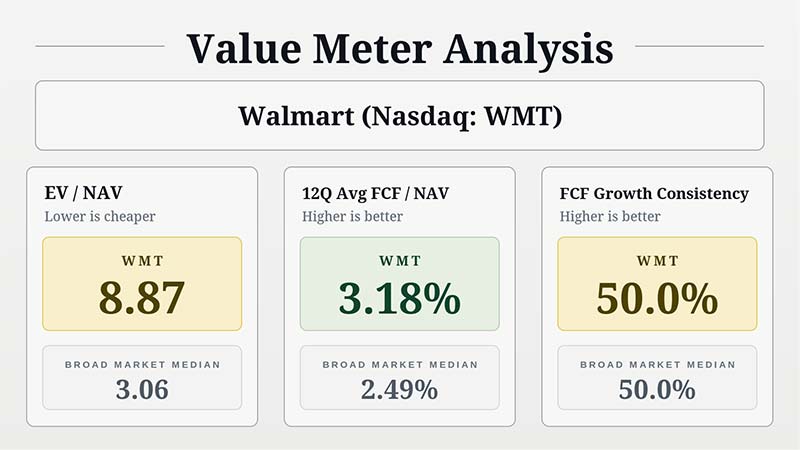
Walmart’s enterprise value-to-net asset value, or EV/NAV, is 8.87. The median stock in the Value Meter universe sits at 3.06, and the median for the consumer defensive (or consumer staples) sector is 2.68.
That is a steep premium. Investors are paying far more for Walmart’s assets than they are for the typical stock in our universe or in Walmart’s sector.
Its cash generation looks better.
Walmart’s free cash flow-to-NAV is 3.18%. The universe median is 2.49%, while the sector median is 3.47%.
This metric compares Walmart’s average quarterly free cash flow over the past three years with its average net asset value over the latest two quarters.
Put simply, Walmart produces more cash from its asset base than the typical stock in our universe. But it produces a little less than the typical company in its own sector.
Lastly, its year-over-year free cash flow growth consistency is 50.0%. That matches the universe median yet trails the sector median of 58.3%.
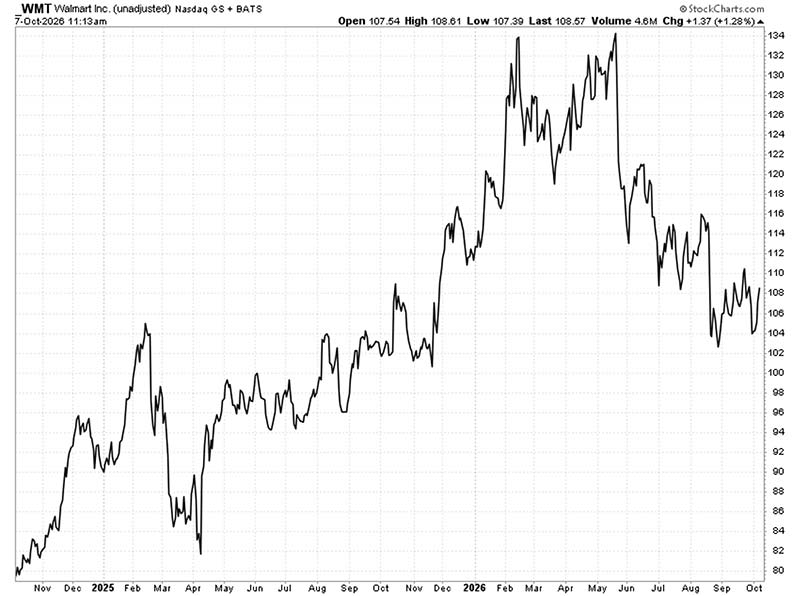
The stock has had a strong run, but it has not been a straight line. After reaching a peak this past spring, shares pulled back sharply and have spent the past few months trading well below those highs.
Walmart’s growth story is real. But the cash numbers do not fully justify calling the stock cheap.
That leaves us with a successful business trading at a demanding price.
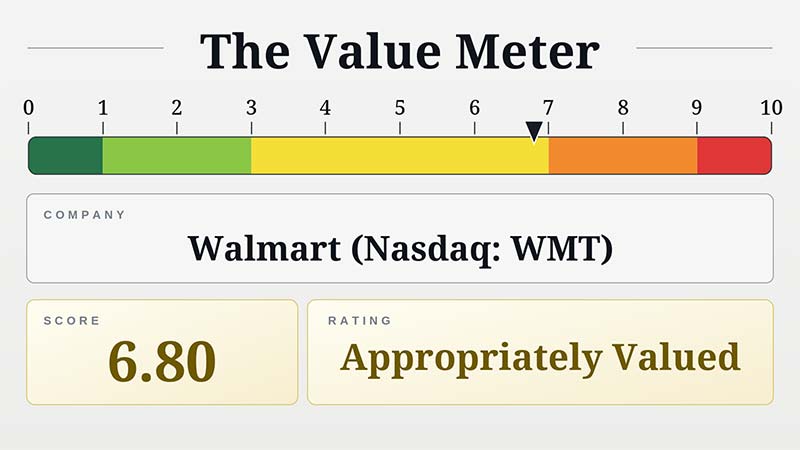
The Value Meter rates Walmart as “Appropriately Valued.”
What stock would you like me to run through The Value Meter next? Post the ticker symbol(s) in the comments section below.