
Broadcom (Nasdaq: AVGO) is making billions from the AI boom. Now it’s helping finance the equipment its customers need to keep buying its chips.
Last month, four major financial firms announced a joint $63 billion deal to help fund AI equipment built with Broadcom’s chips. The equipment will be leased to Anthropic, the company behind the AI chatbot Claude.
The deal could mean billions in new sales for Broadcom. But there’s a catch: The company has agreed to help cover losses if Anthropic fails to make its lease payments and the equipment can’t be sold for enough money to cover the debt.
That puts Broadcom in an awkward position. It could be on the hook for as much as $43 billion if the deal goes badly.
Broadcom says a payout of that size is unlikely, and the amount at risk will fall as Anthropic makes its lease payments.
Still, that’s a staggering sum… which raises an obvious question: Why is Broadcom willing to take on so much risk in the first place?
The answer appears to be just how profitable the AI boom has become.
In the third quarter, Broadcom’s revenue surged 86% to $29.6 billion, while sales of AI chips alone jumped 221% to $16.7 billion.
That’s remarkable growth for a company of Broadcom’s size. (With a market cap of around $1.4 trillion, it’s the eighth-largest company in the S&P 500.)
That growth is producing cash. Broadcom generated $13.7 billion in free cash flow during the quarter, nearly twice as much as a year earlier.
The company also has another major source of revenue: its infrastructure software business, which helps large companies run and manage their technology systems.
In short, Broadcom isn’t simply betting that AI will become a profitable business someday. It’s already making billions from it.
That helps explain why the company is willing to take on more risk to keep its growth going. But there’s a difference between making billions from AI today and counting on customers to keep paying their bills years from now.
If the AI boom slows, some customers could struggle to meet their financial obligations − and Broadcom could be left covering part of the losses.
That brings us to the question investors need to answer: Does Broadcom’s stock offer enough value to justify its high price and the risks that come with its growth?
That’s where The Value Meter comes in.
Our system compares what investors are paying for a business with the value of its assets, the cash those assets produce, and how often that cash flow improves.
On price alone, Broadcom looks expensive.
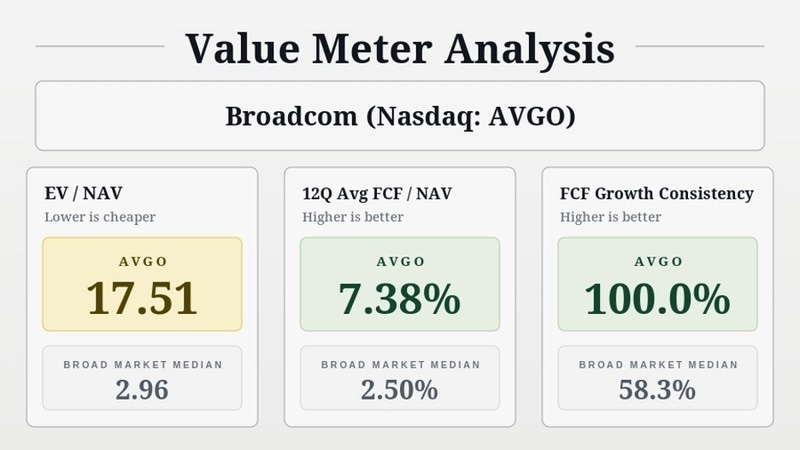
Its enterprise value is 17.51 times its net asset value (NAV), or what the company owns minus what it owes. For the typical stock, that figure is just 2.96.
Over the past 12 quarters, its average quarterly free cash flow equaled 7.38% of its NAV. The average stock in our universe produced just 2.50% of its NAV.
Broadcom also improved its free cash flow from a year earlier in each of the past 12 quarters. That’s an impressive record of growth and steady cash production.
And it helps explain why Broadcom scores so well despite its high price.
Investors are paying a lot for the business, but they’re also getting a company that has proved it can turn its assets into cash at an exceptional rate.
The new financing deal adds risk. There’s no getting around that.
But it doesn’t erase Broadcom’s record of strong cash flow.
For now − especially after yesterday’s sharp sell-off in tech − the numbers support a favorable verdict.
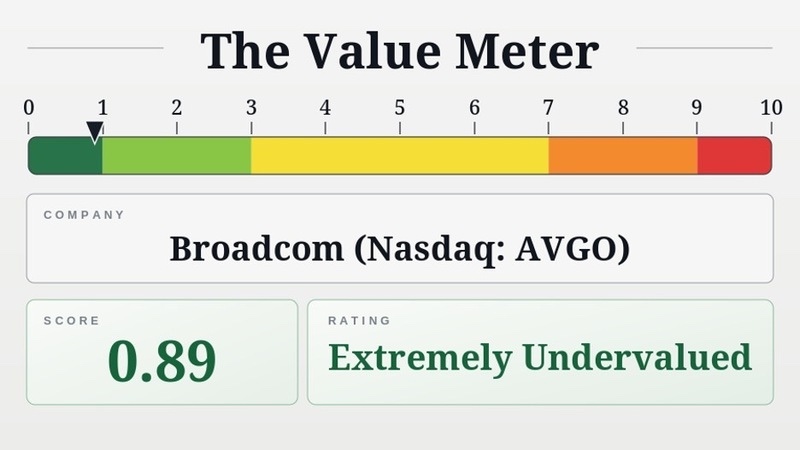
The Value Meter rates Broadcom as “Extremely Undervalued.”
What stock would you like me to run through The Value Meter next? Post the ticker symbol(s) in the comments section below.