

For the past six months, I’ve received dozens of comments and questions in response to my newsletter, The Skousen Report, as well as my VIP Trading Services and weekly columns in Wealthy Retirement and Liberty Through Wealth.
I appreciate the topics my readers raise, and they deserve answers. So from time to time, I plan to answer some of the most pressing questions in my weekly columns.
Today, I’m highlighting three questions…
Question 1: What’s the Best Way to Make a Killing in the Market?
In several columns, I’ve written about the wide variety of ways to beat the market and why it pays to try out several strategies to see which one is best for you.
In response to one of those columns, a reader named Ron wrote, “Thank you, Dr. Skousen, for your simple, down-to-earth kind of advice. There is so darn much advice out there, so darn many ‘strategies,’ that it has my head spinning. You keep me grounded and focused.”
Another column addressed how you can dramatically increase your chances of making a million dollars without playing the lottery or spinning the roulette wheel in Vegas (hint: the answer is investing in the stock market!).
I gave several examples of investors making millions on Wall Street by getting in early on stocks like Amazon, Apple, Netflix, and Nvidia, which went on to become 10-baggers for some. But to make it big, investors had to stay invested during market crashes from time to time. Nvidia, for example, fell significantly during the 2008 financial crisis and went nowhere for years.
In response to this column, an anonymous subscriber wrote, “While I agree with your advice of ‘hanging on during brutal declines,’ it often clashes with the 25% stop-loss principle at The Oxford Club.”
For most investors, the 25% stop-loss rule makes sense because most can’t tolerate huge losses, especially if they are in retirement. As one money manager said, “Buy-and-hold works if you live long enough, never need the money, and don’t mind losing 50% or more from time to time” (quoted in The Maxims of Wall Street, Page 137).
But if you are a gambler who’s willing to buy a stock with great potential and you have the time to hold through thick and thin, speculating in future Nvidias with a portion of your portfolio may be your game.
As Jesse Livermore said, “The big money is not in the buying and the selling, but in the sitting” (quoted in Maxims, Page 194).
Question 2: Should I Spend My Children’s Inheritance?
I received quite a few letters about my recent Wealthy Retirement column on the need to spend more money when you are retired rather than saving it all to give it away to your heirs and kids when you die.
Mary wrote, “Best advice ever!”
Tom said, “Great advice, my financial advisor (I believe he is a subscriber also) and I have adopted this strategy. His comment to me once was ‘Tom, my clients don’t tend to run out of money, they tend to run out of time.'”
Amen!
In response to the column, John asked, “Have you ever heard of the book Die with Zero by Bill Perkins? I read it last year, he agrees with you!”
I am familiar with the book. Perkins’ thesis is that the purpose of accumulating wealth is to use it to maximize life experiences, rather than simply die with a large, unused fortune.
One way to do this is to donate all of your estate to your favorite think tanks, freedom organizations, or charities and have them create a charitable remainder trust that pays you monthly income for the rest of your life. When you die, the value of the entire asset goes to the organization. If you don’t have a favorite nonprofit organization, you can also buy an immediate annuity that pays you a monthly income as long as you live.
I wouldn’t go as extreme as Perkins, who recommends donating all your assets to various organizations. You may still want to create a trust or two for your grandchildren’s education, for example, or children who are still in need of assistance.
I like what Warren Buffett advises: “You should give your kids enough money to do anything but not enough money to do nothing” (quoted in Maxims, Page 143).
Question 3: What Does “AEIOU” Mean?
And now for the most common question I get these days…
JW wrote, “I joined about a year ago, and I’ve been wondering what Skousen’s parting signature ‘AEIOU’ stands for. Can someone explain?”
Answer: AEIOU is a puzzle wrapped in an enigma surrounded by a paradox.
AEIOU first appeared in the middle of the 15th century, when Frederick III (1415-1493), the Habsburg emperor of the Holy Roman Empire and ruler of Austria, began to inscribe it on buildings, coins, and other items.
He never explained its meaning, but it has been interpreted in Latin as “Austriae est imperare orbi universo” or in German as “Alles Erdreich ist Österreich untertan.”
In English, these roughly translate to “Austrian Empire Is Overall Universal.”
All three are meant to convey the idea that Austria is destined to rule the world. But that never happened. The Austro-Hungarian Empire lasted only until World War I.
So what does it mean to me? There are a couple of possibilities…
Since the Austrian school of economics is my favorite, one meaning could be “Austrian Economics Is Overall Universal.”
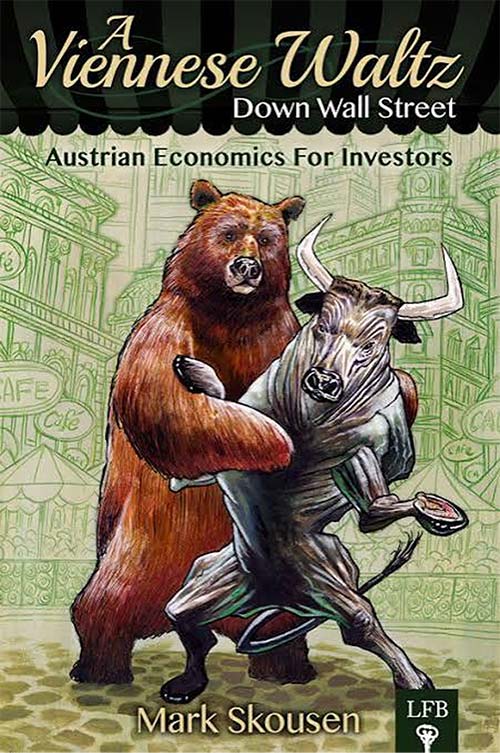
I’ve even written an entire book on the subject – A Viennese Waltz Down Wall Street: Austrian Economics for Investors − which is available for free here.
I also have a limited supply of quality paperback copies available for only $30 each, which you can order here. I autograph all copies and mail them at no extra charge inside the U.S.
As for the second possibility…
For Americans – especially those of us who believe strongly in a free enterprise system of government – AEIOU could also mean “American Economy, I.O.U.”
Which is the true meaning?
You decide.