

AST SpaceMobile (Nasdaq: ASTS) has a simple goal: allow normal cellphones to connect directly to a satellite network when no tower is nearby.
No special satellite phone. No new device.
But don’t let that simplicity fool you. This is a very big idea.
Cell towers can only cover so much ground. Building more of them is costly, slow, and often impractical in remote areas.
AST wants to fill those gaps from space.
If it works at scale, mobile carriers could offer service across far more of the planet without building a tower in every hard-to-reach place.
The company has shown that this is more than a science project. It’s a real tech disruption taking shape right before our eyes.
AST works with nearly 60 mobile carriers that serve more than 3 billion people. It has launched more satellites and shown that its system can deliver useful download speeds.
The progress, so far, is real. But the harder question is “How much of tomorrow’s progress are investors already paying for today?”
In the first quarter, revenue rose to $14.7 million from just $718,000 a year earlier. Most of that revenue came from equipment and software sold to mobile partners, not from steady, recurring service payments.
The company also posted a $191 million loss − wider than its $45.7 million loss in the first quarter last year. A one-time financing charge made that loss look worse than it actually was, but the cash picture was still weak. AST used $48.1 million in operating cash, and after spending on satellites and other equipment, simple free cash flow was -$309.7 million.
Those numbers reflect a company that is still deep in its build stage. Yet investors seem willing to look past that immaturity and focus on what AST could become.
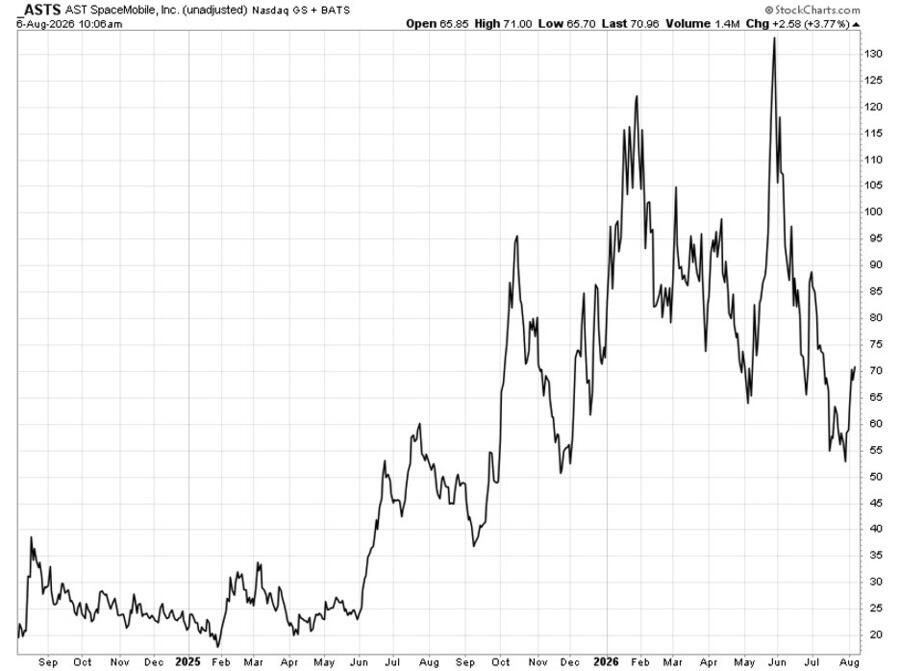
That optimism shows up in the chart above. The stock has regained strength as launches, carrier deals, and new funding have made the plan feel more real.
In other words, future potential has done much of the work in lifting the shares. However, a good business case doesn’t mean a good price for the stock.
Here at The Oxford Club, we do not let optimism overrule discipline. The Value Meter helps us cut through the excitement and ask a simpler question: Does AST’s current business justify the price investors are paying for its future?
When I ran the stock through The Value Meter in May of last year, the answer was a resounding no, as it earned an “Extremely Overvalued” rating.
Let’s see if the picture has changed.
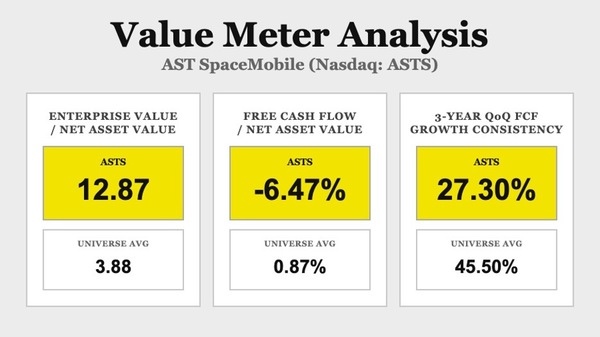
AST’s enterprise value-to-net asset value ratio, or EV/NAV, is 12.87. The broad market average is just 3.88. That is a steep premium. Perhaps AST will earn it one day as its satellites, licenses, and carrier deals grow into a large commercial network.
But it has not earned it today.
AST’s trailing 12-month free cash flow-to-net asset value ratio, or FCF/NAV, is -6.47%. The market average sits in positive territory at 0.87%.
That means AST’s assets are currently using more cash than they produce.
Additionally, the cash flow the company does produce has been uneven. Over the past three years, quarterly free cash flow improved from the prior quarter only 27.3% of the time. The broad market average is 45.5%.
Suffice it to say, AST has not yet earned this premium valuation.
We know what it would take: rising service revenue, lower cash burn, and steady gains in free cash flow. None of that has happened yet.
Investors should be careful not to pay today for results the company may deliver years from now.
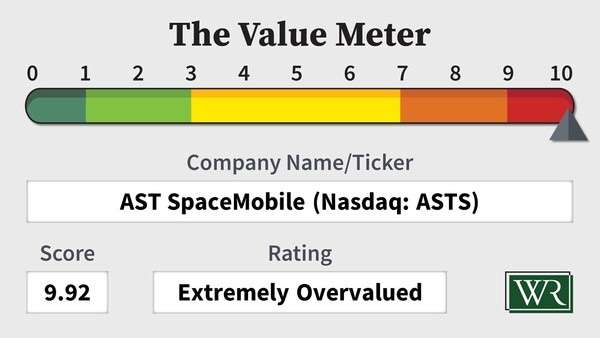
The Value Meter rates AST SpaceMobile as “Extremely Overvalued.”
What did you think of this analysis? What stock would you like me to run through the Value Meter next? Let me know in the comments below.
I would find it helpful if based on the current valuation assessment what should the stock actually be priced at.
AVAV
Mode mobile
I don’t understand! What does extremely overvalued mean on The value Meter? Is it a positive or a negative. Does it mean invest or not? The word overvalued has left me more confused. I find this method extremely lacking in detail and not providing enough good information to make a solid decision. Please try to make your research more clear. Thank you,
Hi Mark, we appreciate the question and the feedback. “Overvalued” (i.e., a higher Value Meter score) is negative, and “undervalued” (i.e., a lower Value Meter score) is positive. So AST’s score of 9.92 is extremely poor. Thanks for reading!
How about RDW
How about SNDK?
GSAT
What about the ”Micro Magnificent Seven”?