
“A wise trader never ceases to study general conditions.”
– Edwin Lefèvre (The Maxims of Wall Street, Page 62)
“Games are won by players who focus on the playing field, not by those whose eyes are glued to the scoreboard.”
– Warren Buffett (Page 116)
As your Macroeconomic Strategist here at The Oxford Club, I’m always on the lookout for powerful new trends that explain how the world works.
One question many analysts are asking is, “Why is the U.S. stock market doing so well in the face of rising inflation, higher interest rates, Trump tariffs, war in the Middle East, and sluggish economic growth?” This relentless upward movement on Wall Street appears to defy gravity, logic, and the anxieties of the daily news cycle.
In response, financial gurus often quote the famous line “Bull markets climb a wall of worry” (Maxims, Page 64), but I firmly believe we can dig more into the details to find out the root cause of the bull market on Wall Street.
We have entered an era of slow growth, as measured by gross output (GO) and gross domestic product (GDP).
Nevertheless, there are many reasons stocks are moving higher. One is the AI and technology boom, which is leading to explosive growth in profit margins and productivity and causing what I call the second “Roaring ’20s.” There’s also geopolitical optimism that the United States and Iran may be moving closer to an agreement and that the Strait of Hormuz will eventually open back up.
No. 1 Reason for Optimism
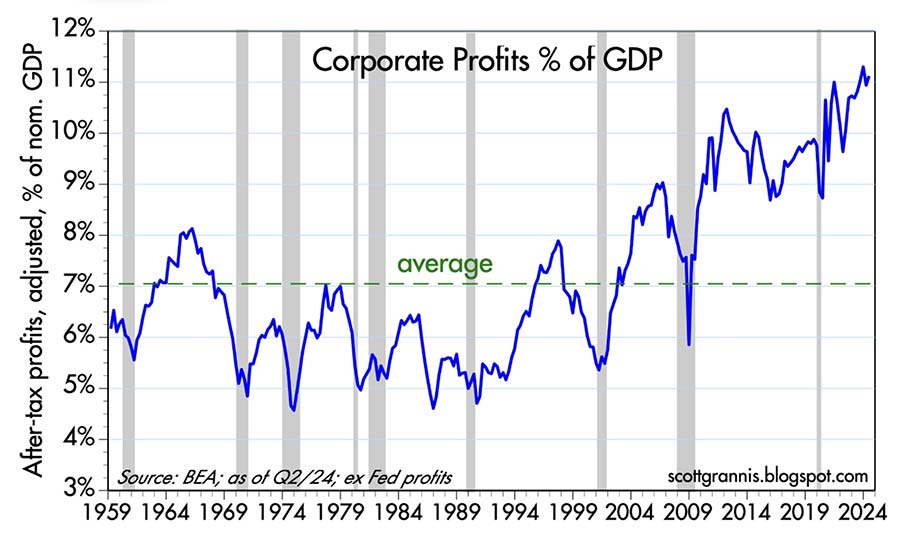
But in my judgment, the biggest driver of this bull market is found in this chart.
Source: Scott Grannis
Corporate earnings are driving stocks higher!
Approximately 80% of S&P 500 companies that have reported recently have beaten profit expectations, with some sectors on track for their strongest growth since late 2021. When companies earn more money, they inherently become more valuable, which naturally drives prices higher.
Since the beginning of the 21st century, corporate earnings have been in a secular climb, and that growth has accelerated since the 2020 pandemic. Why? One reason, I believe, is the sharp decrease in the corporate income tax from 35% to 21%. This corporate tax cut has allowed businesses to keep more of their earnings and invest in more productivity.
It has also made them more competitive against foreign firms. Corporate rates have been falling across all nations since Ireland cut its corporate rate to 12.5% in 2003, creating a global competition among countries to lower marginal tax rates. The United States used to have the highest corporate tax rate in the world among major nations at 35%. Now, at 21%, it’s much more competitive.
Beware of the “Croakers”
If you are following the advice of Oxford Club experts, you are fully invested and taking full advantage of this bull market.
Unfortunately, too many investors are still on the sidelines, fearing another crash or bear market due to some unforeseen “black swan” event. There are plenty of doomsayers preaching fear at all times, but here at The Oxford Club, Alexander Green, Marc Lichtenfeld, and I are more upbeat about the outlook of the markets and the economy. Despite every effort by politicians to overtax and overregulate us, our economy is still growing. American exceptionalism is still alive and well.
We at The Oxford Club recommend you take advantage of any sell-offs in the market to buy – not to sell – and to stay fully invested. As Sir John Templeton writes, “If you are a long-term investor, you will view a bear market as an opportunity to buy” (Maxims, Page 108). J. Paul Getty warns, “Investors can profit handsomely if they will disregard the pessimistic auguries of self-appointed prophets of doom” (Page 110).
Ben Franklin called the doomsayers “croakers,” noting, “I saw in the public papers of different states frequent complaints of hard times, deadness of trade, scarcity of money, etc. It is always in the power of a small number to make a great clamor. But let us take a cool view of the general state of affairs, and perhaps the prospect will appear less gloomy than has been imagined.”
Adam Smith said it best 250 years ago when he wrote in The Wealth of Nations, “The uniform, constant, and uninterrupted effort of every man to better his condition… is frequently powerful enough to maintain the natural progress of things toward improvement, in spite both of the extravagance of government and of the greatest errors of administration.”
This is a quote at the end of my essay, “The Genius of Adam Smith,” published by the Institute of Economic Affairs (IEA) in London on the 250th anniversary of Adam Smith’s magnum opus. You can read it here.
A Personal Note: Take the Time to Read!
From time to time, I receive unsolicited endorsements of my books. Last week, Lucy Artiga from Madison Avenue in New York City wrote me the following:
“I wanted to let you know how much I enjoyed the 12th edition of The Maxims of Wall Street. Your book really resonated with me, especially the way you combined history, investing, and practical wisdom in such an engaging way. It made a lasting impression on me.”
You see, Maxims isn’t just a quote book. It is, as Alex Green says, “a crash course in financial freedom, a treasure trove of proverbs, slogans, stories, and useful quotes.” Alex added, “[Skousen] provides plenty of commentary to go with these gems. I still refer to it regularly.” You should too!
Many of you have a copy of Maxims. If you don’t, you can purchase one for the discounted price of $22 at www.skousenbooks.com − and pay only $12 for additional copies as gifts for friends and clients. I autograph all copies and ship them at no extra charge if mailed inside the U.S.
Order your copy (or copies) today and see why I’ve sold over 70,000 copies. It’s not sold in stores and not available on Kindle or Audible. It’s a classic that should be read in leather-bound hardback!
You’ll recognize the name of the person I’ve dedicated the book to.
For full details on my book The Maxims of Wall Street, click here.
Why the sign off “AEIOU”?