
“We cannot direct the wind, but we can adjust the sail.”
– The Maxims of Wall Street, Page 30
Is there a way to invest and make millions in the stock market without taking on a lot of risk? And is there such a thing as risk-free investing?
Early investors could’ve made millions investing in stocks like Apple, Amazon, and Nvidia, but the risks were high. These stocks are up 10,000% or more, but they often collapsed 90% or more along the way.
Most people can’t stomach that kind of volatility.
That’s why I recently hosted a two-hour masterclass session focusing on “sleep well at night” investment strategies that can limit downside and still beat the market. (I discussed that session and some strategies in a recent Liberty Through Wealth article, which you can read here.)
Limiting downside is especially important when volatility is high, and few corners of the market are as volatile as tech.
That means it’s crucial to know the best ways to navigate the potentially treacherous tech stock market.
Is AI in a Bubble?
A lot of folks keep asking me how much longer this incredible run in AI and technology can last.
Is it real, or is it all hype? Is it a bubble about to burst?
Right now, I believe we’re only in the middle stages of the AI boom. If the new “Roaring ’20s” (the 2020 decade) are anything like the Roaring ’90s (the 1990 decade), we are only halfway there, as this chart shows.
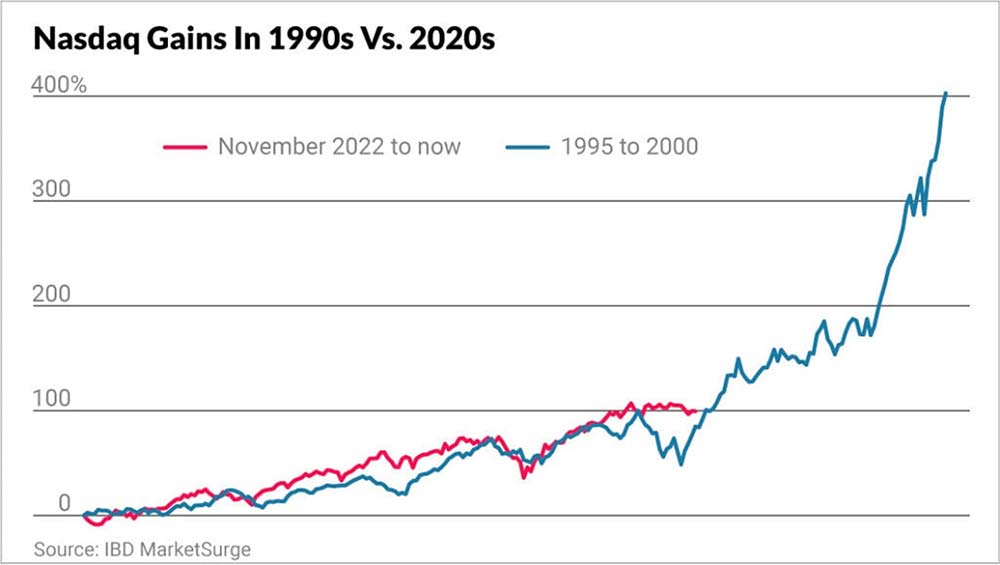
It was in late 1996 when Fed Chairman Alan Greenspan warned that the stock market had reached a point of “irrational exuberance.”
And the Nasdaq doubled and then doubled again after that!
The AI tech revolution is so explosive that I see the Nasdaq doing the same (more or less) this time around.
Recently, Ray Dalio, the billionaire founder of Bridgewater Associates, said, “We’re close to the point where the AI bubble could burst.” Sounds like Greenspan all over again. But his accuracy in predicting has been mixed, so who knows?
I expect corrections, even severe ones, along the way, but any sudden tech sell-offs will be only temporary turbulence in a long-term bull market that I expect to continue for the rest of the decade.
I now believe we are in “Phase 2” of the AI tech boom. If history is any guide, it’s the phase where AI stocks could double and then double again… similar to my 1995 prediction of the Nasdaq doing just that.
In Phase 1, AI generated a lot of money… as well as a lot of controversy. So what will Phase 2 hold?
Phase 2: “The Anthropic Effect”
When you look at the technology and the potential economic prosperity it could create, the opportunity here is truly unprecedented.
We are already witnessing the incredible impact of SpaceX and Nvidia in the AI marketplace. The next best opportunity may well be when Anthropic (owner of Claude) goes public.
The company officially filed to go public this morning, with an initial expected valuation of between $1.5 trillion and $2 trillion. That could make it the most valuable IPO in history, surpassing SpaceX’s earlier this year.
Anthropic could begin trading as soon as next month. When it does, it is likely to generate another move up in AI stocks.
I also believe it’ll kick off a wave of an estimated $4 trillion in AI IPOs that are slated to come to market in the next 12 months.
What About Volatility?
As incredible as this opportunity is, there’s one thing that can take it from you. And that’s volatility.
Being right about AI won’t be enough. During Phase 2, the stock gains could be greater… but the volatility could be too.
Remember how Nvidia fell around 80% in the 2008 financial crisis before taking off again? The same could happen to AI stocks.
The stocks that hand you returns of 300% to 400% don’t climb in a straight line. They often drop 30% to 40% along the way, over and over again.
And every one of those drops can scare ordinary investors into selling at the worst possible moment – right before the biggest move.
So how does one deal with the volatility?
The Oxford Club’s Four Pillars of Wealth offer some helpful strategies, including position sizing, diversification, and a solid exit strategy.
I’m also impressed with new short-term trading techniques that have been developed to minimize your risk when investing in AI tech stocks.
There are a number of services out there that aim to help you get into the market during uptrends and out of the market during downtrends.
Some time ago, my colleagues at The Oxford Club and I were introduced to a breakthrough from one of the world’s leading quant firms: a company called TradeSmith, which uses AI to analyze stocks and generate trading forecasts, including for technology and AI-related stocks.
To learn more about TradeSmith and their mission to empower individual, self-directed investors with powerful tools that were once available only to hedge funds and professional traders, click here.