
“The years roll round and the last will come; when I would rather have it said, ‘He lived usefully,’ than, ‘He died rich.'”
– Benjamin Franklin
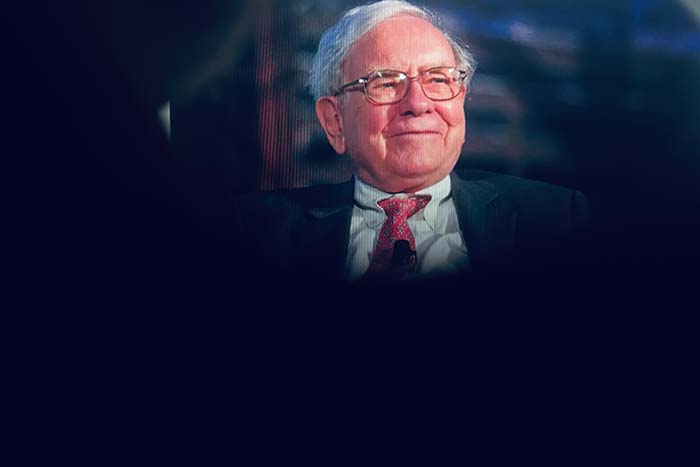
Last week, Warren Buffett resigned as chairman of Berkshire Hathaway at the amazing age of 96. He said, “Father Time always wins. He has, however, been generous with me.”
Indeed, his statement reminds me of Psalms 116:7, which says, “Return unto thy rest, O my soul; for the Lord has dealt bountifully with thee.”
When I think of the title of this e-letter, Wealthy Retirement, Buffett comes to mind. He will retire at No. 10 on the Forbes 400 list of the richest people in America. He was No. 1 in 1993 but has gradually given away so much wealth that he’s dropped down a few places. Still, he’s worth over $144 billion today.
He may not be the wealthiest man in the world, but he is without a doubt the world’s most successful investor. A $10,000 investment in Berkshire Hathaway in 1965 would be worth $615 million today. That amounts to a 20% annualized return over 60 years – double the return of the S&P 500. (And the S&P 500’s return includes reinvested dividends, while Berkshire hasn’t paid a dividend since 1967.)
My wife, Jo Ann, and I met Buffett in 2010 in New York. In the photo below, you can see we are exchanging a joke.
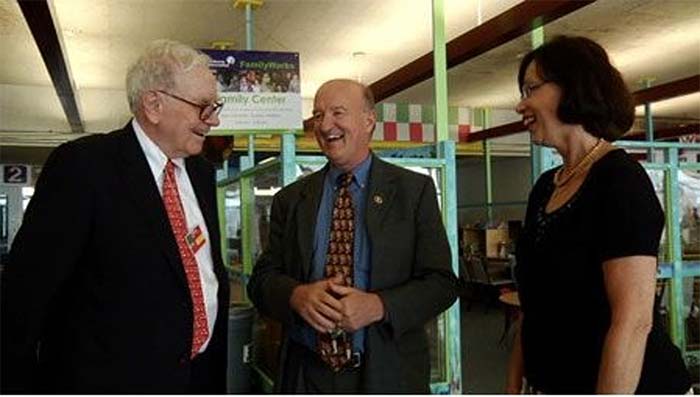
We were all smiling probably because I mentioned to him that he invested up to $10 billion to save Goldman Sachs during the financial crisis of 2008 rather than Lehman Brothers, which went bankrupt.
Gold vs. Stocks: My Debate With Buffett
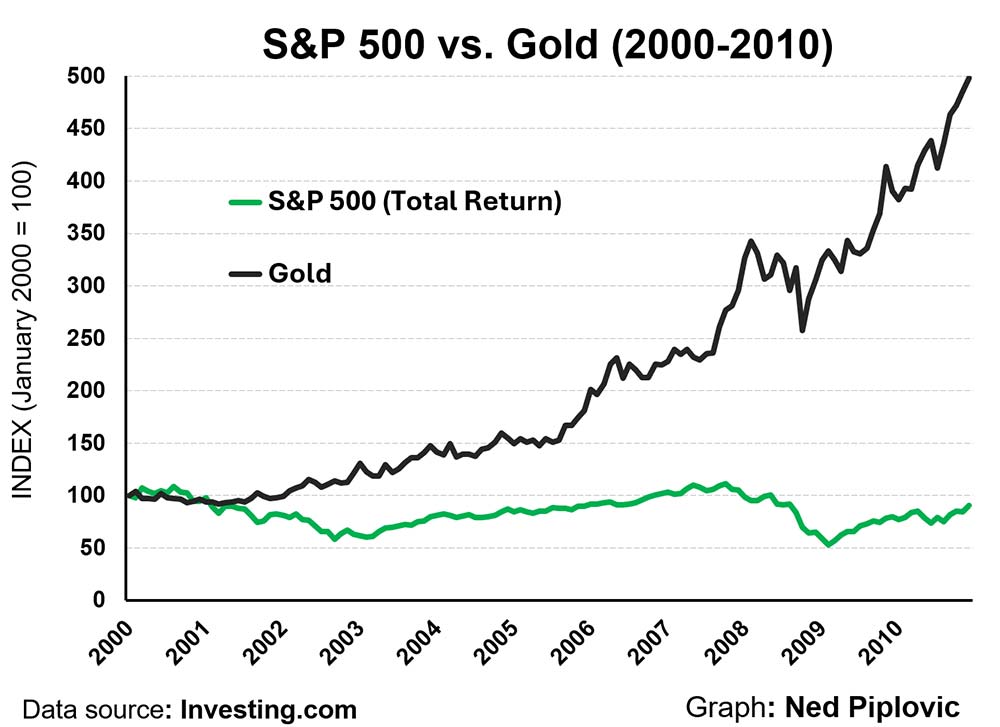
A few minutes into our conversation, I pulled out a lucky coin – a Mexican 50-peso, which I think is the world’s most beautiful coin (and is among the heaviest gold coins at 1.2 ounces). My “gold bug” friends had been bragging about how gold had done much better than most stocks since 2000 and was a superior inflation hedge.
So I asked Buffett, “What’s your opinion of gold?”
He looked at my gold coin and laughed, saying, “My father was a collector of silver dollars. I collect businesses and friends!” (His father, Howard Buffett, was a staunch Republican congressman from Nebraska who supported the gold standard, advocated for balanced budgets, and opposed American involvement in foreign wars.)
Then Buffett turned serious. He said, “Stocks are a much better investment than gold. If you own an ounce of gold now and you caress it for the next hundred years, you’ll have an ounce of gold a hundred years from now.”
He added, “The one thing I would bet my life on, essentially, is over a 50-year period, not only will Berkshire do considerably better than gold, but common stocks as a group will do better than gold.”
Indeed, since our little debate in 2010, gold is up 300%, but Berkshire Hathaway has climbed 577% and the S&P 500 has delivered a total return – including dividends – of nearly 870%!
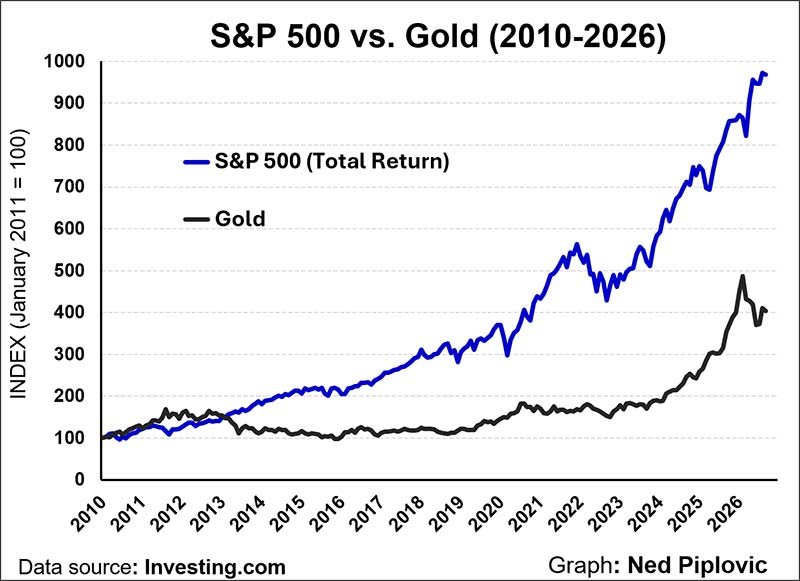
My preference is to be invested in both lots of stocks and some gold as a hedge.
Why Buffett Endorsed The Maxims of Wall Street
Despite our little debate, Buffett and I remained friends, and when I published the first edition of my book The Maxims of Wall Street, I sent him a copy and received a surprise endorsement. He wrote, “Loved your great little book. I plan to shamelessly steal some of the lines.”
Now I know why. It turns out that I quote Buffett more than any other financial guru – more than Jesse Livermore, Ben Franklin, or Gerald Loeb. He’s not only the world’s most successful investor but also the most quotable, with over 40 of his quotes making it into my book.
When he announced his retirement last week, I once again sent him a copy of Maxims. It is now in its 12th edition, having sold over 100,000 copies.
Drawing on my bestseller, I cite the wisdom of Buffett and other financial gurus regularly in my newsletter, The Skousen Report, and my Wealthy Retirement and Liberty Through Wealth columns.
A Visionary Man
The last time I saw Buffett in person was at Berkshire’s 50th anniversary shareholder meeting in 2015. I invited my son Todd to attend with me.
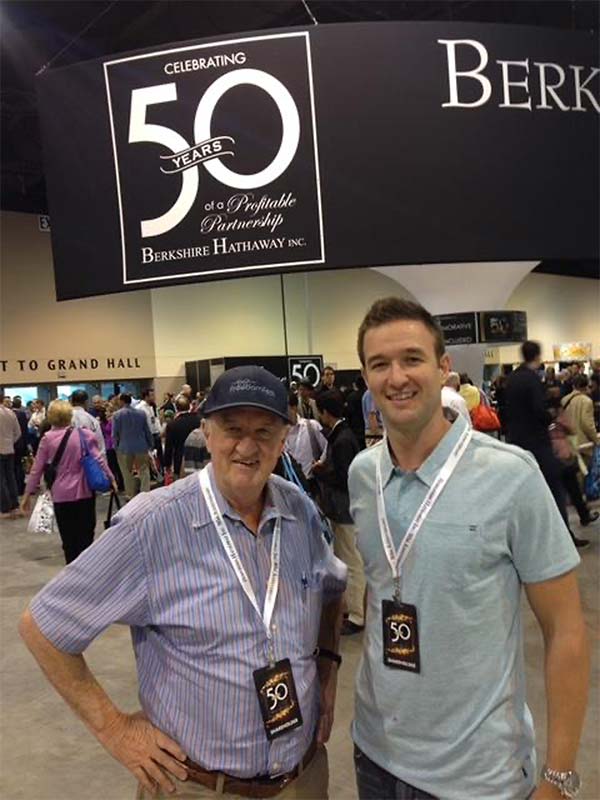
We had a great time seeing and listening to Buffett and his sidekick, Charlie Munger, and found it to be entertaining and educational, especially his annual shareholder report.
At the meeting, which was held during an election year, Buffett rejected the notion of permanent American economic decline, asserting that the American Dream was still alive and that today’s newborns are the “luckiest crop in history.” He added, “Betting against America would be a terrible mistake.”
Munger agreed, saying, “If people weren’t so often wrong, we wouldn’t be so rich.”
As I was reflecting on my conversations with him and rereading the Buffett quotes in Maxims, I thought, “What a visionary man!”
Here are a few of my favorite Buffett quotes from Maxims:
- “If you wait to see the Robin sing, Spring may be over” (Page 46).
- “My idea of a group decision is to look in the mirror” (Page 95).
- “The light on Wall Street can at any time go from green to red without pausing at yellow” (Page 111).
- “When we see something that makes sense, we act very fast and very big” (Page 193).
“The Buffett Way”
Buffett’s secret to success was to buy “great businesses at a fair price” rather than to buy “fair businesses at a great price,” a philosophy he learned from Munger (see the quote on Page 37 of Maxims).
In most cases, Buffett and Munger did not try to buy mismanaged “turnarounds,” instead choosing to pay reasonable prices for well-managed companies they expected to burgeon over time (e.g., Apple, Coca-Cola, and American Express).
Buffett’s biggest winners were private companies, such as the Nebraska Furniture Mart (then run by “Mrs. B,” Rose Blumkin) and See’s Candies. He also saw big profits in Geico − where his mentor, Benjamin Graham, was chairman of the board − when he bought it near bankruptcy as a turnaround in 1976! Its assets amount to about $93 billion today.
Buffett’s Berkshire Hathaway used to beat the market handily over the years, but in the past 10 years, it has underperformed for two reasons: It’s gotten too big and it has too much of its portfolio in cash. Recently, Buffett has told new investors to put their money into the S&P 500.
I believe his formula for beating the market still works, but I suggest investing with The Oxford Club might be a better choice.