
Recursion Pharmaceuticals (Nasdaq: RXRX) has more proof behind its AI drug pitch than it did a year ago. Yet investors are paying far less for the stock.
Recursion uses AI to analyze huge sets of biological data in search of new drugs. It also has deals with major drugmakers and a pipeline of treatments of its own.
REC-4881, one of its lead drugs, is being tested in patients with familial adenomatous polyposis, or FAP, an inherited condition that causes large numbers of colon polyps and greatly raises the risk of cancer.
Early results were encouraging. Among patients who could be evaluated, 75% saw their polyp burden fall. The median reduction was 43% after 12 weeks of treatment. Most patients who showed improvement also maintained that improvement after treatment stopped.
Genentech, one of Recursion’s partners, has provided another sign of progress: It chose to advance a drug target that was discovered through its collaboration with Recursion.
Those are important steps. Recursion is starting to produce evidence that its technology can lead to real drugs and real interest from major partners.
However, progress in the lab does not automatically make a stock attractive.
Second quarter revenue was $7.7 million, which was down from $19.2 million a year earlier − though that drop doesn’t necessarily mean the business weakened.
Much of Recursion’s revenue comes from research partnerships, and that money is recorded as specific work is completed or certain milestones are reached.
Simply put, the company received less partner revenue this quarter than a year ago.
As for earnings, Recursion lost $131 million in the quarter, and through the first six months of 2026, it used $187 million in cash to run the business.
That was an improvement from $208.4 million a year earlier. Still, burning nearly $200 million in six months is hardly ideal.
Recursion reported $545.7 million in cash and cash equivalents, so it has time to keep funding its research. The problem is the business is still spending far more cash than it brings in.
Investors have also already taken a lot of air out of the stock.
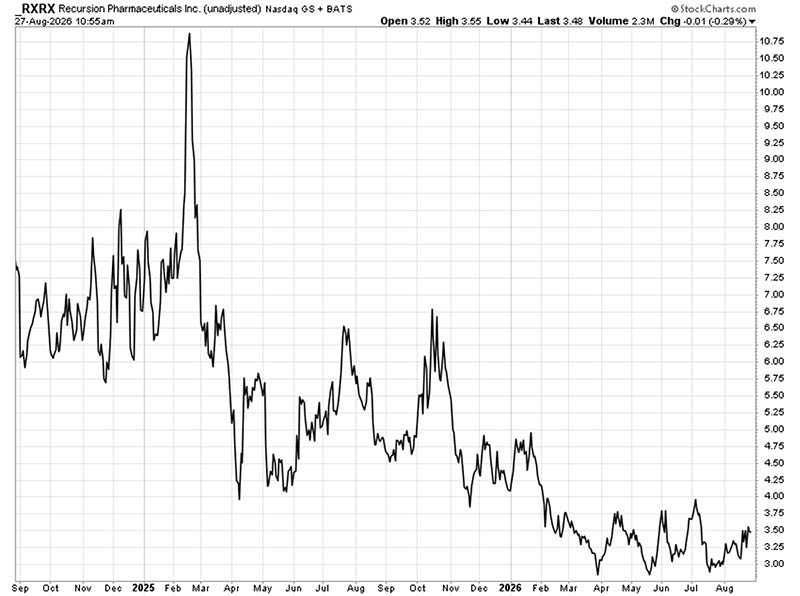
Recursion traded above $10 in February 2025, when AI excitement and Nvidia’s stake helped lift shares. It now sits near $3.48, even as the company has made progress on the clinical and partnership fronts.
That makes the price look more reasonable. It does not make the stock cheap by default.
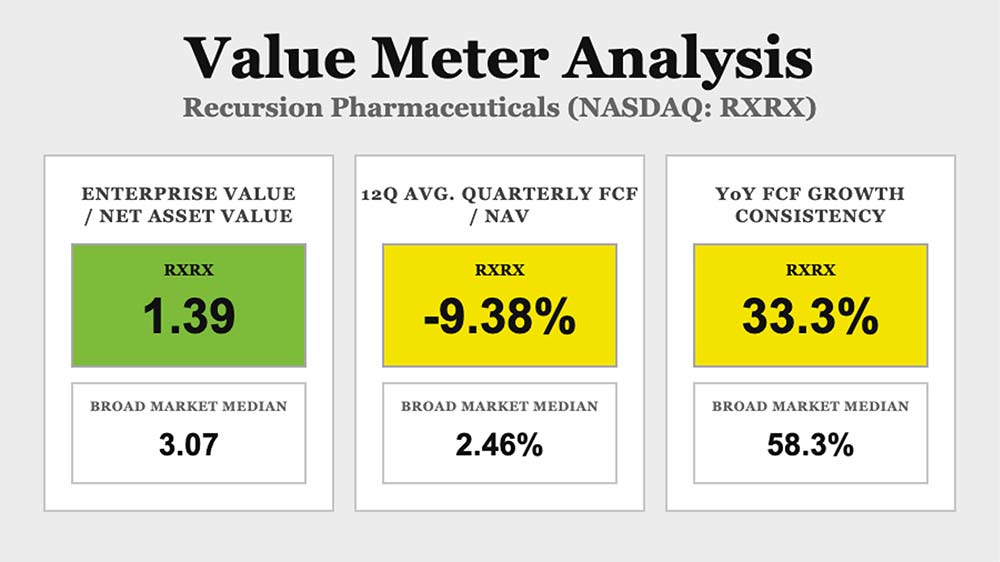
Recursion’s enterprise value-to-net asset value (EV/NAV) ratio is 1.39 − nearly 55% below the median for the entire market. That seems like an appealing discount… but as is often the case, there’s a good reason for it.
The company’s 12-quarter average FCF/NAV is -9.38%, compared with a median of 2.46% across all stocks in our database. In plain English, Recursion is burning cash, while the average company is producing it.
There’s another wrinkle here too: A meaningful part of Recursion’s asset base is cash that’s raised from investors and then used to fund research and clinical trials. That cash gives the company time, but it’s different from cash the business generates on its own.
Making matters worse, the company’s cash flow record is uneven. Recursion’s year-over-year cash flow growth consistency is just 33.3%, versus 58.3% for the broad market. So even when cash flow improves, that improvement has not shown up with much regularity.
Clearly, the stock is much cheaper than it was, and Recursion has more progress behind it now. But the business is still burning enough cash to make that low valuation less comforting than it first appears.
Recursion has earned more attention, but not a stronger value call yet.
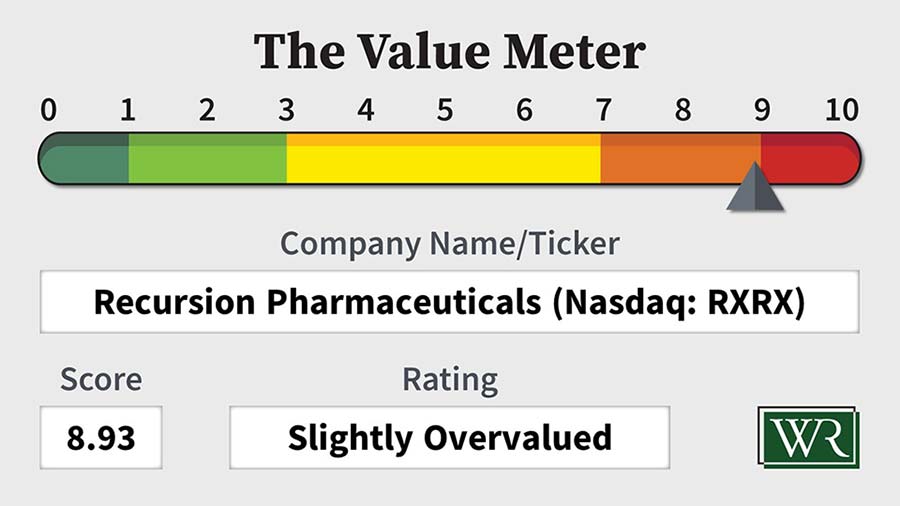
The Value Meter rates Recursion Pharmaceuticals as “Slightly Overvalued.”
What stock would you like me to run through The Value Meter next? Post the ticker symbol(s) in the comments section below.
Brk.b
Bsx
SWMR
TFPM
BFLY
TPL
TPL, ORA. GEV, PWR, VRT
ABSCI