

“I believe that he who learns only how to obey orders can never be a great explorer.”
− Capt. James Cook (1728-1779)
I just returned from the Forbes Cruise to Alaska with Steve Forbes. This was my fifth trip to Alaska, and it’s always an awe-inspiring experience.
I’ve long admired the men and women who live in Alaska. Most of them are rugged individualists with an independent libertarian streak.
At the end of our voyage, I met up with a group of subscribers and book buyers in Anchorage, where we were hosted by Dr. Jeffrey Gonnason, an eye doctor and native Alaskan.
My advice to the group was to put the majority of their investments in dividend-paying growth stocks and only speculate in high-risk adventures with “money you can afford to lose.”
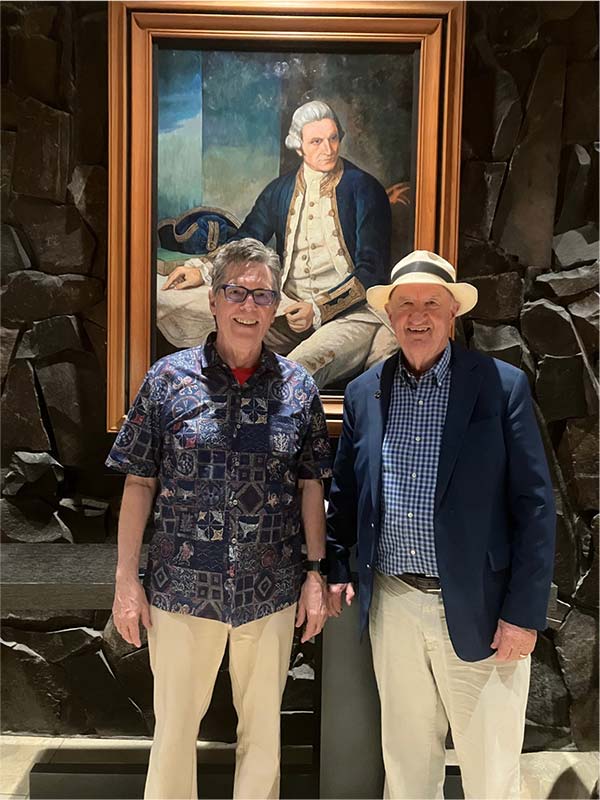
After our meeting, Jeff showed my wife and me around the historic Hotel Captain Cook in Anchorage. I had stayed there a couple of times years ago and wanted to see it again.
The Captain Cook is the state’s premier luxury hotel, having hosted presidents, foreign dignitaries, celebrities, business leaders, and major civic events for decades. Douglas Brinkley, “America’s Historian,” considers it one of his favorite hotels in America.
The hotel is over 50 years old and retains much of its original mid-century design. It also features an extensive art collection inspired by the voyages of Capt. James Cook.
Capt. Cook was, like many leading men of the Enlightenment era, a commoner. Yet through his three world voyages, which included visits to Australia, New Zealand, Tahiti, and Alaska (and made him the first European to discover the Hawaiian Islands), he became one of the greatest maritime explorers and mapmakers in history.
To achieve any level of success, you have to be a risk taker. Capt. Cook took great risks as an explorer to discover new territories. He was willing to face uncertainty and grave dangers, whether it was enduring bad weather in arctic conditions, running out of food and fresh water, or running aground on unknown coastlines.
Throughout his journeys, he learned to take action only after making careful preparations and minimizing the risks. Thus, he was able to go on three round-the-world trips.
Ben Graham’s Advice to Investors: “Always Maintain a Margin of Safety”
As investors, you may face similar dangers: investing in emerging “growth” stocks in technology or in mining precious metals that promise huge returns but also represent huge risks.
Ben Graham, a Columbia professor of finance and the author of The Intelligent Investor, is considered the father of value investing.
He emphasized the importance of always maintaining a “margin of safety” when it comes to investing in potentially profitable companies. Like Capt. Cook, you need to do your due diligence, measure the pros and cons of every investment, and never put the majority of your assets at risk.
I’ve known too many cases where investors got too greedy and put too much of their capital at stake in high-risk ventures, only to lose a fortune of their hard-earned assets.
The “Mature” Capt. Cook Makes a Fatal Mistake
Don’t think it can’t happen to you in your mature years.
Even after spending years at sea, Capt. Cook − at age 50 and on his third tour − made a fatal mistake.
After exploring Alaska in 1778, he headed to Hawaii to escape the harsh Arctic winter, repair his ships, and get fresh food and water. His crew was physically exhausted and mentally drained from months of sailing in the freezing Arctic, battling intense storms, and navigating dangerous pack ice.
The tropical climate and warm hospitality of Hawaii offered the perfect environment for the men to rest, recuperate, and boost their spirits before attempting the Arctic passage again the following year.
During this visit to the Big Island of Hawaii, one of the natives stole one of Cook’s longboats. Cook attempted to kidnap the ruling king of Hawaii and hold him hostage until the boat was returned.
However, he completely underestimated the hostile reaction of the surrounding crowd of several thousand natives. He only had a handful of armed sailors to protect him. As the tension peaked and rocks were thrown, Cook fired his musket and killed a villager, shattering any chance of a peaceful retreat.
Overwhelmed by the armed crowd, Cook was struck in the head with a club and stabbed to death at the water’s edge on February 14, 1779.
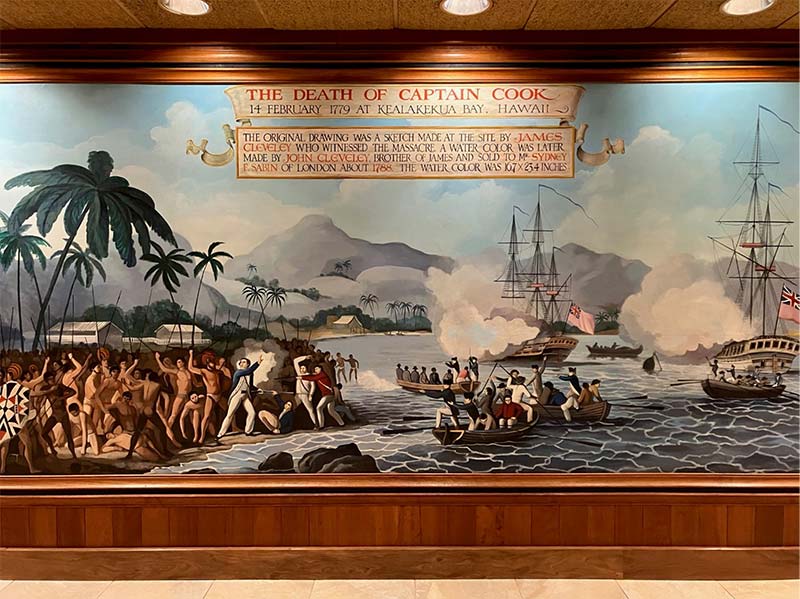
A painting titled The Death of Captain Cook displayed at Hotel Captain Cook (photo by Mark Skousen)
The lesson is clear. As Charles Lindbergh, who took great risks flying across the Atlantic from New York to Paris in 1927, said (and as you’ll find on Page 51 of The Maxims of Wall Street), “Nothing can be accomplished without taking some risk, but I don’t believe in taking foolish chances.”
I recently read the amusing story of “Wrong Way” Corrigan. If you are not familiar with the story, it’s worth reading
I share your interest in Alaska, and being given additional historical prospective. Your financial advice is well founded, and investing in any venture without spending the time to obtain as much pertinent information as possible prior to committing will frequently reveal many possible pitfalls, rather than simply going with public sentiment.
That’s a wise comment. Avoid foolish chances