

“I’m tired of Love: I’m still more tired of Rhyme. But Money gives me pleasure all the time.”
– Hilaire Belloc
“[There is a] tranquil, permanent felicity with which domestic society in America, blesses most of its inhabitants.”
– Thomas Jefferson
On July 4, we celebrated our nation’s 250th birthday, and on July 8, actor Dean Cain, who played Superman in the Lois & Clark TV series, read out loud the Declaration of Independence at FreedomFest in Las Vegas. It was a moving moment.
In its most famous line, the Declaration highlights three inalienable rights: life, liberty, and the pursuit of happiness.
Ever since then, Americans have pursued “felicity,” as Thomas Jefferson called it. The American Dream is on everyone’s mind.
Years ago, I read a sermon by a church leader on the “four sources of happiness.” He spoke of…
- Work
- Recreation
- Love
- Worship.
I’m reminded of these four principles whenever I teach at Chapman University. In the university’s central plaza, there are four pillars representing the need for students to develop their intellectual, physical, social, and spiritual dimensions.
Like many Americans, Ben Franklin pursued all four, and at the end of his life, despite the ups and downs, he was a happy man. He was able to say, “When I reflect on the number of terrible maladies human nature is subject to… these have not yet deprived me of my natural cheerfulness, my delight in books and enjoyment of social conversation. There are many sorrows in this life, but we must not blame Providence inconsiderately, for there are many more pleasures. This is why I love life.”
Let’s remember the benefits of all four elements of happiness.
The Importance of Work
First, you have to find rewarding and honest employment to be happy and a member of what Franklin called “the society of the free and easy.” Hard work and entrepreneurship offer the opportunity to create surplus wealth and financial independence.
Being out of debt and having money in the bank give you a real sense of security, as well as the freedom to do what you want to do. Moreover, studies show that unemployed people, believing they are not contributing to society or themselves, are generally unhappy.
To a great extent, therefore, money can buy you happiness and a satisfactory retirement.
As I point out in The Greatest American, Franklin retired at age 42 after operating a successful printing business, allowing him to spend time engaged in useful inventions, scientific research, and civil duties to his city and country.
He concluded, “It is incredible the quantity of good that may be done in a country by a single man who will make a business of it.”
Income and Happiness
The following shows the relationship between income and happiness, both for individuals and for nations.
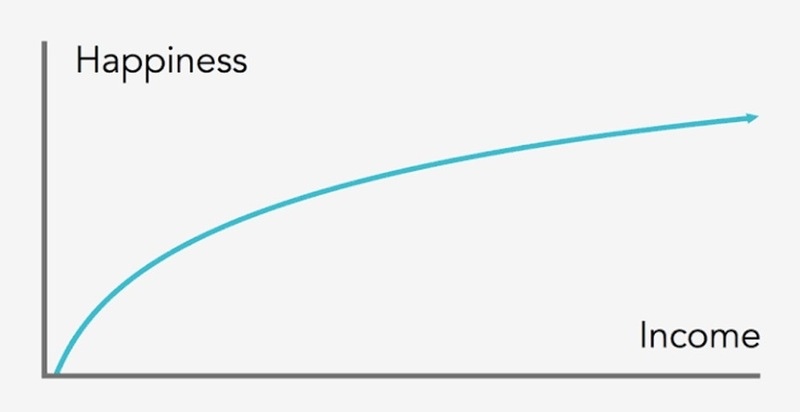
In general, many people in poorer countries are less satisfied than those in wealthier countries. As economists Bruno Frey and Alois Stutzer state in their book Happiness and Economics, “Countries with higher per capita incomes tend to have more stable democracies than poor countries have… The higher the income, then the more secure human rights are, the better average health is, and the more equal the distribution of income is. Thus, human rights, health, and distributional equality may seemingly make happiness rise with income.”
However, the graph also indicates that money causes diminishing returns in happiness. Subjective well-being rises with income, but once beyond a certain threshold, income has little or no effect on happiness. Many wealthy people have experienced this law of diminishing returns and are not any more happy than middle-class people. In fact, some wealthy people are downright unhappy.
Frey and Stutzer conclude, “Higher happiness with material things wears off.”
The Need for Recreation and Avocations
Second, recreation is essential to your well-being. It helps to take a break from work from time to time. People who spend too much time at the office and can’t relax with their family or friends at home need to learn the joy of recreation with a hobby, sports, travel, or other avocation.
Some of my most memorable times have been playing softball, basketball, or golf with friends; traveling with family members on weekends and on vacations; and helping those in need during natural disasters.
As for Franklin, he enjoyed swimming, playing chess and card games, and traveling. “I depend chiefly on these journeys for the establishment of my health,” he wrote while based in London as a colonial agent. He especially loved Scotland – the food, the friendships, and the Scottish ballads. He once wrote, “I must say, I think the time we spent there, was six weeks of the densest happiness I have met with in any part of my life.”
Love and Friendship
Third, love and friendship are also key elements of happiness. Everyone needs someone to confide in, to spend time with, to learn from, to reminisce with, and to love. For most people, love and friendship take time and effort. You have to work at developing friendships, but the rewards are never-ending.
Aristotle spoke of three levels of friendship: utility (mutual benefit, such as working together in business), pleasure (shared enjoyment and common interests), and virtue (shared moral character and mutual growth).
I’ve found the last two levels of friendship the most enjoyable and lasting.
As Franklin said, “A true friend is the best possession… I find I love company, chat, a laugh, a glass, and even a song… [and] relish better than I used to do the grave observations and wise sentences of old men’s conversation.” And, Ben, don’t forget the ladies!
Feeding Your Spirit
Finally, worship. Developing one’s spiritual side is essential to happiness. Some of my friends say they don’t need religion, but they are missing out on one of the joys of life – fellowshipping with like-minded friends, being inspired by a great sermon or hymn, doing charitable work, meditating on the word of God, and praying for God’s help in solving business or family problems.
Regarding religion, Franklin counseled, “Doubtlessly, faith has its use in the world; I do not desire to see it diminished, nor would I endeavor to lessen it in any man. But I wish it were more productive of good works than I have generally seen: I mean real good works, works of kindness, charity, mercy, and public spirit; not holiday-keeping, sermon-reading or hearing, performing church ceremonies, or making long prayers, filled with flatteries and compliments, despised even by wise men, and much less capable of pleasing the Deity.”
Let me conclude with a delightful stanza by the Norwegian playwright Henrik Ibsen, who put the role of money in the proper perspective (see Page 203 in The Maxims of Wall Street).
Money may be the husk of many things,
but not the kernel.
It gives you food, but not appetite.
Medicine, but not health.
Acquaintances, but not friends.
Servants, but not faithfulness.
Days of pleasure, but not peace or happiness.
Mark, what would you do if you stumbeled over a plan that could lead humanity towards Heaven on Earth? Geir
Good article. Read Maxims of Wall Street a couple of years ago – a much appreciated read. Thanks Mark.
Hillaire Belloc must have been a very sad excuse for a man. Ibsen has the preferable view of life. IMHO
Your article on Happiness and Money had many profound truths. I had not known some of the facts you shared about Benjamin Franklin, Thank you for sharing.
This has given me some great insights. I agree in general with all of it, and he didn’t even use the cliché “money never buys happiness” but did point out there is a point of diminishing returns, which is more true. I have visited countries in Africa where there is abject poverty and seen poor people that were still happy, though hopeful of better times. One of the joys of having money is using any surplus to help others, and that is perhaps the closest I can think of to countering “Money never buys happiness.” It is refreshing to see many wealthy people, such as Warren Buffet and others, working to give away their wealth to worthy causes before they pass on.
The second thing I thought real hard about was the fact that my wife and I have each other and truly do love, confide in, and support one another. However, what struck me is that if one of us died, who would that friend be that could provide that support? I have many friends, but no deep friends that I would be totally comfortable with to fill that role.I have had some friends like that, but they have died. As I continue to get older, it is something I need to think about. I have friends that would willingly and feel obligated to step in and help if they saw the need, but none at the moment that I personally get together with to do things without a group of other friends. I need to connect that thought with taking a break and just having fun, which at present for me is working by myself on hobbies or even worse, wasting time just looking at Facebook.
I agree tending to one’s spiritual side is one of the keys to happiness, and it brings much solace during hard times. I couldn’t agree more than with the quote from Franklin, which perhaps put another way would be to say, to truly worship God, do things that please Him by helping others, not things that look good in the eyes of men in an attempt to justify to yourself or others that you are doing good.
I love your letters and read perhaps 80% of them but what do you mean by AEIOU?
GREAT INSPIRATION, DR. I FEEL SO WARM & FUZZY!