
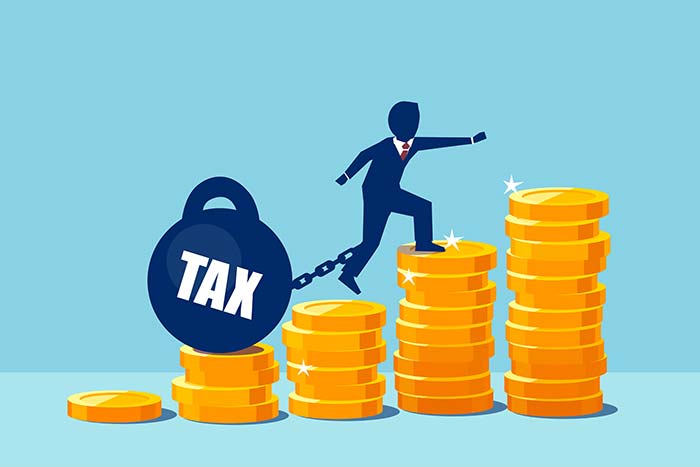
Let me tell you how it will be
There’s one for you, nineteen for me
‘Cause I’m the taxman
Should five percent appear too small
Be thankful I don’t take it all
‘Cause I’m the taxman
– The Beatles (“Taxman,” 1966)
Sixty years ago, the Beatles released the song “Taxman,” written by George Harrison to protest the punishing 90% to 95% supertax imposed on high earners by the U.K.’s Labour government.
Frustrated that most of their earnings were going to the Treasury, Harrison – aided by John Lennon – mocked tax laws and name-dropped politicians Harold Wilson and Edward Heath.
It’s one of my favorite Beatles songs. It highlights the remarkable creativity of governments everywhere to find sneaky new ways to exact more taxes out of their citizens’ pockets.
Now it’s happened in America, the land of the free, as we approach the 250th anniversary of our independence.
The Politics of Envy Is Back
Here are the latest examples of government’s attempts to reduce state deficits and fund new social programs:
- New York’s socialist mayor, Zohran Mamdani, and Democratic governor, Kathy Hochul, have imposed a new annual real estate tax on luxury second homes (pieds-à-terre) in New York City that are valued at $5 million or more.
- Washington state has imposed a 9.9% income tax on residents making $1 million or more and a 7% capital gains tax.
- In November, voters in California will vote on a referendum imposing a one-time 5% wealth tax on billionaires. Most analysts expect it to pass, even though Democratic Gov. Gavin Newsom opposes it.
Art Laffer Takes on the Billionaire Tax Proposal
Last week, Art Laffer, the father of supply-side economics and creator of the Laffer curve, debated Berkeley professor Emmanuel Saez, a French economist who favors the billionaire tax in California.
Laffer rightly pointed out that the wealth tax is a bad idea because it’s forcing productive entrepreneurs like Elon Musk and Mark Zuckerberg and their employees to leave the state and it won’t raise the revenue legislators expect.
Indeed, Laffer was a longtime resident of California but left after the once-Golden State raised the state income tax to 14.4%, the highest of any state.
However, I was dumbfounded to see Laffer join forces with Saez in advocating taxing unrealized capital gains every year at a 17% rate! In essence, that’s the same as a wealth tax – and just as bad as the billionaire tax idea. It will also discourage the efficient use of capital, the lifeblood of the economy.
Lord Acton was right when he said, “There is no error so monstrous that it fails to find defenders among the ablest men” (The Maxims of Wall Street, Page 140, available at Skousen Books at Discount).
Why Raising Taxes Backfires
The bad news is raising taxes on the rich is a failed policy for two reasons.
First, it does not address the real problem: wasteful and misguided spending.
New York, Washington, and California don’t have a tax problem – their taxes are already too high. They have a spending problem. They refuse to live within their budget on public education, Medicaid, homelessness, and other social projects that are only getting worse.
Then there are infrastructure boondoggles like the California High-Speed Rail project, with cost overruns of $135 billion and counting.
Ben Franklin identified the problem when he said, “No revenue is sufficient without economy” (Maxims, Page 20).
Raising more revenue to fund wasteful and inefficient projects only allows politicians to expand their budgets, which fuels more deficits until a financial crisis hits the state.
Second, wealthy taxpayers can escape the new tax increases by leaving the state.
The American Revolution started with a tax rebellion. Thomas Jefferson and the founders included taxes among their list of grievances of King George III in the Declaration of Independence: “He has erected a multitude of new offices, and sent hither swarms of officers to harass our people, and eat out of their substance.”
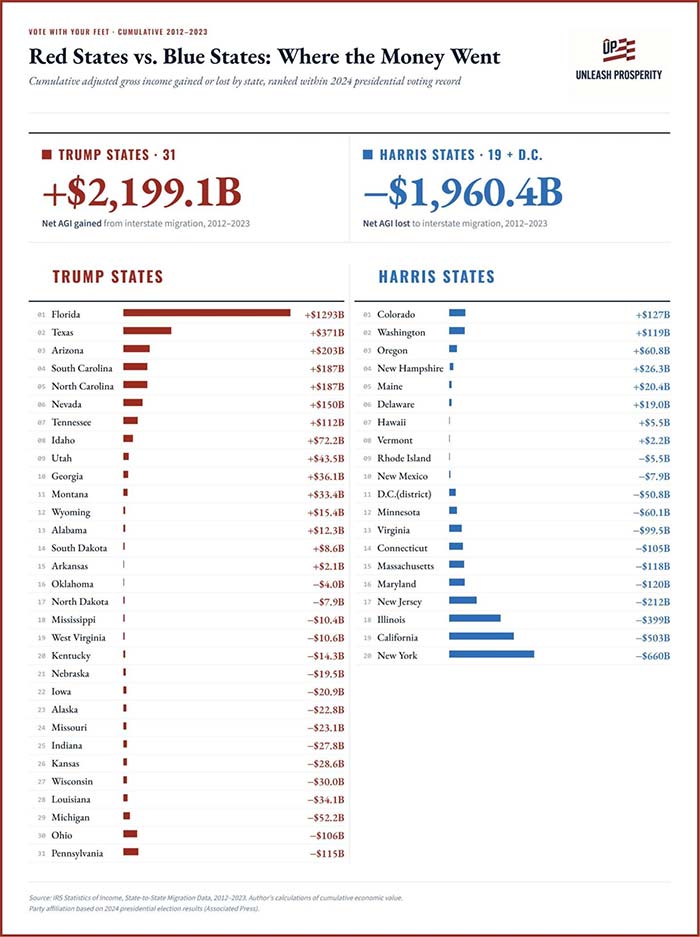
The wealthy are rebelling by moving out of the high-tax states such as New York and California and moving their residency and businesses to Texas, Florida, and other low-tax states.
According to Steve Moore, from 2012 to 2023, some $2.2 trillion in cumulative income migrated out of high-tax states and into low-tax states! (See the chart below.)
Action to Take: If you live in a state that is raising taxes, you can create your own tax cut by moving to a low-tax state like Texas, Florida, Tennessee, New Hampshire, Arizona, or Utah (among others). Make your plans now before it’s too late.
Going to Bat for Oxford Club Members!
I can’t think of anyone in the country who wants to see everyday investors get richer more than the strategists of The Oxford Club: Marc Lichtenfeld, Alex Green, and Mark Skousen.
You came to the right place to learn how to make money and keep the lion’s share of your profits through legal tax-cutting strategies.

This is a fantastic article. Thanks for putting it together. I was shocked that laffer would support unrealized capital gains!
Moved NYC to San Marcos TX first of year. Very happy paying my last New York City April 15th! Did it in reverse: working in New York and retiring in Texas.
Mark, You recommended some kind of annuity or something several months ago, including the name of the contact person. It seemed ideal for me, but I have lost the name and number. Can you please help?
Compassion compassion without common sense is fraud.